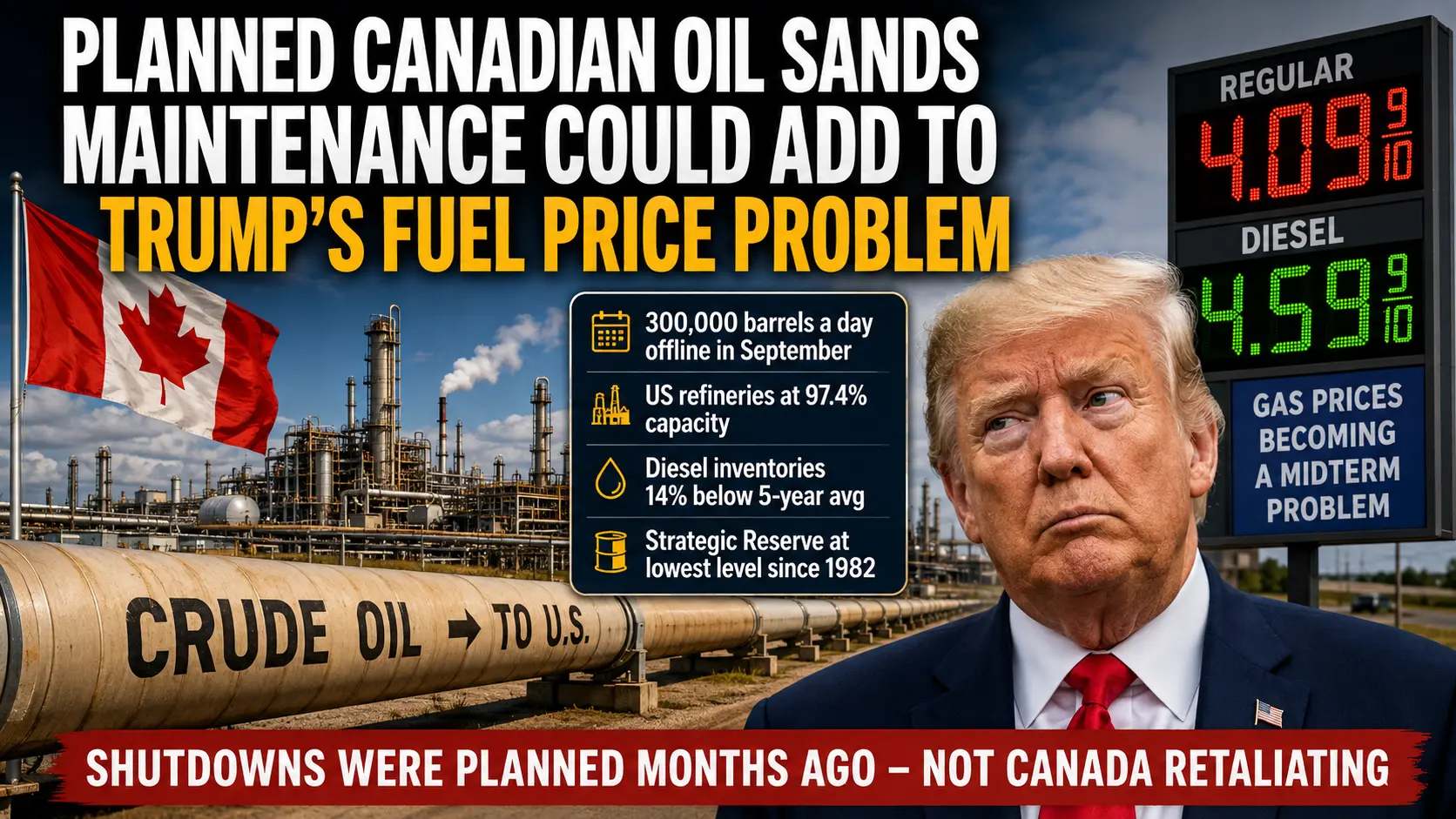
US refineries are heading into September running close to capacity as routine maintenance in Canada’s oil sands is expected to remove around 300,000 barrels of crude production a day. The shutdowns were planned well in advance, but their timing could create another headache for Donald Trump as fuel prices become an increasingly important issue ahead of November’s midterm elections.
A routine maintenance season in Canada’s oil sands could soon provide an uncomfortable test of just how dependent parts of the United States remain on crude oil from their northern neighbour.
Around 300,000 barrels of Canadian oil production a day is expected to be temporarily taken offline during September as operators carry out planned maintenance, according to Rystad Energy figures reported by Bloomberg.
There is nothing unusual or political about the work itself.
Oil sands facilities undergo scheduled maintenance and major turnarounds as part of their normal operating cycles, with some of the work planned months in advance.
What is unusual is the condition of the US energy system waiting on the other side of the border.
Canadian maintenance was planned in advance
Among the companies carrying out work is Canadian Natural Resources, which operates the Horizon oil sands project in Alberta.
The company confirmed in its second-quarter results that a planned 35-day turnaround at Horizon will begin on September 8.
Importantly, the effect of that shutdown was already included in Canadian Natural’s annual production guidance.
In other words, this is not a sudden Canadian decision to restrict oil exports to the United States and there is currently no evidence that the maintenance has anything to do with relations between Prime Minister Mark Carney’s government and the Trump administration.
Bloomberg has also reported planned maintenance involving facilities operated by Suncor, including work at the Syncrude upgrader.
Rystad Energy estimates the combined effect could temporarily remove approximately 300,000 barrels a day from Canadian production during September.
Why Canada matters so much to US refineries
The United States may be one of the world’s biggest oil producers, but that does not mean every barrel of American crude can simply replace the oil arriving from Canada.
Canada is the United States’ largest foreign supplier of crude oil, normally providing around four million barrels a day.
Much of it is heavy Canadian crude particularly suited to refineries in the US Midwest.
Bloomberg reports that Midwest refineries rely on Canadian oil for around 70% of their crude supply.
That makes scheduled Canadian maintenance considerably more important than the relatively modest 300,000-barrel-a-day figure might initially suggest.
And it comes at a time when American refineries are already running extremely hard.
US refineries running at 97.4% capacity
Figures released by the US Energy Information Administration for the week ending August 21 show American refineries operating at 97.4% of their available capacity.
They processed approximately 17.4 million barrels of crude oil a day.
That leaves relatively little spare capacity in the system if further problems develop.
Stocks of distillate fuels, which include diesel and heating oil, are also tight.
US distillate inventories fell to approximately 103.4 million barrels during the same week, around 14% below the five-year average for this time of year.
Gasoline stocks were around 6% below their five-year seasonal average.
The Strategic Petroleum Reserve has also been heavily used during the continuing disruption to global oil markets.
The reserve contained approximately 289.7 million barrels on August 21, its lowest level since 1982.
Donald Trump authorised a 172-million-barrel emergency exchange from the reserve earlier this year as part of a coordinated International Energy Agency response to disruptions caused by the conflict with Iran.
That does not mean all 172 million barrels have already been removed. It is the overall authorised programme.
But the reserve is nevertheless now at a historically low level.
Why diesel could matter beyond the petrol pump
Any squeeze on diesel supply has consequences far beyond what motorists see at petrol stations.
Diesel powers much of the machinery and transport infrastructure used to move goods around North America.
Trucks, agricultural machinery, freight operations and parts of the construction industry are all heavily exposed to diesel prices.
That means higher costs can eventually feed through into food, deliveries and other consumer goods.
Reuters reported on Friday that increased fuel costs linked to disruption from the Iran conflict are already resulting in substantial transport fuel surcharges being imposed on American businesses.
So even relatively small changes in available fuel supply can have wider economic consequences when inventories are already tight.
Fuel prices are becoming a midterm problem
The timing also carries an unavoidable political dimension.
Reuters reported this week that Trump is expected to meet US refiners and fuel retailers as his administration attempts to demonstrate that it is responding to rising fuel prices ahead of November’s congressional midterm elections.
Average US petrol prices have moved above $4 a gallon following months of disruption to global energy markets caused by the conflict with Iran.
That creates a political problem for an administration which has repeatedly presented increased American energy production as one of its major economic achievements.
The Canadian maintenance programme does not create that underlying problem.
But it could add further pressure to a system which is already stretched.
Could Canada become the political target?
The video accompanying this article raises another possibility.
Its presenter predicts that, if American fuel prices rise further during the Canadian maintenance period, parts of the pro-Trump media may attempt to portray the reduction in Canadian production as deliberate retaliation against the United States.
That has not happened and should not be reported as though it has.
It is a prediction.
But if such claims do emerge over the coming weeks, there is already a clear factual record against which they can be tested.
The maintenance programme was known about before September.
Canadian Natural had publicly disclosed its Horizon turnaround and its September 8 starting date.
The expected reduction in Canadian production was being reported before the shutdowns began.
And there is currently no evidence that the Canadian government ordered producers to reduce supplies to the United States.
Whatever happens to fuel prices in September, routine industrial maintenance should not subsequently be rewritten as an unexpected Canadian political action.
What we know
Canadian oil sands maintenance is expected to temporarily remove around 300,000 barrels of production a day during September.
At least some of the shutdowns were announced and incorporated into company production plans well in advance.
Canada remains the largest foreign supplier of crude oil to the United States.
US refineries were operating at 97.4% of available capacity in the latest government figures.
US distillate inventories were approximately 14% below their five-year seasonal average.
The Strategic Petroleum Reserve stood at 289.7 million barrels, its lowest level since 1982.
And rising fuel prices are already becoming an issue for the Trump administration ahead of the November midterm elections.
What we don’t know
We do not yet know how much, if at all, the Canadian maintenance programme will affect US petrol or diesel prices.
We do not know whether other supplies will compensate for the reduction.
And we do not know whether Trump, his administration or sympathetic media organisations will attempt to blame Canada if prices rise.
For now, that remains a prediction.
But one thing is already documented: the Canadian shutdowns were planned before they happened.
Watch: Why Canada’s oil sands maintenance could matter
The video below discusses the expected Canadian production reduction, the pressure currently facing US refineries and the possibility that Canada could become a political target if American fuel prices rise further.