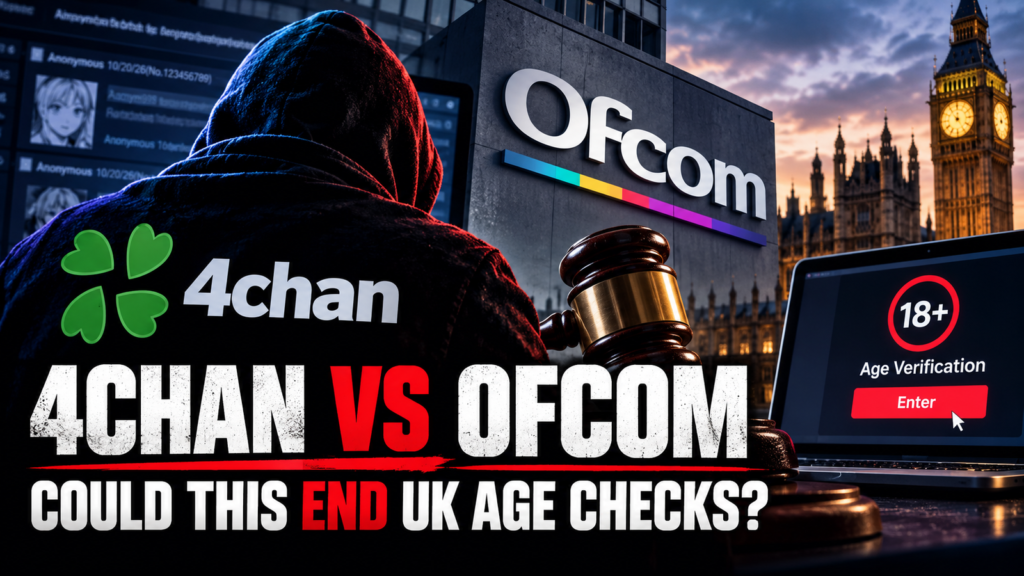
The American imageboard website 4chan has claimed a significant victory in its dispute with UK regulator Ofcom after the watchdog admitted that some fines issued under the Online Safety Act may be impossible to recover from overseas companies. The development raises questions about Britain’s ability to enforce online age-verification requirements, although neither the legislation nor the existing age-check rules have been overturned.
Why is 4chan claiming victory over Ofcom?
The latest controversy follows evidence given to the House of Commons Digital, Culture, Media and Sport Committee on Tuesday 20 October 2026.
During the hearing, Ofcom chief executive Dame Melanie Dawes revealed that the regulator had issued 11 fines under the Online Safety Act, but only two had been paid.
Of the nine outstanding fines, one was being appealed and another was not yet overdue. Seven were overdue.
Dawes explained that two companies with unpaid fines had subsequently introduced effective age checks, while four others had blocked access to their services from the UK.
That left three fined services still accessible without the identified risks having been adequately addressed.
The regulator also acknowledged the difficulties of recovering penalties from businesses based in countries whose courts may refuse to enforce British regulatory decisions.
Dawes told MPs:
“We will not be able to recover every single fine on online safety.”
However, she also made clear that Ofcom intended to pursue enforcement wherever possible.
Her remarks were not a specific announcement about 4chan, nor did they cancel any fines issued against the platform.
Nevertheless, they prompted an immediate response from American lawyer Preston Byrne, who represents 4chan.
In an article published the same day, Byrne declared that Ofcom had effectively conceded defeat.
He argued that the regulator had acknowledged the practical limits of its authority over American businesses operating entirely within the United States.
That interpretation has attracted attention because it highlights an issue at the heart of the Online Safety Act: how can a British regulator compel a foreign website to comply with British rules?
Read the parliamentary evidence in full.
Why did Ofcom fine 4chan?
The dispute began before the latest parliamentary hearing.
Ofcom investigated 4chan over its compliance with the Online Safety Act 2023, which requires certain online services accessible to UK users to take steps to protect children from harmful material and address risks involving illegal content.
In October 2025, Ofcom imposed a £20,000 penalty on 4chan for failing to comply with statutory information requests.
Further penalties followed on 19 March 2026.
Ofcom announced fines totalling £520,000, consisting of:
- £450,000 for failing to introduce effective age assurance to prevent children encountering pornography.
- £50,000 for failing to carry out an adequate illegal-content risk assessment.
- £20,000 for failing to explain in its terms of service how users would be protected from illegal content.
Combined with the earlier penalty, the fixed fines announced against 4chan amounted to £540,000, excluding any additional daily penalties.
The regulator also ordered the website to take corrective action by 2 April 2026 or face further daily penalties for continued non-compliance.
Ofcom maintained that online services available to people in Britain must comply with relevant British legislation, regardless of where the companies are based.
4chan disputed the regulator’s approach, arguing that its American operations should not be subject to British enforcement demands.
Read Ofcom’s original announcement.
What did the American court actually decide?
An important part of the dispute reached the US District Court for the District of Columbia.
4chan and Lolcow LLC, the company operating Kiwi Farms, challenged Ofcom’s actions in an American federal court.
On 15 September 2026, US District Judge Rudolph Contreras dismissed their lawsuit.
The judge ruled that Ofcom was protected by foreign sovereign immunity, meaning the American court lacked jurisdiction to hear the companies’ claims against the British regulator.
On that particular legal question, the ruling favoured Ofcom.
However, the judgment also contained observations that have become central to 4chan’s subsequent claim of victory.
Judge Contreras explained that, should Ofcom seek to enforce a British judgment against companies whose operations and assets were entirely in America, those businesses could seek protection from American courts.
The judge noted that US courts are not necessarily required to enforce foreign financial penalties and may reject judgments that conflict with constitutional protections.
These observations did not amount to a ruling that Ofcom’s fines were unenforceable.
That question was not directly decided by the court.
Nevertheless, Byrne argues that the judgment demonstrates why Ofcom would face substantial legal obstacles if it attempted to recover its penalties in the United States.
The distinction matters.
4chan did not win its September lawsuit, but the judgment identified potential legal defences against future attempts to enforce British penalties in America.
Read the US federal court judgment.
Could this end age verification in the UK?
For British internet users, this is arguably the most important question.
The immediate answer is no.
Nothing in the American court judgment or Ofcom’s parliamentary evidence repeals the Online Safety Act or removes the legal requirements already placed on online services.
Age-verification and age-estimation rules introduced under the legislation remain in force.
Since 25 July 2025, services within the relevant scope have been required to implement highly effective age assurance to prevent children accessing pornography and certain other harmful content.
The rules do not mean that every adult must verify their identity simply to use the internet.
Instead, they impose responsibilities on services hosting or providing particular categories of content.
Ofcom’s guidance permits several methods of establishing a user’s age, including facial age estimation, digital identity services, credit card checks and certain other verification systems.
The legislation does not require every provider to collect a photograph of a passport or driving licence.
However, the implementation of age checks has also raised legitimate questions about privacy, personal information and the accessibility of lawful content.
Those concerns remain relevant regardless of the outcome of 4chan’s dispute.
The Information Commissioner’s Office has stressed that organisations carrying out age assurance must comply with data-protection law and avoid collecting more personal information than necessary.
Read Ofcom’s age-assurance guidance.
Could Ofcom block 4chan in Britain instead?
This is where the dispute could become more significant for UK internet users.
Even if Ofcom cannot recover a fine from a company in America, the Online Safety Act contains separate enforcement mechanisms.
Under existing legislation, the regulator can seek a court order requiring third parties, including internet service providers, to restrict access to a non-compliant service in appropriate circumstances.
That could mean a website remaining freely available in the United States while being blocked through British internet providers.
During the October parliamentary hearing, Dawes acknowledged that the practical reach of such measures was limited.
A UK court could potentially require restrictions on access within Britain, but that would not necessarily force a website to stop operating in another country.
It also raises the question of users accessing foreign websites through virtual private networks, commonly known as VPNs.
Dawes acknowledged that geo-blocking can be circumvented.
In July 2026, the British government said it would not ban or impose age gates on VPN services, recognising their legitimate privacy and security uses.
However, ministers also indicated that circumvention of online child-protection requirements would remain under review.
This leaves an important distinction between enforcing British restrictions within Britain and compelling an American website to change its operations worldwide.
Ofcom wants stronger enforcement powers
Rather than abandoning online safety regulation, Ofcom is seeking changes that could make enforcement easier.
During the parliamentary hearing, Dawes identified reform of business disruption measures as a priority.
In particular, the regulator wants a more effective process for obtaining interim court orders where there is evidence of urgent harm.
Such orders could allow action to restrict access to a website while an investigation continues, rather than requiring the existing process to run its course first.
This is a potentially important development.
If overseas websites refuse to comply with British fines, regulators may increasingly turn to measures directed at UK internet infrastructure and other businesses that support access to those services.
Supporters of stronger enforcement argue that overseas companies should not be able to avoid safeguards simply by locating themselves beyond Britain’s borders.
Critics, meanwhile, question whether expanded blocking powers could restrict access to lawful information, interfere with freedom of expression or create disproportionate consequences for internet users.
The dispute therefore extends beyond 4chan itself.
It concerns where national regulatory authority should end when a service operates internationally.
Does this mean the Online Safety Act has failed?
The evidence does not support such a sweeping conclusion.
Ofcom’s admission that some fines may never be collected demonstrates a problem with cross-border financial enforcement.
But collecting fines is not the only way the regulator assesses compliance.
Dawes told MPs that some companies had introduced age checks or restricted UK access following enforcement action, even though their penalties remained unpaid.
From Ofcom’s perspective, changes that reduce access by children to harmful material can represent progress regardless of whether a financial penalty has been recovered.
From 4chan’s perspective, resisting the regulator’s demands while remaining outside its direct financial reach demonstrates the practical limits of overseas enforcement.
Both positions concern different measures of success.
It is possible for a regulator to secure compliance from some companies while struggling to enforce penalties against others.
It is equally possible for a foreign website to resist a fine without securing any change to the legislation affecting users in Britain.
The latest developments should therefore be understood as an ongoing jurisdictional and enforcement dispute, rather than a legal defeat of the Online Safety Act itself.
What happens next?
Several questions remain unanswered.
Ofcom has not established through the September American judgment that its penalties against 4chan can be enforced in the United States.
Equally, 4chan has not obtained a court judgment declaring those penalties invalid or cancelling the UK’s age-verification requirements.
Further legal proceedings, enforcement attempts or changes to British legislation could alter the position.
For now, British websites and overseas services falling within the Online Safety Act’s scope remain subject to the relevant UK rules.
The broader implications may be felt in the government’s response to Ofcom’s requests for additional powers.
The 4chan dispute has demonstrated how difficult it can be to apply national internet regulations to businesses operating across international borders.
It has also highlighted an unresolved tension between protecting children online, preserving adults’ privacy and freedom of expression, and determining how far a country’s laws can reach beyond its territory.
For UK internet users, age verification is not disappearing because of 4chan’s challenge. The more consequential question is whether the dispute ultimately leads to stronger powers to restrict access to websites that refuse to comply.
That question remains open.
Sources and further reading
- UK Parliament: The work of Ofcom, oral evidence, 20 October 2026
- Ofcom: 4chan fined for failing to protect children, 19 March 2026
- US District Court: 4chan Community Support LLC v Ofcom, 15 September 2026
- Preston Byrne: Ofcom Concedes Defeat in the 4chan Case, 20 October 2026
- Ofcom: Age assurance duties under the Online Safety Act
- UK Government: Growing up in the online world, July 2026 response