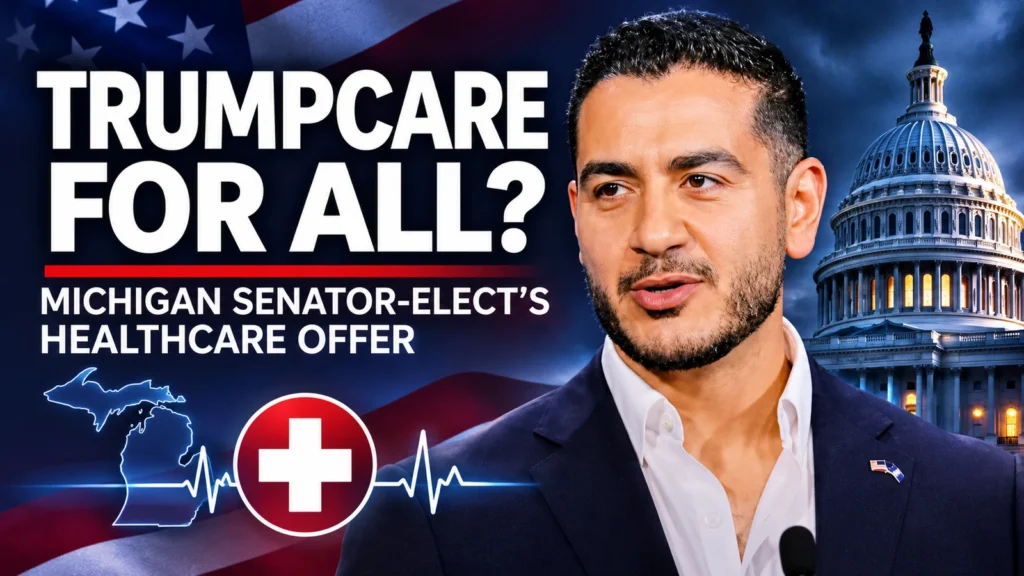
Michigan senator-elect Abdul El-Sayed has offered Donald Trump an unusual political bargain: put the president’s name on a universal healthcare plan if that helps get it into law.
The Democrat, who won Michigan’s open US Senate seat in the 3 November midterm election, said he would accept the name “Trumpcare-for-All” for a policy he campaigned on as Medicare for All. It is an invitation to cooperate, not an agreement. There is no verified indication that Trump has accepted it.
What El-Sayed told Mehdi Hasan
Speaking to journalist Mehdi Hasan on Zeteo’s Mehdi Unfiltered on 6 November, El-Sayed was asked about the possibility of Trump signing legislation to establish universal healthcare. He responded: “If he wants to pass Trumpcare-for-All, I’m ok with it.”
El-Sayed also addressed the president directly: “Donald, if you’re watching, we’ll put your name on it.” His argument was that securing healthcare coverage for every American mattered more than the name attached to the legislation.
The exchange followed comments from independent senator Bernie Sanders, who had suggested Democrats should pursue Medicare for All regardless of whether Trump might veto it, while leaving open the possibility that the president could eventually support the measure.
Why the offer matters after the midterms
El-Sayed defeated Republican Mike Rogers in a race to replace retiring Democratic senator Gary Peters. The former Detroit health director will become the first Muslim elected to the US Senate, according to Associated Press election reporting. Universal healthcare was a central part of his campaign.
Democrats have also won control of both chambers of Congress in the midterms, giving them greater power to pursue healthcare legislation from January 2027. But they will still face a Republican president who can veto legislation, as well as political differences within their own party over how far reform should go.
By offering Trump public credit for a policy closely associated with the Democratic left, El-Sayed is testing whether a shared legislative outcome could matter more than party ownership. The idea does not, on its own, create a bipartisan agreement.
What would Medicare for All change?
Medicare for All generally refers to a national health insurance system that would guarantee coverage to everyone, replacing much of the current mixture of employer-sponsored private insurance and public programmes. It is not the same as simply expanding the existing Medicare scheme for older Americans.
Bills introduced in April 2025, including House bill H.R. 3069 and Senate bill S. 1506, set out proposed national programmes. Neither introduction constituted enactment. Financing, taxation, the role of private insurers and the transition for patients and providers would all require substantial political and legislative decisions.
Supporters argue a universal system could improve access and reduce the complexity of insurance. Opponents question its cost, the tax implications, government administration and the effects on existing coverage. Renaming the proposal would not resolve those disputes.
Has Trump responded?
In a separate interview with ABC News on Sunday, 8 November, El-Sayed repeated that he was willing to work with Trump on Medicare for All while strongly criticising the president’s other policies.
He told ABC that he had never met Trump and had received no outreach. That makes the current position clear: El-Sayed has made a public offer, but it is not evidence of negotiations, presidential backing or a bill ready for signature.
The legislative hurdle
Even with majorities in the House and Senate, Democrats would need to agree on the details of a major overhaul and overcome Senate procedural hurdles. Most ordinary contested legislation can face a 60-vote threshold to end debate, while overriding a presidential veto generally takes a two-thirds vote in both chambers.
For now, the question is not whether Americans will soon be signing up for “Trumpcare-for-All”. It is whether El-Sayed’s deliberately provocative proposal can prompt a serious discussion between political rivals about universal coverage, and whether either side is prepared to negotiate the substance.