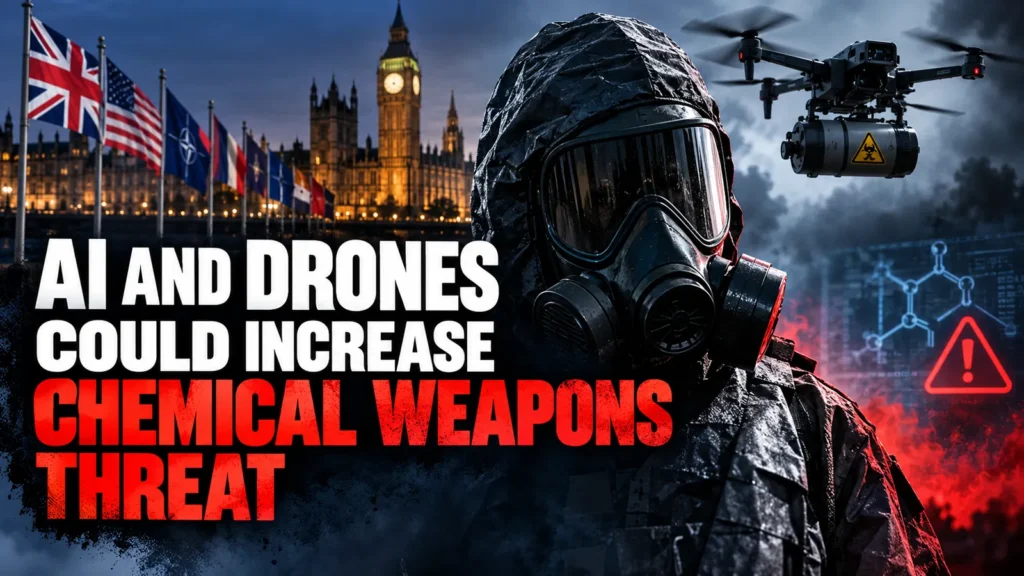
A senior US defence official has warned that emerging technologies could make chemical weapons easier to acquire and deploy, as international experts meeting in London examine threats involving artificial intelligence, drones and automated chemical production. The warning came at the 28th Chemical Weapons Demilitarisation Conference, hosted by the UK’s Ministry of Defence and Defence Science and Technology Laboratory (Dstl), where delegates also examined chemical weapons destruction efforts in Syria and concerns about chemical agents on the battlefield in Ukraine.
AI and Drones Raise New Chemical Weapons Concerns
The international conference brought together defence officials, scientists and chemical weapons specialists to consider how technological advances could affect global chemical security.
Cassandra Simmons-Brown, the acting US Deputy Assistant Secretary of War responsible for Chemical, Biological, Radiological and Nuclear Defense Programs, warned that several emerging technologies could weaken longstanding barriers to chemical weapons development.
She identified advanced intelligent systems, automated chemistry, additive manufacturing, including 3D printing, and drone delivery technology as areas of concern.
According to Simmons-Brown, their integration is “rapidly lowering traditional barriers to chemical weapon acquisition and use.”
The warning raises questions about whether technologies developed for legitimate industrial, scientific and commercial purposes could also be exploited to create or deliver prohibited weapons.
However, the conference announcement did not identify a specific new chemical weapons programme involving these technologies or establish that an attack using them was imminent.
The risks discussed concern how future capabilities could change the threat landscape, rather than confirmation of a newly deployed weapon.
Syria’s Chemical Weapons Legacy Remains a Major Challenge
One of the conference’s central discussions concerned efforts to dismantle the chemical weapons programme developed under former Syrian president Bashar al-Assad.
Since the fall of Assad’s government in December 2024, international inspectors have gained opportunities to investigate facilities and materials that had not previously been fully disclosed.
In May 2026, the Organisation for the Prohibition of Chemical Weapons (OPCW) announced that investigators working with Syria’s new authorities had discovered previously undeclared chemical munitions, chemical substances, equipment and documents.
The discoveries included dozens of munitions and thousands of pages of records connected with the former government’s chemical weapons programme.
A further milestone followed in August 2026, when OPCW inspectors verified the irreversible destruction of 42 aerial bombs declared by Syria.
The operation marked the first verified destruction of Syrian chemical munitions since 2014.
However, substantial work remains to establish the complete extent of the former regime’s programme and safely eliminate remaining materials.
On 13 October 2026, OPCW Director-General Sabrina Dallafior met Syrian Foreign Minister Asaad al-Shaibani in Damascus. Both sides discussed further cooperation to locate and destroy remaining Assad-era chemical weapons.
Britain Raises Concerns About Chemical Weapons in Ukraine
The London conference also addressed the British government’s concerns about Russia’s alleged continued use of chemical weapons during the war in Ukraine.
Damian Johnson, the Ministry of Defence’s Director for Homeland Defence and Strategic Threats, called for accountability and emphasised the need to improve methods of identifying, tracing and destroying chemical weapons.
Independent OPCW investigations have established that samples collected from Ukrainian battlefield locations contained CS, a chemical commonly associated with riot-control agents.
In June 2025, the OPCW reported that laboratory analysis of samples linked to an alleged February incident in Ukraine’s Dnipropetrovsk region confirmed the presence of CS or related compounds.
The samples included grenade components, soil, vegetation and material collected from drone wreckage.
Under the Chemical Weapons Convention, riot-control agents must not be used as a method of warfare.
Importantly, the laboratory findings establish the presence of the chemical in the tested samples. They do not, on their own, determine which military forces were responsible for its deployment.
The British government’s accusations against Russia therefore remain distinct from the findings of the OPCW’s technical assistance reports.
Scientists Focus on Detection and Chemical Forensics
Although the potential misuse of emerging technology attracted attention, the conference also examined how new scientific capabilities could help prevent chemical weapons attacks.
Specialists discussed the use of artificial intelligence and machine learning in chemical analysis, techniques for identifying unknown substances and improvements in chemical forensics.
Such methods can assist investigators in examining complex samples and establishing the origins of substances recovered after suspected incidents.
Portable chemical detection systems and research into biological indicators of chemical exposure were also among the subjects presented.
Dstl chief executive Dr Paul Hollinshead emphasised the importance of maintaining specialist scientific capabilities as threats develop.
The conference also examined lessons from existing destruction programmes, including Japan’s work to eliminate abandoned chemical weapons left in China following the Second World War.
Why Chemical Weapons Remain an International Security Threat
The Chemical Weapons Convention, which entered into force in 1997, prohibits the development, production, acquisition, stockpiling, retention, transfer and use of chemical weapons.
The OPCW oversees international efforts to enforce the treaty and verify the destruction of declared stockpiles.
In July 2023, the organisation confirmed that all chemical weapons stockpiles declared by participating states had been irreversibly destroyed.
That represented more than 72,000 metric tonnes of chemical agents eliminated under international verification.
However, the achievement did not mean that every chemical weapon in existence had been discovered or destroyed.
Previously undeclared weapons, abandoned munitions and the potential misuse of new technologies continue to create significant challenges.
International Cooperation Seen as Essential
The London conference highlighted the importance of maintaining international scientific expertise and cooperation between governments, laboratories and industry.
The concerns raised about AI, automated chemistry and drones underline a developing challenge for arms-control authorities: technological innovation may improve detection and prevention while also creating opportunities for misuse.
For governments and international inspectors, the task is not simply to destroy existing chemical weapons but to identify emerging risks before they lead to further violations.
With weapons destruction continuing in Syria and allegations of chemical weapons use remaining a serious issue in Ukraine, the conference provided a reminder that chemical disarmament is an ongoing responsibility.
The central warning from London is that the technology used to prevent and investigate chemical weapons threats must continue to develop as rapidly as the threats themselves.
Sources
- UK Ministry of Defence and Dstl, London chemical weapons conference, 21 October 2026
- OPCW: Previously undeclared chemical weapons discovered in Syria, 27 May 2026
- OPCW: Director-General’s visit to Syria, 13 October 2026
- OPCW: Technical assistance findings on CS in Ukraine, 26 June 2025
- OPCW: Eliminating chemical weapons