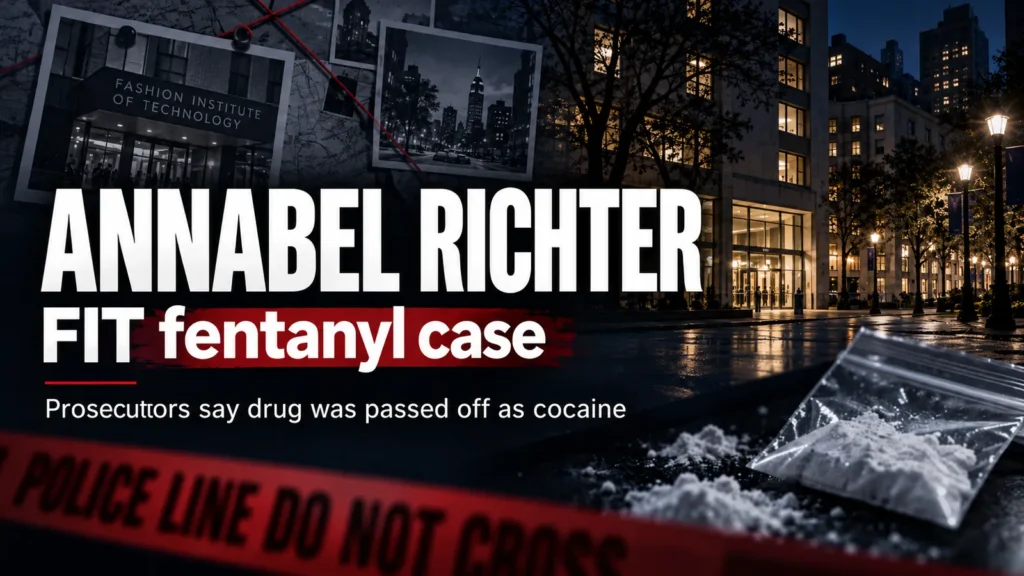
Federal prosecutors allege that a New York college student was given fentanyl disguised as cocaine and raped while unconscious. A second student narrowly survived, and two men now face federal drug charges following the death of Annabel Richter.
Annabel Richter, a student at New York’s Fashion Institute of Technology (FIT), died on 21 March 2026 after taking fentanyl allegedly presented to her as cocaine inside her Manhattan residence hall. Federal prosecutors say 19-year-old Moises Freire supplied the drug, raped Richter while she was unconscious and delayed seeking medical help. Her roommate survived after emergency treatment. A superseding indictment announced on 15 October has brought additional charges against Freire and an alleged accomplice, Brian Peralta Cabrera, 18.
What happened to Annabel Richter?
On 18 March 2026, two female students at the Fashion Institute of Technology in Manhattan were inside their residence hall when they were visited by Moises Freire, a teenager from the Bronx who was not enrolled at FIT.
According to a federal indictment released by the US Department of Justice, Freire brought a substance he described to the women as pure cocaine.
Prosecutors allege that the substance was actually fentanyl, an extremely potent synthetic opioid, and that Freire knew it was dangerous.
Both women took the substance and lost consciousness almost immediately.
The indictment alleges that Freire then raped Richter while she was incapacitated.
It further alleges that instead of immediately calling for medical assistance, he spent approximately 45 minutes sending photographs of the unconscious women to other people.
When he eventually approached campus security, prosecutors say he initially claimed the students had consumed too much alcohol.
Campus security personnel administered emergency treatment, including Narcan, which can reverse the effects of an opioid overdose.
Both women were taken to Manhattan hospitals.
Richter never regained consciousness and was pronounced dead on 21 March. The New York City Office of Chief Medical Examiner determined that her death resulted from complications of acute fentanyl intoxication.
The second student survived following lifesaving treatment.
What prosecutors allege Freire knew about the drugs
One of the most significant elements of the prosecution’s case concerns what Freire allegedly knew before entering the dormitory.
Investigators say Freire had previously described the substance as fake and as poison, despite later representing it to the students as pure cocaine.
Christopher Roberts, the Drug Enforcement Administration’s New York Task Force Division special agent in charge, told CBS New York that Freire had previously tried the substance himself and had described feeling ill.
Prosecutors also allege that Freire discussed obtaining drugs from Brian Peralta Cabrera that would be powerful enough to last throughout the night.
According to the indictment, Freire suggested that if the drugs were sufficiently strong, the women might become addicted.
He allegedly called this a “win win situation”.
Prosecutors say Cabrera subsequently supplied fentanyl while knowing Freire intended to distribute drugs to at least two women.
These alleged communications are central to the prosecution’s account of the drug conspiracy. They are not, however, a court finding that either defendant has committed the offences.
What happened inside the dormitory?
The indictment sets out a sequence of allegations concerning the period between the women taking the substance and the arrival of emergency assistance.
Prosecutors say Freire encouraged the women to take the drugs but did not take any himself that night.
Both women then became unconscious.
While they were incapacitated, Freire allegedly sexually assaulted Richter.
Investigators further allege that he photographed the women and shared the images before seeking assistance.
After approximately 45 minutes, he approached campus security and initially attributed their condition to alcohol consumption.
Federal prosecutors say this account was false.
An indictment is an accusation rather than proof. The allegations concerning the assault, Freire’s intentions and his conduct during the emergency remain matters for the criminal proceedings.
What did toxicology testing reveal?
The toxicology evidence is an important distinction in this case.
According to the federal indictment, samples taken from both women tested positive for fentanyl.
Neither woman’s toxicology results indicated the presence of cocaine.
This means the prosecution’s account is not simply that cocaine had been contaminated with fentanyl.
Instead, investigators allege that the women were given fentanyl while being told it was cocaine.
That distinction is central to the allegation of deliberate deception.
The medical examiner concluded that Richter died from complications of acute fentanyl intoxication. The other student suffered serious bodily injury but recovered following hospital treatment.
Who has been charged?
On 15 October 2026, the US Attorney’s Office for the Southern District of New York announced a three-count superseding indictment.
Moises Freire, 19, of the Bronx, faces three federal charges:
- Conspiracy to distribute narcotics resulting in death and serious bodily injury.
- Distribution of narcotics resulting in death and serious bodily injury.
- Distribution of a controlled substance with the intent to commit rape.
The third charge relates to the allegation that Freire supplied fentanyl without Richter knowing what the substance was, intending to commit rape.
Brian Peralta Cabrera, 18, of Queens, faces a charge of conspiracy to distribute narcotics resulting in death and serious bodily injury.
Both defendants face a mandatory minimum prison sentence of 20 years and a maximum of life imprisonment if convicted of the death-resulting drug conspiracy charge.
Freire’s additional charge of distributing a controlled substance with intent to commit rape carries a maximum sentence of 20 years.
Both men pleaded not guilty to earlier charges. As of the reports following the new indictment, they had not yet entered pleas to the superseding charges and remained in federal custody.
A third man, Harry Rosales Pino, previously pleaded guilty in September to a related narcotics conspiracy offence and was awaiting sentencing.
Importantly, Cabrera has not been charged with committing the alleged sexual assault. His accused role must be distinguished from the separate allegations against Freire.
All defendants are presumed innocent of charges to which they have not pleaded guilty unless and until proven guilty.
Who was Annabel Richter?
Annabel Richter had moved to New York to pursue her interest in fashion and design.
Originally from São Paulo, Brazil, she was studying at FIT when she died.
Her mother, Flavia Rocha, has spoken publicly about her daughter’s love of music, art and the people around her.
Speaking to the New York Post, Rocha remembered Annabel, affectionately known as Bel, as someone whose personality and laughter brought people together.
She also expressed the hope that her daughter’s death would bring greater awareness to violence against women and contribute to the pursuit of justice.
The federal indictment does not name the victims, but Richter has been identified by her family and in subsequent news reporting.
The identity of the second student has not been publicly disclosed in the court documents reviewed by F4N.
What has the Fashion Institute of Technology said?
FIT president Jason Schupbach responded to the latest charges by acknowledging the seriousness of the tragedy and outlining measures to improve campus safety.
According to reporting on his message to the university community, Narcan kits were already available in the lobbies of residence halls.
Public safety supervisors are now required to carry the medication as part of their regular equipment.
The college has also reported improvements to security arrangements and training, alongside educational programmes concerning healthy relationships and sexual misconduct.
These measures raise broader questions about how universities protect students in residential accommodation and respond to emergencies involving dangerous drugs.
However, the existence of the criminal allegations does not in itself establish that FIT or its security personnel acted negligently.
Timeline: How the case developed
February–March 2026: Prosecutors allege Freire and Cabrera participated in a conspiracy to distribute fentanyl.
18 March 2026: Freire allegedly brought fentanyl disguised as cocaine to the students’ Manhattan residence hall. Both women lost consciousness and required emergency medical attention.
21 March 2026: Annabel Richter died after never regaining consciousness.
September 2026: Harry Rosales Pino pleaded guilty to a related narcotics conspiracy charge.
15 October 2026: Federal prosecutors announced a superseding indictment against Freire and Cabrera, including a new charge against Freire relating to the alleged intent to commit rape.
18 October 2026: The prosecution remains ongoing. The allegations in the superseding indictment have not been determined at trial.
F4N Fact File: What we know and what remains disputed
What is established by official records?
The US Department of Justice has confirmed the filing of a superseding federal indictment against Freire and Cabrera.
The indictment records toxicology findings of fentanyl and no cocaine in samples taken from the women.
It also records the medical examiner’s conclusion that Richter’s death resulted from complications of acute fentanyl intoxication.
A second woman survived after emergency hospital treatment.
What do prosecutors allege?
Prosecutors allege that Freire knowingly misrepresented fentanyl as cocaine, encouraged the women to consume it and raped Richter while she was unconscious.
They also allege that he delayed seeking help, distributed photographs of the unconscious women and initially misled security personnel.
The alleged drug conspiracy involves Freire and Cabrera, while the additional intent-to-rape charge applies to Freire alone.
What remains unresolved?
The criminal proceedings have yet to establish whether the defendants are guilty of the charges.
The court must determine what the available evidence proves about Freire’s knowledge, intentions and conduct, alongside Cabrera’s alleged participation in the conspiracy.
The full circumstances of the alleged assault, the significance of the electronic communications and any further defence evidence remain matters for the legal process.
What happens next?
The case is being prosecuted by the Southern District of New York, with investigations involving the DEA and New York Police Department.
Assistant US Attorney Ariana L. Bloom is leading the prosecution.
The superseding charges will be addressed through the federal court process, with any trial or sentencing dependent on future developments.
For Annabel Richter’s family, the criminal proceedings concern not simply a fatal drug poisoning, but serious allegations about deception, sexual violence and the actions allegedly taken when two young women urgently needed medical assistance.
The outcome remains for the courts to decide.
Sources and official documents
- US Department of Justice — Superseding indictment announcement, 15 October 2026
- United States District Court — Superseding indictment, S1 26 Cr. 111 (PDF)
- The Guardian — Reporting on the prosecution, Annabel Richter’s identification and FIT response
- CBS New York — DEA investigator’s account and alleged prior knowledge