Argentina has lost its bid to temporarily halt oil development off the Falkland Islands after the International Tribunal for the Law of the Sea rejected its request by 18 votes to three on Saturday, 28 November 2026.
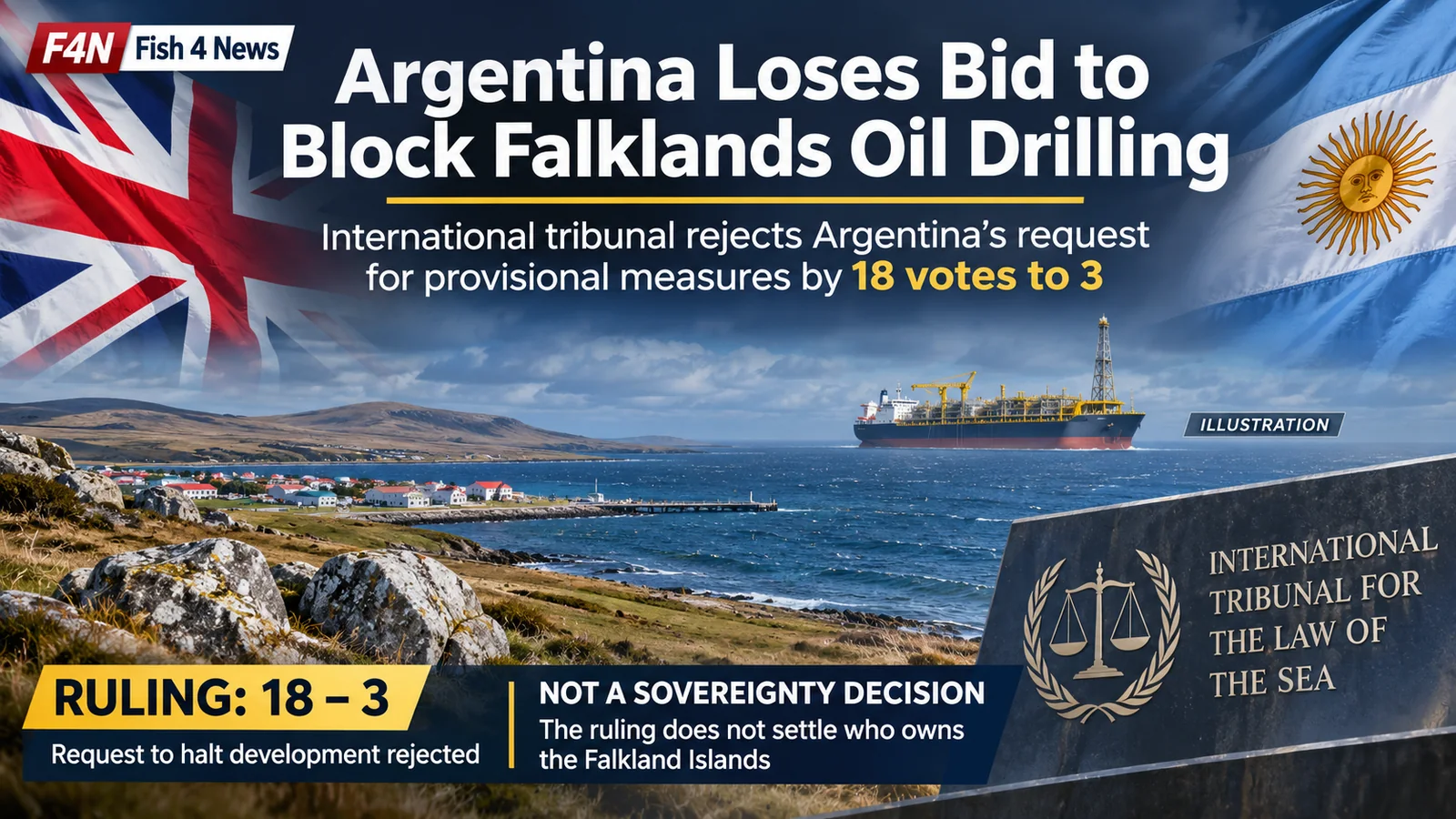
The decision removes an immediate legal obstacle to the Sea Lion oil project, a major offshore development in the South Atlantic. However, it does not settle the sovereignty dispute between Britain and Argentina or bring the wider arbitration proceedings to an end.
What Did the International Tribunal Decide?
The International Tribunal for the Law of the Sea (ITLOS) in Hamburg considered Argentina’s request for provisional measures under Article 290(5) of the United Nations Convention on the Law of the Sea (UNCLOS). These are temporary protections that can be ordered while a separate arbitration tribunal is being established.
Argentina initiated arbitration proceedings on 28 September 2026 and made its application for temporary measures on 13 October. The tribunal heard arguments from both countries on 10 and 11 November.
Argentina wanted Britain to prevent further development drilling and production infrastructure at Sea Lion, protect its claimed interests in discoveries and marine environmental responsibilities, and prevent further resource authorisations or actions that would worsen the dispute.
In its signed order, the tribunal rejected the application. Judges Horinouchi, Patel and Judge ad hoc Vinuesa voted against that outcome. Separate opinions and dissenting opinions are available through the case register.
Why Did Argentina Lose Its Legal Bid?
Argentina argued that Britain was authorising the unilateral exploitation of natural resources in waters over which Argentina claims rights. It maintained that temporary measures could protect those interests without requiring a decision on ownership of the islands.
Britain argued that the proposed arbitration tribunal did not have jurisdiction over Argentina’s claims, that the requirements for temporary protections were not met and that there was no immediate need for intervention.
The ITLOS majority concluded that the provisions relied upon by Argentina did not establish a sufficient preliminary basis for the future arbitration tribunal’s jurisdiction. In particular, deciding several of the claims would require addressing the underlying question of territorial sovereignty, which UNCLOS does not resolve.
The tribunal consequently did not need to consider the other requirements for provisional measures, including the alleged risk of irreparable harm. Its decision should not be read as a finding that the project has no environmental risks.
Does the Ruling Settle Who Owns the Falkland Islands?
No. The ruling is about a request for temporary measures, not sovereignty or a final judgment on the legality of oil extraction.
Paragraph 133 of the order expressly leaves the jurisdiction of the separate arbitration tribunal, the admissibility of Argentina’s claims and their substantive merits open for argument. The order also emphasises that UNCLOS applies in the maritime areas in dispute.
What Is the Sea Lion Oil Project?
The field lies approximately 220 kilometres north of the Falkland Islands in the North Falkland Basin. It is being developed by Navitas Petroleum, which operates the project through its UK subsidiary and holds a 65% working interest, alongside British company Rockhopper Exploration, which holds 35%.
The discovery was made in 2010. The two companies took their final investment decisions for the initial development on 10 December 2025. The Falkland Islands Government confirmed that its existing approvals for phases one and two of the Northern Development Area had taken effect.
The operator plans to connect 11 subsea wells to a floating production, storage and offloading vessel in the first phase. A second phase would add 12 wells. Production has yet to begin.
How Much Oil Could Sea Lion Produce?
Rockhopper’s December 2025 investment announcement put the funding requirement for the initial phase at US$1.8 billion to first oil and US$2.1 billion to completion, including financing and contingency costs.
An updated independent resource evaluation commissioned by Rockhopper, effective 31 July 2026 and announced on 26 August, put proved and probable recoverable oil reserves for the first two northern development phases at approximately 314 million barrels across the project.
The same evaluation identified around 626 million barrels of additional contingent resources on a best-estimate basis, including developments not yet commercially viable. These are not equivalent to reserves, and their eventual production is not assured.
For the Falkland Islands, where fishing is a central part of the economy, oil development could create jobs, new business opportunities and public revenues from taxation and royalties. The eventual benefits will depend on production, prices, costs and the terms of the project.
What Are the Environmental Concerns?
The Falkland Islands Government published the project’s environmental impact assessment and consultation documents. A statutory public consultation took place between July and August 2024, followed by publication of the revised assessment.
Potential impacts include oil pollution, disturbance to marine mammals and seabirds, effects on fishing, seabed disturbance, greenhouse gas emissions and additional pressure on local infrastructure. The assessment outlines mitigation and monitoring measures but does not eliminate all risks.
Argentina has also raised concerns about pollution and its claimed environmental responsibilities in the disputed waters. Saturday’s decision does not resolve those questions. Environmental compliance, spill response arrangements and decommissioning remain important areas to monitor throughout development.
Why Do Britain and Argentina Dispute the Falklands?
The Falkland Islands are a self-governing British Overseas Territory in the South Atlantic. Argentina calls them the Islas Malvinas and claims sovereignty over them.
As the House of Commons Library explains, Britain’s claim dates to 1765. Argentina bases its claim in part on succession to Spanish territorial rights after independence. Britain resumed administration in 1833 and has controlled the islands since, apart from the period of Argentine occupation during the 1982 war.
The United Nations General Assembly Resolution 2065 of 1965 recognised the existence of the dispute and called for negotiations towards a peaceful solution, taking account of the population’s interests. It did not determine sovereignty.
Britain maintains that the islanders have the right to determine their own future. In a referendum in March 2013, 99.8% of votes cast for either option supported remaining a British Overseas Territory, on a turnout of 92%. Argentina rejects the application of self-determination to this particular dispute and maintains that its territorial integrity must be respected.
How Have Britain, Argentina and the Islanders Responded?
Foreign Secretary Ed Miliband and Attorney General Ellie Reeves welcomed the decision in a joint statement on Saturday, reaffirming Britain’s sovereignty position and calling for an end to Argentine economic pressure on the islands.
The Falkland Islands Legislative Assembly also welcomed the outcome. In a statement reported by MercoPress, members said that the project could improve the islands’ economic independence while acknowledging that arbitration would continue.
The Argentine presidential office said it would respect the decision but disagreed with the tribunal’s preliminary jurisdictional finding. It reiterated Argentina’s sovereignty and resource claims, announced its intention to pursue further protective measures through the arbitration tribunal and said new sanctions proceedings against five parties had been initiated on Friday, 27 November.
Argentina’s government also urged its lower house of parliament to pass proposed sovereignty legislation the following week. That legislation is separate from the international tribunal’s decision.
When Could Falklands Oil Drilling Begin?
The order records assurances from Britain that development drilling will not begin before 21 March 2027, that extraction will not begin before March 2028, and that no additional licences will be issued while the licensing regime remains suspended.
Navitas currently plans first oil for March 2028. Neither the date of commencement nor future production is guaranteed by this ruling.
What Happens Next?
The United Kingdom expects the separate Annex VII arbitration tribunal to be established by the end of 2026 or by January 2027. ITLOS encouraged both sides to cooperate in establishing it promptly. Argentina has indicated that it intends to seek further measures once it is in place.
The next developments to watch are the formation of the tribunal, any renewed application for temporary restrictions, Argentina’s sanctions and legislation, and progress towards drilling in 2027.
Follow the story: Fish 4 News will follow the wider arbitration and the Sea Lion project as new verified developments emerge.
Sources
- ITLOS: signed order of 28 November 2026, Case No. 37
- ITLOS: case documents, hearings and judicial opinions
- UK Government: joint statement on the ruling
- Argentina: official statement No. 174 (Spanish)
- MercoPress: Falkland Islands Legislative Assembly response
- Falkland Islands Government: Sea Lion development approvals
- Navitas Petroleum: Sea Lion project
- Rockhopper: final investment decision
- Rockhopper: independent resource evaluation, August 2026
- Falkland Islands Government: environmental documents
- House of Commons Library: UK-Argentina tensions over the Falkland Islands
- UN General Assembly Resolution 2065