Flávio Bolsonaro received 56,104,268 votes, or 47.03% of valid ballots, against 53,876,617 votes and 45.16% for incumbent president Luiz Inácio Lula da Silva, according to Brazil’s Superior Electoral Court. Neither candidate secured the majority required to win outright, meaning Brazil will return to the polls for a second-round vote on 25 October.
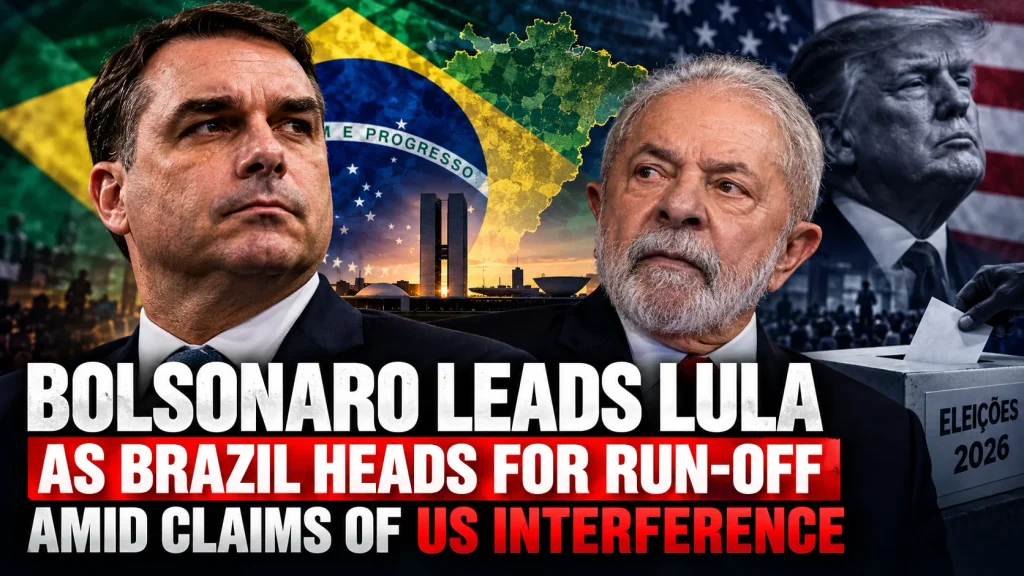
The result puts Bolsonaro, a senator from Rio de Janeiro and son of former president Jair Bolsonaro, narrowly ahead in the contest to lead Latin America’s largest economy.
It also means allegations of foreign involvement in the election are unlikely to disappear.
Brazilian intelligence raised concerns over US interference
Days before Sunday’s vote, Reuters reported that Brazil’s intelligence agency, ABIN, had briefed French and German officials on what it described as alleged interference in the Brazilian election by both the United States and Russia.
According to Reuters, a report from the meetings said ABIN identified US activity ranging from “lawfare” to more overt forms of intervention.
The claims have not been independently established as proof that Washington manipulated Sunday’s vote, and US authorities have previously denied interfering in Brazilian elections. They are nevertheless significant because they came from Brazil’s state intelligence service rather than from either candidate’s campaign.
Concerns have also been raised inside the United States.
A group of Democratic members of Congress wrote to Secretary of State Marco Rubio in September accusing the Trump administration of conducting a “sustained, multifaceted campaign of interference and destabilization in Brazil”.
Separately, Senators Jeanne Shaheen, Tim Kaine and Peter Welch called on Rubio to respect the election result, accusing the administration of using diplomatic, economic and political pressure in ways that could undermine Brazil’s democratic institutions.
These remain political accusations rather than a finding that the US interfered with ballot counting or Brazil’s voting system.
There have been no credible reports that Sunday’s electronic vote count itself was fraudulent.
Trump’s pressure on Brazil
The accusations have not emerged in isolation.
Relations between Washington and Brasília deteriorated after the Trump administration imposed tariffs and targeted sanctions while openly objecting to the treatment of Jair Bolsonaro.
The former Brazilian president was prosecuted over attempts to overturn the result of the 2022 presidential election after losing to Lula.
US senators critical of the Trump administration have specifically accused Washington of using tariffs and sanctions in an attempt to influence the Brazilian Supreme Court’s handling of Jair Bolsonaro’s case.
Flávio Bolsonaro is politically close to his father and has positioned himself considerably nearer to the Trump administration than Lula.
That makes the relationship between Brazil and the United States a substantial issue in the second-round campaign rather than simply a dispute imported from Washington.
BRICS, China and Brazil’s mineral wealth
The two candidates also offer sharply different approaches to Brazil’s place in the world.
Lula has strengthened Brazil’s involvement with BRICS and advocated closer economic relationships with China and other developing economies while arguing that Brazil should retain control over its strategic resources.
Bolsonaro has proposed moving Brazil substantially closer to Washington and has raised the possibility of withdrawing the country from BRICS.
His campaign has also supported closer cooperation with the United States and a more open approach to international investment.
That debate matters because Brazil possesses some of the world’s most important reserves of critical minerals.
The country has the world’s second-largest known rare-earth reserves after China, making it increasingly important to the United States and other nations attempting to reduce their reliance on Chinese supply chains.
Foreign investment in Brazilian rare-earth exploration has consequently accelerated, including substantial interest from US, Australian and Canadian-backed companies.
There is, however, no evidence supporting some of the stronger claims circulating online that Bolsonaro has agreed to surrender control of Brazil’s resources to Washington or turn the country into a US-controlled raw-material supplier.
The genuine political argument is over how Brazil develops those resources, how much processing and manufacturing takes place domestically, and how closely its trade and foreign policy should align with either Washington or Beijing.
The shadow of 1964
Critics of US involvement have also invoked Brazil’s history.
In 1964, the United States backed forces opposing President João Goulart as Brazil’s military seized power and established a dictatorship which lasted for more than two decades.
Declassified American records have since revealed preparations under Operation Brother Sam to provide logistical support, fuel and other assistance to anti-Goulart forces if required.
That history makes allegations of American political pressure particularly sensitive in Brazil.
But describing the present election as a literal repeat of the 1964 coup goes beyond the available evidence.
Brazil is currently conducting a competitive election through established democratic institutions, and allegations of foreign political influence should not be confused with evidence of a military coup or manipulation of the ballot itself.
Markets react to Bolsonaro’s first-round lead
Bolsonaro’s stronger-than-expected showing has already prompted a substantial reaction in financial markets.
A Brazil-focused exchange-traded fund trading in Frankfurt jumped by more than 15% on Monday, while Brazilian shares listed overseas and government debt also rallied.
Investors have generally viewed Bolsonaro as more likely than Lula to pursue spending restraint, privatisation and tax reductions.
That reaction highlights another division in the election.
Supporters of Bolsonaro argue that a more market-orientated government could attract investment and improve Brazil’s fiscal position.
Lula’s supporters argue that economic growth should be combined with stronger social programmes, domestic industrial development and protection of strategic Brazilian assets.
Brazil decides on 25 October
The first round has therefore settled very little.
Instead, it has produced a three-week battle between two dramatically different visions for Brazil while simultaneously intensifying questions about how far foreign governments should become involved in another country’s democratic process.
Bolsonaro enters that contest with the advantage of having received approximately 2.2 million more votes than Lula on Sunday.
But neither candidate reached 50%, leaving millions of Brazilians who supported other candidates – or did not cast a valid vote – potentially decisive.
On 25 October, Brazilian voters will make the final decision.
And whatever the outcome, the conduct of Washington during the remaining weeks of the campaign is likely to receive almost as much scrutiny as the candidates themselves.