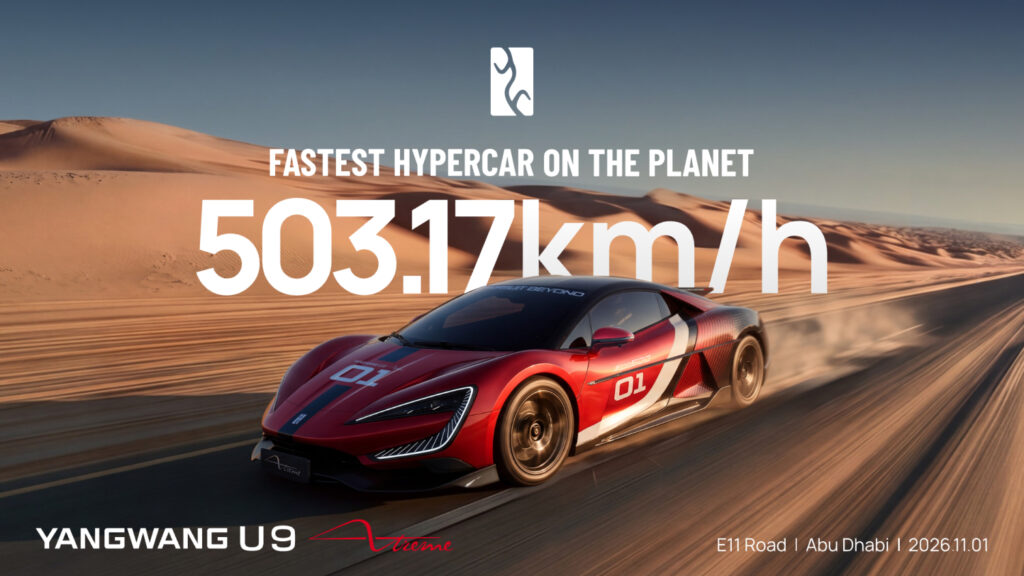
A BYD electric hypercar has become the first production car to exceed 500 km/h in a verified single-direction speed run, reaching 503.17 km/h (312.65 mph) on a closed highway in Abu Dhabi.
The Yangwang U9 Xtreme achieved the speed on 1 November 2026, driven by German racing driver Marc Basseng. Motorsport’s governing body, the FIA, has recognised the result, while Guinness World Records has confirmed two titles covering single-direction production-car speed.
What exactly has been verified?
Guinness World Records lists the U9 Xtreme as the fastest production car and the fastest electric production car in a single-direction run. It says a calibrated VBOX measurement system was used alongside the car’s speedometer, with the FIA reviewing the evidence.
That distinction matters. The traditional fastest-production-car comparisons often use the average of two runs made in opposite directions to reduce the influence of wind and road gradient. The 503.17 km/h figure is a genuine, independently recognised one-way achievement, but it should not be described as a conventional two-way average record.
How the Abu Dhabi attempt unfolded
The attempt took place on Sheikh Khalifa Bin Zayed International Road (E11) in Abu Dhabi’s Al Dhafra region. Local authorities helped close a 10 km section, with approximately seven kilometres of straight road available for the high-speed runs.
The team completed two attempts on 31 October, reaching a maximum of 490 km/h. Engineers subsequently adjusted the rear-wing angle, suspension settings and tyre pressures. Two more runs followed on 1 November, with the final attempt producing the 503.17 km/h result.
BYD says the road surface was cleaned and checked for debris before the runs. Although the location was normally a public highway, the speed attempt took place on a specially closed and secured section, not among ordinary traffic.
What makes the U9 Xtreme different?
Yangwang is BYD’s luxury performance brand. Its U9 Xtreme is a specialised version of the standard U9, rather than the same car sold with a routine showroom specification.
The record car uses four independent electric motors developing a combined 3,019 metric horsepower (PS), more than twice the standard U9’s quoted 1,287 PS. Its 1,200-volt electrical system, active suspension and electronically controlled torque distribution are intended to deliver power and maintain stability at extreme speeds.
At 503.17 km/h, the car covers nearly 140 metres every second. BYD says production of the U9 Xtreme will be limited to 30 examples worldwide, with customer specifications and manufacturing arrangements under way.
How it compares with the previous result
The same U9 Xtreme, also driven by Basseng, reached 496.22 km/h at Germany’s ATP Papenburg test facility in September 2025. The Abu Dhabi run improved on that figure by 6.95 km/h, taking the verified one-way result beyond the 500 km/h threshold.
The achievement demonstrates the performance possible with an all-electric powertrain, but it does not mean the figures are representative of ordinary road-going electric cars or normal driving conditions.