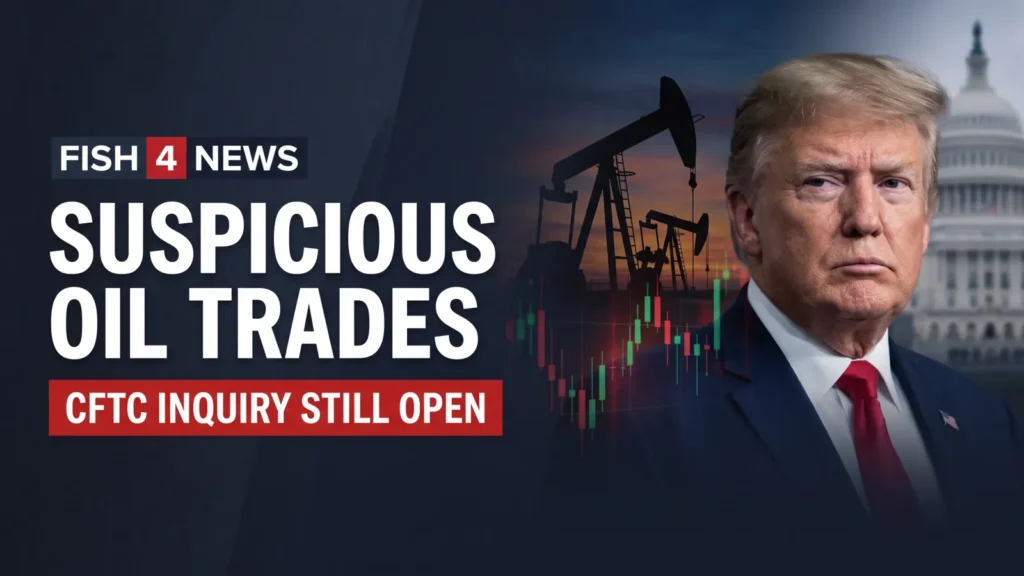
Career regulators at a US financial watchdog were reportedly told to withdraw a referral concerning unusually timed oil trades made shortly before Donald Trump reversed a threat to attack Iranian energy facilities. The regulator now insists its investigation is continuing.
The intervention, reported by Bloomberg on 13 October, has raised questions about political involvement in the Commodity Futures Trading Commission (CFTC), which oversees US derivatives markets. But the reporting does not establish that Trump personally ordered the referral withdrawn, that anyone in the White House made the trades, or that insider dealing took place.
What happened before Trump’s Iran announcement?
On 23 March 2026, a burst of activity in oil futures preceded a consequential announcement about the war involving Iran. According to Bloomberg’s reporting, traders sold Brent and West Texas Intermediate oil futures representing at least six million barrels in a roughly two-minute period shortly before 7am Eastern Time. That was more than eight times the comparable trading volume observed over the previous week.
About 15 minutes later, Trump posted that planned strikes against Iranian power plants would be postponed. The announcement changed market expectations, sending oil prices lower and shares higher.
Bloomberg also reported that large positions had been taken in contracts that would benefit from falling oil prices and a rising S&P 500. The remarkable timing prompted questions about whether any trader knew of the announcement in advance. The identities of those who placed the trades have not been publicly established.
Why was a CFTC referral reportedly withdrawn?
According to people familiar with the process who spoke to Bloomberg, career analysts in the CFTC’s Division of Market Oversight examined the transactions and sent a referral to the agency’s Division of Enforcement. Such a referral is a request for further scrutiny, not a conclusion that a crime has occurred.
Bloomberg reported that Mel Gunewardena, a senior adviser to CFTC chairman Michael Selig, then instructed a market oversight supervisor to retract the referral. Selig was appointed to lead the agency under President Trump. The reported instruction was regarded as highly unusual by people familiar with the watchdog’s normal procedures.
The report also included the agency’s explanation. An unnamed CFTC official said the initial work concentrated on US markets and a broader international review was needed, covering futures and other financial instruments. According to that account, Gunewardena was considered well placed to oversee the expanded analysis because of his markets experience.
The important distinction is between an internal referral being withdrawn and the entire investigation being closed. Those are not the same thing.
CFTC says the investigation remains open
On 22 October, CFTC enforcement director David Miller said the agency had been examining the trading from the beginning and that the investigation remained open, Reuters reported.
The following day, chairman Selig said on Bloomberg Television that the enforcement division had been looking at the trading activity since 23 March and that market oversight was being taken seriously.
These statements do not resolve why the original referral was reportedly retracted or what effect the intervention had on investigators. They do, however, contradict claims that the entire inquiry has definitively been killed.
Senators want answers about possible insider trading
Questions about suspicious trading did not begin with the October Bloomberg investigation. On 10 April, Democratic senators Elizabeth Warren and Sheldon Whitehouse asked the CFTC to investigate unusual transactions before major announcements concerning Iran.
Their letter raised concerns about both 23 March and 7 April, when a separate large bet on falling oil prices reportedly preceded a ceasefire announcement. The senators warned that traders might have used confidential government information. That was a request for investigation, not evidence that any named official had profited.
After the October Bloomberg report, Warren called for Selig and Gunewardena to answer questions before Congress about the status of the inquiry and potential enforcement action.
What is confirmed, and what remains unknown?
- Confirmed by public statements: CFTC officials said on 22 and 23 October that enforcement staff were continuing to examine the oil trading.
- Reported by Bloomberg: An adviser to the Trump-appointed CFTC chairman instructed career staff to retract an internal enforcement referral. The precise consequences of that instruction are not publicly established.
- Not established: The traders’ identities, whether they obtained non-public information, whether any law was broken, or whether Trump personally directed the reported intervention.
Claims circulating online that the trades came from inside the White House, or that Trump himself carried out and profited from them, go beyond the evidence currently available.
The central issue is therefore not a proven White House insider-trading operation. It is whether the regulator’s examination of extraordinary market activity was independent and effective, and whether a political adviser’s reported intervention impeded the normal process.
Sources and further reading
- Bloomberg, 13 October: CFTC staff told to retract analysis
- Reuters, 22 October: Enforcement director says probe remains open
- Bloomberg Law, 23 October: Chairman Selig comments on investigation
- US Senate Banking Committee, 10 April: Warren and Whitehouse letter
- US Senate Banking Committee, 13 October: Warren statement