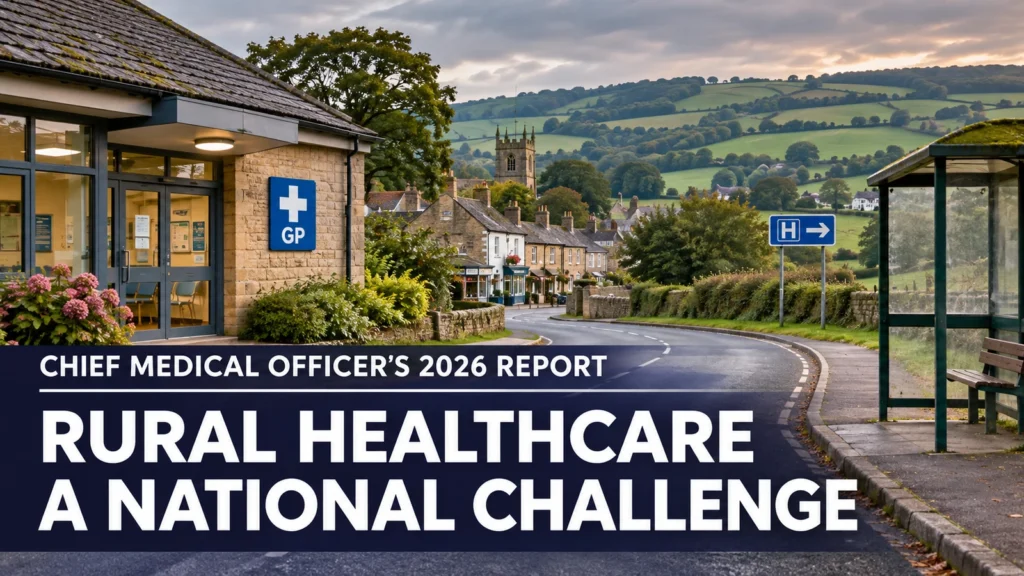
England’s rural communities and small towns need healthcare services designed for an older population, longer journeys and often hidden deprivation, Chief Medical Officer Professor Sir Chris Whitty has warned. His 2026 annual report says the challenge must be treated as a national responsibility, not left solely to local services.
The 288-page report, published on 4 November 2026, examines why healthcare needs in rural England differ from those in major cities. It also identifies possible solutions, including more flexible appointments, tailored training for healthcare staff and better use of remote consultations.
The report is not an assessment of every GP surgery or hospital in England, nor does it establish that all rural residents have worse health outcomes than urban residents. Its central argument is that the age profile, geography and working life of rural areas create different demands which national planning must recognise.
Older populations mean different healthcare demands
In smaller rural areas of England, around 28% of residents were aged 65 or over in 2024, compared with about 12% in London, according to figures cited in the report. The equivalent figure in larger rural areas was roughly 25%, against approximately 18% in urban areas outside London.
Whitty links this pattern partly to people leaving cities as they get older and younger adults moving away from rural communities for study and work. Population projections indicate that the concentration of older residents will grow in many rural and coastal areas over the coming decades.
An older population does not mean illness and disability are inevitable. However, long-term conditions and needs for health and social care tend to become more common with age. Whitty argues that NHS staffing, facilities and budgets should be planned around those foreseeable needs.
A hospital journey can be much harder without a car
Some of the starkest differences concern access rather than treatment itself. The report cites 2019 figures showing that around 50% of rural residents could reach a hospital within 60 minutes by public transport or walking, compared with around 90% of urban residents.
These are historic accessibility measurements, not a new assessment of transport in 2026. Nevertheless, Whitty identifies long distances, limited services and the cost of running a car as continuing barriers to healthcare, especially for older people who may no longer be able to drive.
He recommends allowing patients travelling from remote areas more choice of appointment times, supporting community transport and improving public transport links to healthcare. In some areas, a hospital appointment can involve much of a day spent travelling.
Rural poverty can disappear into the statistics
Whitty also warns that deprivation in rural England is often masked by figures covering much larger areas. A household struggling with low wages, expensive transport or poor access to services may live within a district that appears relatively prosperous overall.
The report says standard deprivation measures can miss pockets of disadvantage in sparsely populated areas. It calls for more detailed measurement, combining national statistics with local knowledge so public health resources reach communities most in need.
Housing adds another pressure. Older, poorly insulated rural properties may be difficult and costly to heat or adapt for someone with reduced mobility. Whitty recommends that new homes and improvements to existing properties reflect local ageing trends.
GP recruitment and training need to reflect rural practice
Rural GP practices and other services can be vulnerable when just one or two clinicians leave. Staff may have to cover a wider range of conditions with less immediate access to specialist hospital support and face professional isolation or longer journeys.
The report says the national share of GP trainees receiving a placement in a small town or rural setting rose from around 25% in 2021 to 28% in 2026. That still leaves most trainees without such a placement.
Whitty calls for more rural training opportunities and career support, while recognising benefits of rural practice such as continuity of care and stronger links between clinicians and their communities.
Farmers and military families face particular challenges
Farming brings occupational risks involving machinery, livestock and chemicals, alongside long or seasonal working hours which may not fit conventional appointment schedules. The report cites provisional 2025–26 Health and Safety Executive figures showing 8.09 fatal workplace injuries per 100,000 workers in agriculture, forestry and fishing in Great Britain, the highest rate among the sectors compared.
Whitty recommends outreach through agricultural events and more flexible appointments, as well as support for mental health in farming communities. The report also discusses infections associated with animals and ticks, although it describes these as a small but real risk for the general public.
For military families, frequent moves between areas can disrupt referrals and waiting lists. The report calls for better coordination of defence and NHS medical records and service arrangements so families are not disadvantaged by military postings.
Digital appointments may help, but cannot replace every visit
Video or telephone consultations could save significant travel for people in remote areas when an examination is not required. Whitty supports expanding appropriate telemedicine, potentially with assistance available at places such as GP surgeries or libraries.
He is equally clear that remote care is not a solution for every patient. Clinical suitability, internet access, digital confidence and patients’ preferences matter, and in-person care must remain available when needed.
The report also highlights the value of community hospitals for rehabilitation, outpatient care and other services in places where large acute hospitals are distant.
How public health leaders have responded
The Association of Directors of Public Health welcomed the report on 4 November. Its president, Greg Fell, said locally designed services would need investment, data sharing and collaboration between organisations to turn the recommendations into practice.
The British Geriatrics Society also welcomed its focus on older rural residents, saying neighbourhood health services must be equipped for people living with frailty and multiple long-term conditions.
In one regional response, Devon County Council called for the extra costs associated with rural healthcare to be better reflected in national funding. It said 26.3% of the county’s residents were aged 65 or over, against 18.7% nationally, and raised concerns about long journeys, housing costs and the centralisation of services. Devon illustrates the pressures identified nationally, but the report covers rural communities and small towns across England.
What happens next?
The government’s 10 Year Health Plan for England, published in July 2025, already sets out ambitions to move more care closer to people’s homes and expand digital services. Whitty’s report asks a further question: whether those reforms will be adapted to the realities of smaller towns and remote communities rather than applying a model developed principally for cities.
The Chief Medical Officer’s recommendations are independent advice. Their publication does not itself amount to an NHS funding commitment, a change to hospital services or a guarantee that particular proposals will be adopted. Future decisions on funding, transport links, staffing and community provision will determine how far the proposals are implemented.
Sources
- Chief Medical Officer’s annual report 2026, full report and publication details
- Executive summary and recommendations, GOV.UK
- Association of Directors of Public Health response, 4 November 2026
- British Geriatrics Society response, 5 November 2026
- Devon County Council response, 4 November 2026
- 10 Year Health Plan for England, 2025