More Civil Service jobs are being located outside London, but senior officials remain concentrated in the capital, according to new government figures and independent analysis.
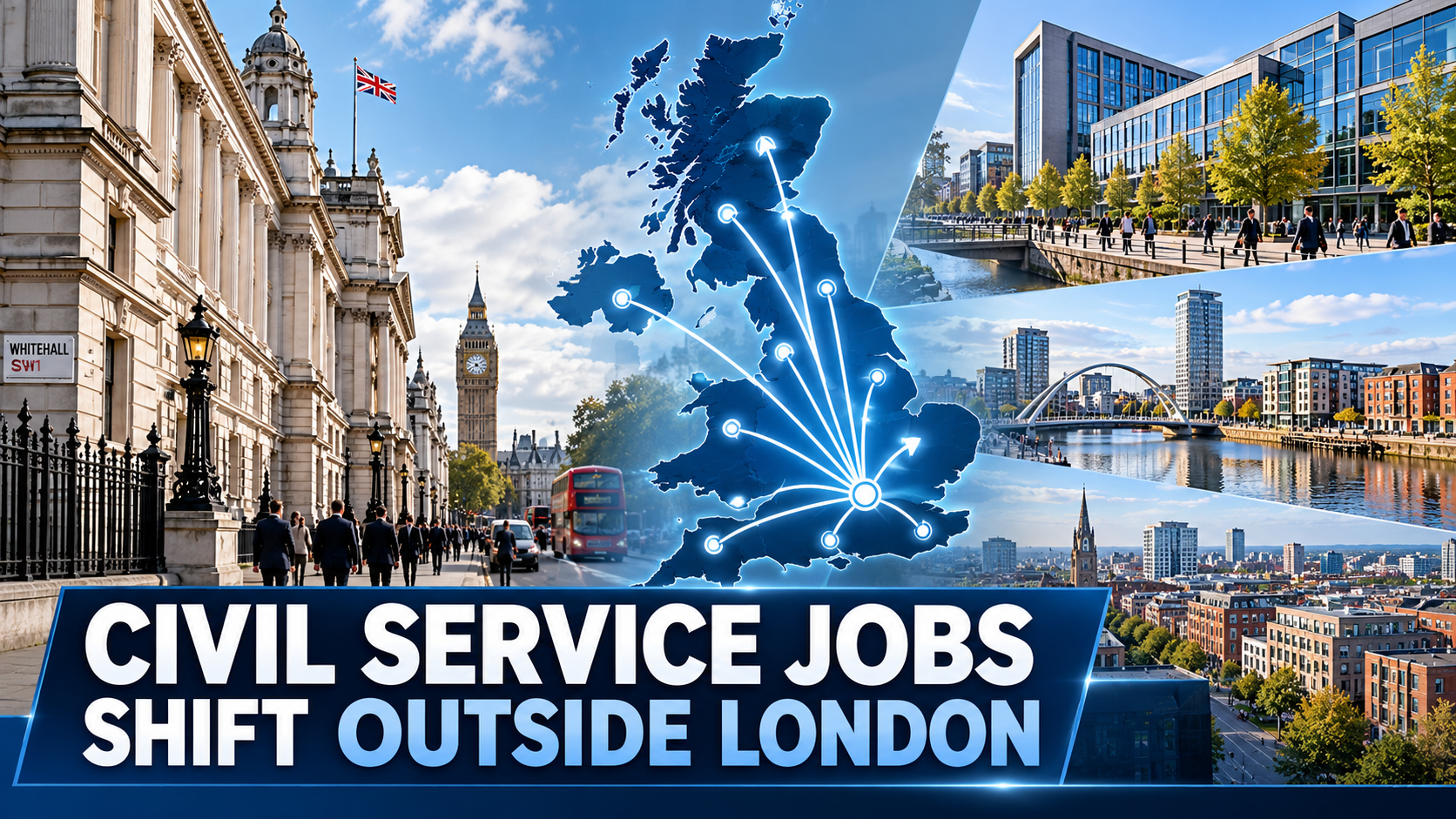
The Cabinet Office said on 30 October 2026 that around 67% of new full-time Civil Service positions were created in key regional locations under its Places for Growth programme. It also reported a cumulative total of 24,621 roles relocated outside London by March 2025.
Those figures describe different things. The relocation total stretches back to the start of the programme and does not mean 24,621 additional jobs were created this year. The government’s release does not specify the precise period or denominator behind its 67% figure.
What the latest staffing figures show
A separate annual statistical release puts the Civil Service workforce at 557,825 people on 31 March 2026, of whom 107,810 were based in London. That makes London’s share 19.4%, down from 19.6% in 2025 and 21.2% in 2021.
The Civil Service Statistics 2026 bulletin records year-on-year increases in almost every UK region. The largest headcount increases were in the North West (2,530), Wales (1,500), Scotland (1,125), Yorkshire and the Humber (1,025) and the West Midlands (910). The East of England was the exception, with a decline.
Civil Service World, reporting on the new Places for Growth location data, says the number of full-time equivalent posts increased by approximately 7,100 outside London between March 2025 and March 2026, compared with around 610 in London. These are changes in staffing levels, not a count of people physically moving from London.
What does a ‘relocated’ job mean?
Places for Growth began under the Conservative government in 2020 with a target of shifting 22,000 roles out of London. The target was originally set for 2030 and later brought forward to 2027. The programme has continued under subsequent governments.
A relocation does not necessarily mean an existing employee packed up and moved. Under the programme’s published definition, it can also include a role transferred between locations, recruitment to a formerly London-based role or a newly created post placed outside the capital that might otherwise have been based in London.
That distinction matters when assessing the economic effects. The figures show where posts are located, but they do not establish that each role represents an additional job for the UK as a whole.
The Cabinet Office says it has 13 cross-government locations, including Aberdeen, Belfast, Birmingham, Bristol, Cardiff, Darlington, Edinburgh, Glasgow, Greater Manchester, Leeds, Newcastle, Sheffield and York. The intention is to create opportunities for government careers in more parts of the country, rather than requiring progression through London.
Senior leadership is moving more slowly
The same government announcement puts the share of UK-based senior civil servants working outside London at 36.6%, against a target of 50% by 2030. At the start of the programme, the government says the proportion was 26%.
That is progress, but the senior Civil Service is still disproportionately concentrated in London. In its January 2026 Whitehall Monitor, the independent Institute for Government said 65% of the senior Civil Service was based in London in 2025 on its headcount measure, unchanged from 2024. It judged the pace of change insufficient to meet the 2030 ambition.
The Institute’s measure and the government’s Places for Growth measure are not directly interchangeable: they use different sources and ways of counting staff. There is also a reference-date inconsistency in reporting of the 36.6% figure: the Cabinet Office’s announcement dates it to March 2026, whereas Civil Service World identifies March 2025. The percentage should not, therefore, be treated as proof of a particular increase over the latest year without clarification.
Why it matters beyond London
For people seeking public-sector careers, relocating policy, management and specialist posts can make it possible to work in government without moving to the capital. For regional offices and local authorities, it may also create closer working relationships with national departments.
But moving a job and devolving decision-making powers are not the same thing. A department can employ staff in a regional centre while important budget and policy decisions remain with ministers and senior leadership in Whitehall.
The government has separately announced plans to second officials into mayoral authorities, alongside a Fast Stream recruitment pilot in Yorkshire and the Humber. Those measures are intended to build regional capacity, but the latest Places for Growth figures do not by themselves demonstrate their impact.
Cabinet Office minister Mark Ferguson said: “We are shifting power and decision making to local communities to ensure that we have a truly UK-wide Civil Service.”
What remains to be established
The new figures document a long-running shift in where government employees work. They do not fully answer how many posts represent net new employment, how many people physically moved from London, whether senior decision-making has shifted at the same pace or what the measurable local economic benefit has been.
The Cabinet Office projects savings and regional economic benefits from the programme by 2030. Those are forecasts, not evidence that all the projected benefits have already been achieved.
Sources
- Cabinet Office announcement, 30 October 2026
- Civil Service Statistics 2026, Cabinet Office
- Places for Growth role relocation data, 29 October 2026
- Places for Growth location data, March 2025 to March 2026
- Places for Growth 2030 programme information
- Institute for Government, Whitehall Monitor 2026
- Institute for Government, methodology
- Civil Service World, 30 October 2026