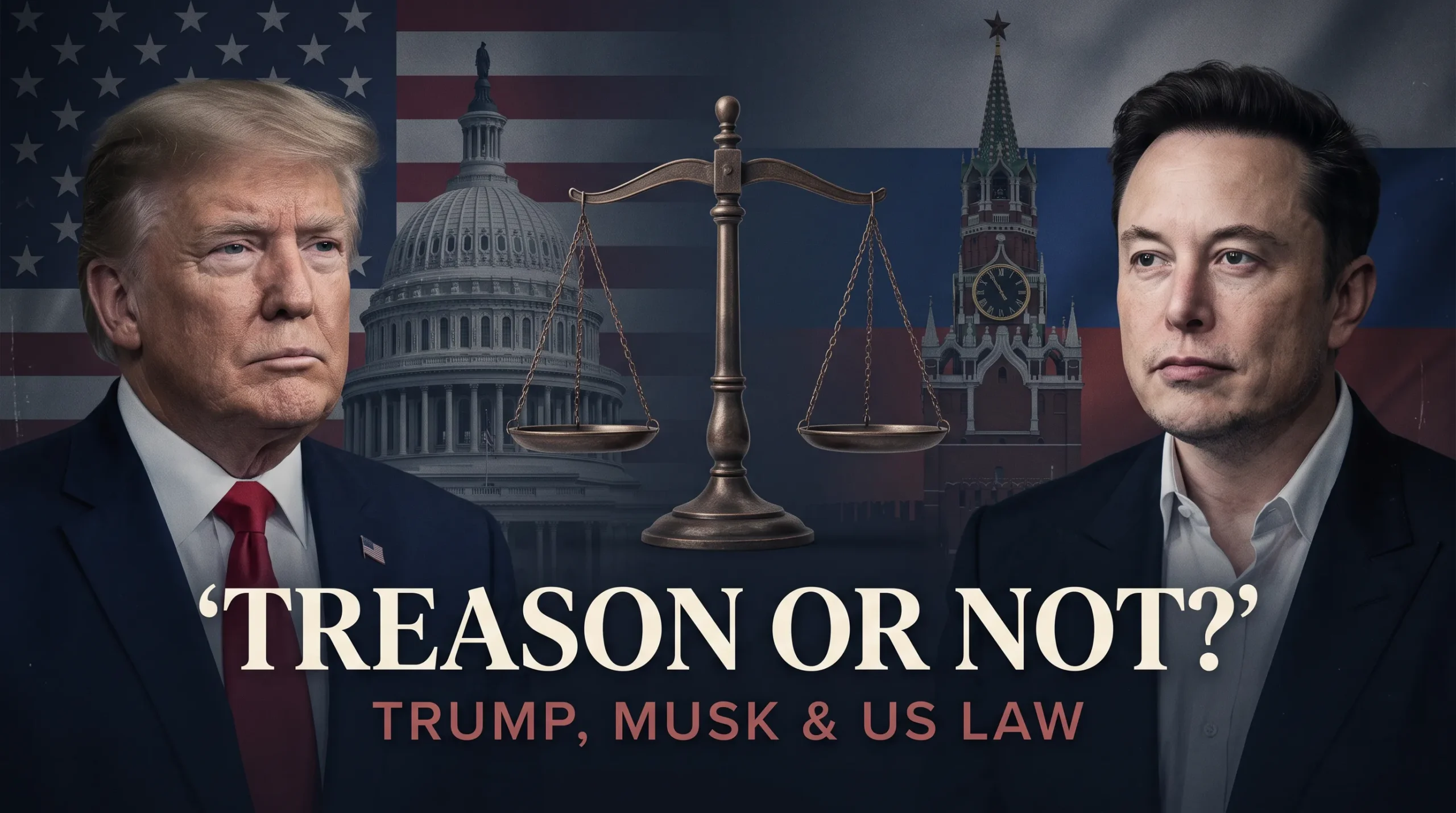
Donald Trump and Elon Musk are frequently accused of helping Russia. But what would investigators actually need to establish before either man could face charges of treason, espionage or another federal offence? The answer is more demanding than the political rhetoric suggests.
Opinion and legal explainer | 27 October 2026. This article discusses reported incidents and clearly identified hypotheticals. It does not allege that Trump, Elon Musk or Donald Trump Jr. has committed any of the offences described.
The short answer: helping Russia is not automatically treason
The US Constitution, Article III, Section 3 defines treason only as levying war against the United States or adhering to its enemies by giving them aid and comfort. Conviction additionally requires two witnesses to the same overt act or a confession in open court. This is deliberately narrow: political disloyalty, a controversial foreign policy, friendship with Russians or a decision that benefits Moscow does not automatically satisfy the definition.
Russia is an American strategic adversary, but the constitutional term ‘enemies’ has historically been understood in the context of war. The United States and Russia are not at war with each other. Even a proven, deliberate disclosure of defence secrets to Russian officials therefore would not automatically constitute treason. It could raise very serious questions under other criminal statutes.
Investigated, charged and convicted: three different things
- Investigated: credible information can justify examination. An inquiry is not a finding of guilt.
- Charged: federal prosecutors ordinarily seek a grand-jury indictment based on probable cause, with at least 12 jurors voting to indict. US Courts explains the process.
- Prosecuted responsibly: Justice Department guidance ordinarily expects prosecutors to believe admissible evidence can secure and sustain a conviction, as well as weighing specified public-interest considerations.
- Convicted: guilt must be established beyond reasonable doubt. An indictment is an accusation, not proof.
That is the test we apply below. The issue is not whether a headline looks suspicious but whether evidence supports every element of a specific offence.
What do the reported incidents actually establish?
Donald Trump Jr.’s wedding and Russian businessman Umar Kremlev
ProPublica reported on 14 September 2026 that Umar Kremlev, a Russian boxing executive close to Vladimir Putin, paid hundreds of thousands of dollars towards celebrations around Trump Jr.’s wedding. The couple acknowledged his role, describing him as a friend. His representatives denied political discussions. Representative Robert Garcia requested records about the arrangement.
President Trump said on 18 September that his son had reimbursed Kremlev. On 6 October Kremlev publicly confirmed repayment, according to Associated Press. Independent public documentation of precisely when or why that repayment was agreed has not been established in the reporting examined.
Could he be charged with treason for accepting the hospitality? Not on those facts. Friendship, a lavish gift and subsequent repayment do not establish the constitutional offence. Could another crime be involved? That would require additional evidence of unlawful conduct, such as an illegal bargain or an arrangement involving a covered public official. The reimbursement timing is a legitimate journalistic question, not evidence of a criminal motive by itself.
Trump’s private contacts with Putin
A president talking privately with another head of state is not itself unlawful. It can prompt questions about transparency and accountability. It does not establish that classified information was transferred or that any secret agreement existed.
Now consider a hypothetical: credible evidence shows an American president deliberately supplied sensitive nuclear submarine plans to Russia. Prosecutors might examine 18 USC §794, which addresses certain transmissions of national defence information to foreign recipients with the required intent or reason to believe it would harm the US or advantage another nation. But the classification of the act, presidential authority and criminal immunity would require difficult legal analysis. That hypothetical is not an allegation that Trump did so.
Would that be treason? Not automatically. Could it be espionage? Potentially, if the legal elements were proved and constitutional protections did not prevent prosecution. A shocking allegation is not a substitute for those tests.
Musk, SpaceX and Starlink/Starshield in Ukraine
Ukrainian officials reported military disruptions after speed restrictions on the Starlink and Starshield satellite systems in October. Reuters reported on 20 October that the Wall Street Journal attributed the slowdown to Musk, while saying it could not independently verify that account. Responsibility has been disputed between SpaceX and US government officials.
On 22 October Senator Richard Blumenthal announced a congressional inquiry, requesting information about contracts, authorisation and communications. On 24 October Ukraine reported restored operating speeds. Musk said Ukraine had violated Starlink’s civilian terms by using it for offensive drone operations. That explanation has been contested.
Does limiting satellite service constitute espionage? No, not merely because the consequences helped Russia. A disputed business or defence-contract decision is not automatically the transmission of national defence information. Breaching a contract, if established, would not itself prove a criminal offence.
Suppose instead investigators uncovered credible evidence that Musk secretly agreed to operate under Russian government direction while in the United States. That could raise questions under 18 USC §951, concerning certain unnotified agents of foreign governments. Investigators would still need to establish its location, direction-or-control, knowledge and notification requirements and consider statutory exceptions. Alternatively, unlawful disclosure of actual defence information could invoke espionage law. Neither has been proved by the public facts of the Starlink dispute.
What earlier Russia investigations found
The Mueller investigation documented Russian interference in the 2016 election and contacts involving Trump campaign associates. But its report stated that it did not establish the campaign had conspired or coordinated with the Russian government in those election-interference activities. Neither overlooking that finding nor treating it as a verdict on every later relationship helps an accurate assessment.
If not treason, what offences could evidence support?
- Espionage: unlawful transmission of qualifying national defence information under 18 USC §794, with the requisite mental state.
- Unnotified foreign-government agency: operating in the US subject to foreign-government direction or control in circumstances covered by 18 USC §951.
- Foreign-agent registration violations: carrying out covered work for a foreign principal without required disclosures, subject to the rules and exceptions in FARA.
- Bribery: a corrupt exchange involving a covered official and official action, rather than simply a gift or hospitality. See 18 USC §201.
- Conspiracy, obstruction or false statements: only if the evidence meets the distinct elements of an unlawful agreement, obstruction offence or applicable false-statement statute.
- Seditious conspiracy: 18 USC §2384 involves specified agreements to use force against the US government or its laws. It is not a catch-all term for helping a foreign adversary.
These are examples of legal routes that might be considered if new evidence emerged. Naming a statute does not mean an existing allegation meets it.
Would presidential immunity protect Trump?
The Supreme Court’s 2024 Trump v. United States decision provides absolute criminal immunity for presidential acts within exclusive constitutional authority, presumptive immunity for other official acts and no immunity for unofficial acts. A court cannot simply declare an official act unofficial by attributing an unlawful motive.
That makes the hypothetical transfer of submarine intelligence legally complicated. Was it presidential foreign-affairs conduct, a private corrupt arrangement or something else? The answer would require a case-specific ruling. The Court could later reconsider the precedent, or determine a particular act lies outside it, but pressure alone does not cancel the judgment.
Separately, the Justice Department has long taken the position that a sitting president cannot be federally indicted while in office. That is its Office of Legal Counsel position, not a Supreme Court judgment on every hypothetical. Musk is not protected by presidential immunity.
What if Democrats win Congress on 3 November?
The House and Senate are two chambers of one legislative branch. Their newly elected members ordinarily take office on 3 January 2027. A Democratic majority in one or both chambers could launch investigations, hold hearings, request or subpoena records within congressional authority and refer evidence to prosecutors. But Congress cannot order the Justice Department to bring criminal charges. USAGov explains congressional elections.
A House majority could impeach the president, but removal requires a two-thirds Senate vote of senators present. Impeachment is separate from criminal prosecution and need not depend on proving treason. Congressional subpoenas can also face legal challenges, and passing legislation normally requires presidential approval or a veto override. A majority in both chambers is not control of all three branches of government.
Should charges follow if sufficient evidence is found?
The same legal standard should apply to everybody. If compelling admissible evidence supports a criminal charge, the decision should not turn on whether a suspect is a Republican, Democrat, president, relative of a president or billionaire. Equally, refusing to convict someone by rumour is not protecting them. It is respecting the rule of law.
A responsible inquiry could find a prosecutable offence, reveal misconduct that is not criminal or establish that an accusation was false. All three outcomes must remain possible. Readers should ask: what happened, what can be proved, which statute applies, and what additional evidence would change the assessment?
What we know and what remains unproven
- Confirmed: Kremlev financed wedding celebrations and later said he was reimbursed.
- Confirmed: Ukrainian officials reported restrictions and subsequent restoration of satellite-service speeds.
- Confirmed: congressional scrutiny of both matters has begun.
- Unresolved: the precise reimbursement arrangements and who authorised the Starlink/Starshield restrictions.
- Not established by the material examined: treason, espionage or other criminal liability by Trump, Trump Jr. or Musk in connection with these incidents.
The next time someone shouts ‘treason’, ask for the evidence and the law. Investigating powerful people where credible evidence warrants it is legitimate. Treating suspicion as a conviction is not. This distinction should survive regardless of who occupies the White House.
Editorial note: This legal assessment reflects publicly available information as at 27 October 2026 and may be updated in response to significant new evidence, judicial rulings or congressional developments.