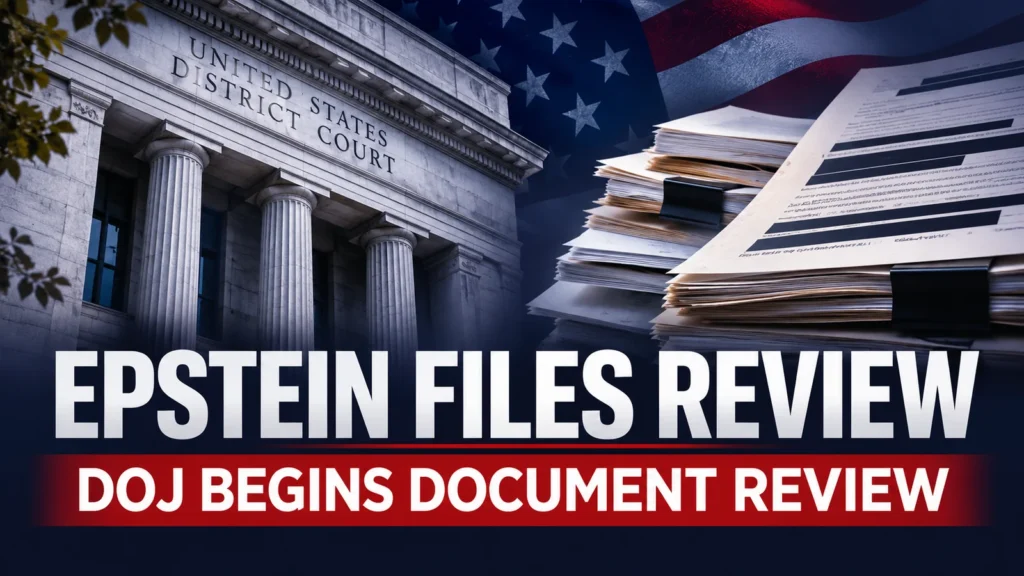
The US Justice Department says it has begun reviewing Epstein-related records previously identified as foreign-language documents, after a federal appeals court rejected its attempt to pause a court-ordered review. The number of documents involved and any timetable for their release remain unclear.
The admission appears in a joint notice filed on 2 November in a case brought by lawyer and journalist Katie Phang against US Attorney General Todd Blanche. The government says it is assessing whether the records fall within the Epstein Files Transparency Act and applying legally required redactions where appropriate.
What the Justice Department has confirmed
In the 2 November filing, government lawyers stated: “the government has begun its review of records that were previously tagged as foreign language documents.” The DOJ said it would first determine which records are relevant to the law’s disclosure requirements, then review any necessary redactions.
The department did not state when the review started, how many records were being examined, how many staff were assigned or how many records had been identified for possible release.
Government lawyers proposed providing another update in 30 days. They asked Judge Emmet Sullivan not to impose a fixed deadline for producing all foreign-language records, arguing that the work involved cannot be fully assessed until each document has been examined.
Appeals court rejected request to suspend review
The dispute follows a 28 October ruling by the US Court of Appeals for the District of Columbia Circuit, which denied the government’s request for a stay pending appeal.
The appeals court found the government had not shown that starting the review would cause irreparable harm. Its ruling left the underlying appeal unresolved and did not decide which particular documents must ultimately be released.
Judge Sullivan had previously ordered the review as part of litigation over compliance with the Epstein Files Transparency Act. That law, enacted on 19 November 2025, required disclosure of specified unclassified DOJ-held Epstein records within 30 days, subject to permitted exemptions.
Phang seeks deadlines and weekly reports
Phang’s lawyers have asked Sullivan to require the DOJ to complete the foreign-language review by Friday 27 November 2026, release qualifying records as they are identified and submit weekly progress reports.
They also want the department to answer initial questions by Friday 6 November, including:
- How many foreign-language records were identified, and whether the review covers all of them.
- When the work began and how far it has progressed.
- How many DOJ staff and working hours have been assigned.
- How the department is ensuring accurate review of documents written in languages other than English.
Neither 6 November nor 27 November should be treated as a new court-imposed deadline. They are dates requested by Phang in the joint notice, and the judge must decide whether to adopt the proposed measures.
The DOJ opposes the additional demands. In the same filing, government lawyers disputed allegations of past non-compliance and argued that reporting requirements do not entitle a litigant to direct questions about departmental staffing or resource allocation.
What the law permits to be withheld
The Epstein Files Transparency Act prohibits withholding records merely to avoid embarrassment, reputational harm or political sensitivity. It does permit certain redactions, including to protect victims’ personal information, exclude child sexual abuse material, safeguard narrowly defined active investigations and protect legitimately classified national security information.
The requirement to review foreign-language material does not mean every document will be published. It remains to be determined which records fall within the Act and what redactions, if any, are lawful.
What remains unknown
- The total number of foreign-language records under review.
- Whether the DOJ has finished examining any of them or approved any for release.
- When additional Epstein-related records might become publicly available.
- Whether Judge Sullivan will impose a further reporting schedule or release deadline.
Claims that the foreign-language records are being deliberately kept secret to protect particular individuals have not been established by the 2 November filing. Phang has sharply criticised the department’s handling of the records, while the DOJ contests allegations that it has disobeyed the court’s orders.
Video: Katie Phang explains the latest filing
Phang is the plaintiff in this case. Her commentary represents her account and legal position, not an independent court finding.
Sources
- US District Court: joint notice, 2 November 2026 (Document 62)
- US Court of Appeals: order denying stay, 28 October 2026
- US District Court: Phang’s notice of proposed order, 2 November 2026 (Document 63)
- US District Court: Judge Sullivan’s 16 September 2026 opinion
- US Congress: Epstein Files Transparency Act, Public Law 119-38
- Katie Phang: lawsuit update, 3 November 2026
- Featured image: Ajay Suresh / Wikimedia Commons (CC BY 4.0; resized).