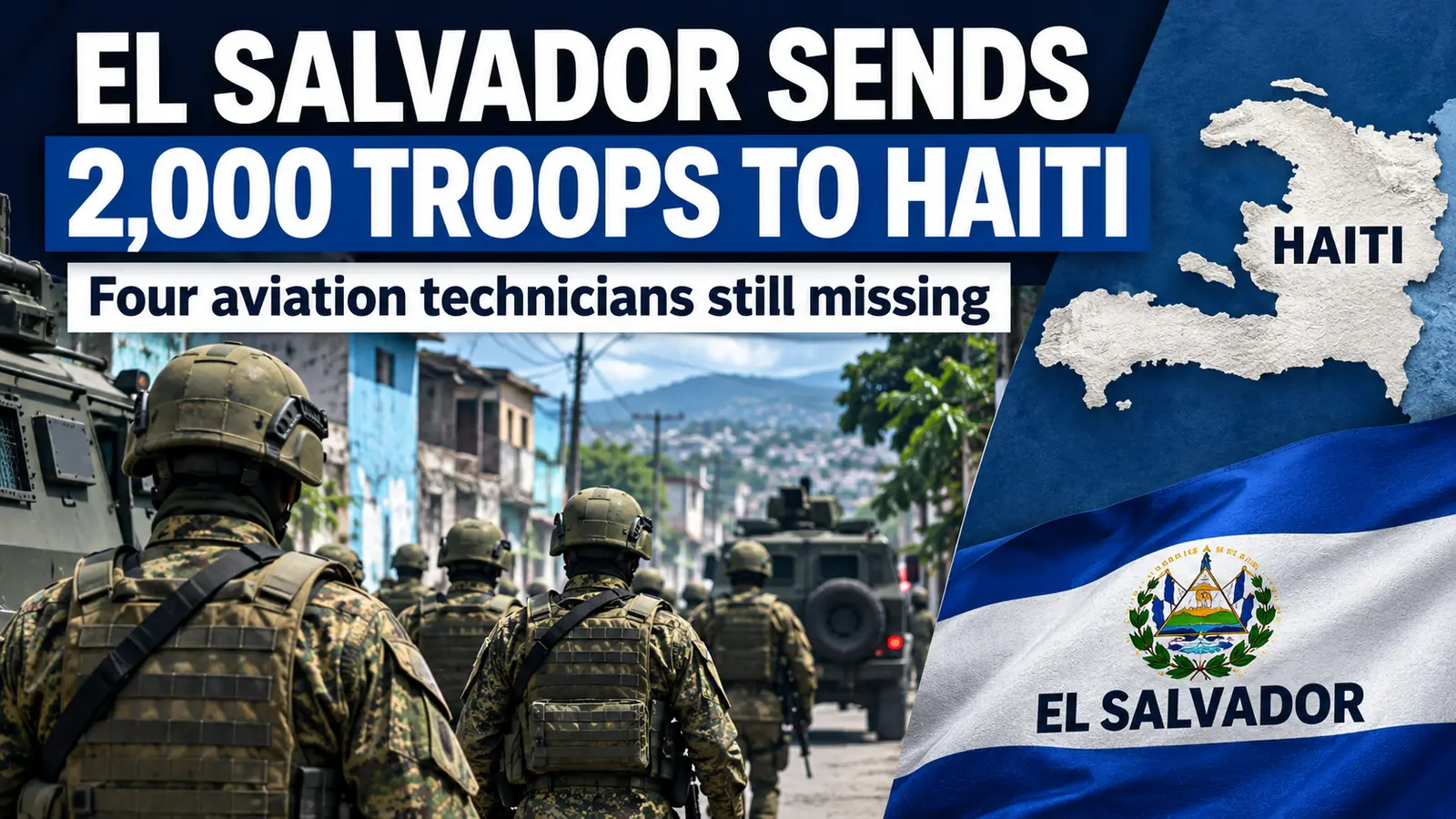
El Salvador has sent more than 2,000 soldiers to Haiti after four Salvadoran aviation technicians disappeared during an armed gang ambush, in a major foreign deployment that has raised questions about military command, civilian protection and the limits of international oversight.
President Nayib Bukele has described the operation as an effort to find and rescue the missing men. But the number of troops dispatched is comparable to the strength of the separate, UN-authorised international force already trying to support Haiti’s police. The United Nations says most of the Salvadoran contingent does not operate under that force’s framework.
The intervention comes as armed gangs retain extensive control over parts of Port-au-Prince, displacing families and frustrating attempts to restore elected government. Here is what is known about the deployment, and what remains unanswered as of 9 November 2026.
What happened to the four missing Salvadorans?
On 18 October, an armoured vehicle carrying four Salvadoran military aviation technicians came under attack in the Santo area of Croix-des-Bouquets, on the outskirts of Port-au-Prince. The technicians fled their burning vehicle and disappeared. Salvadoran authorities say their work within the Gang Suppression Force involved aviation support and medical evacuation rather than frontline combat.
Bukele announced a rescue operation on 21 October. Initial special forces deployments grew rapidly, with Reuters reporting about 1,000 Salvadoran troops in Haiti by 27 October and approximately 2,000 on the night of 28 October. El Salvador’s foreign ministry subsequently said it would deploy more than 2,000 personnel. These are reported operational figures, not a continuously verified troop count.
Haitian police announced that they had recovered the burnt-out vehicle in the Santo area during an operation on 2 November. The discovery did not establish the men’s whereabouts. A previous report that four recovered bodies might be those of the missing Salvadorans was publicly disputed by Bukele. The men’s fate had not been independently confirmed at the time of this report.
Are the Salvadoran soldiers part of a UN mission?
Only a minority of them, according to the UN. In a 3 November press briefing, a UN spokesperson said the approximate number of Salvadoran personnel falling under the UN-authorised Gang Suppression Force (GSF) mandate was 200. The vast majority of the additional troops were outside that framework.
The distinction matters. The GSF is authorised by the UN Security Council, but it is not itself a UN peacekeeping mission. Its mandate includes specific requirements for cooperation with Haitian authorities, international law, human rights due diligence and mechanisms for reporting alleged misconduct. The UN has not said that the larger Salvadoran deployment automatically receives the same operational support or oversight.
The UN spokesperson characterised the separate deployment as a bilateral matter, while insisting that any operation must comply with international law and respect human rights. Operating outside the GSF mandate does not, by itself, establish that a deployment is unlawful; it does leave questions about its legal arrangements and accountability.
Who is commanding the operation?
Haiti’s Prime Minister Alix Didier Fils-Aimé has said international troops are there to support, not replace, the Haitian state and has emphasised Haitian control over security operations. The Salvadoran government has presented its additional troops as a rescue force. Public reporting has not established a complete, independently verified chain of command for the larger contingent, or clarified its rules of engagement and expected departure date.
In a 29 October Reuters investigation, security sources and analysts raised these concerns. Bukele said El Salvador was bearing 90% of the operation’s costs, but a detailed, independently verified budget has not been published.
Why does Haiti need outside security assistance?
Haiti’s gang crisis has overwhelmed parts of its security system. Armed groups have seized or contested neighbourhoods and routes around the capital, while kidnappings, extortion and killings have driven large-scale displacement.
In an October briefing to the Security Council, the UN’s senior representative for Haiti said nearly 1.5 million people had been forced from their homes, including more than 740,000 children. These are national displacement estimates, not casualties from the current Salvadoran operation.
The original GSF mandate, set out in Security Council resolution 2793 (2025), permits up to 5,500 uniformed personnel and 50 civilians. Resolution 2829 (2026) extended the force’s mandate until 31 March 2027. Reuters reported the force itself had reached around 2,000 personnel by late October, well below its ceiling. That GSF figure must not be confused with the separate Salvadoran troop deployment.
Haiti’s presidential and legislative elections, once scheduled for 13 December 2026, have also been postponed. The UN has warned that security improvements must be accompanied by stronger institutions, disarmament and efforts to reintegrate vulnerable recruits if progress is to last.
Is Bukele taking his anti-gang approach abroad?
Bukele’s government has sharply reduced reported gang violence at home through mass arrests, expanded security powers and imprisonment. Rights organisations have also alleged serious abuses, including arbitrary detention and failures of due process. Success or failure in El Salvador cannot simply be projected onto Haiti, where gangs, state capacity and the humanitarian situation differ.
Bukele has publicly warned Haitian gangs that El Salvador can confront them forcefully, while describing the immediate aim as rescuing the four technicians. The size of the operation has prompted analysts to ask whether its purpose could widen beyond the search. That remains a concern and a possibility, not a verified long-term mission plan.
Some Haitians have welcomed additional help against heavily armed gangs. Others, including analysts quoted by Reuters and the Associated Press, warn that intensive military operations in populated neighbourhoods risk displacing residents or harming civilians. Such risks must be distinguished from confirmed allegations against any particular force.
What has happened since the troops arrived?
On 7 November, Reuters reported Haitian authorities’ announcement that gang leader Mathias Saintil had died after injuries from a drone strike. The death was reported during an intensifying security campaign, but the available evidence does not establish that Salvadoran forces conducted that strike.
The 400 Mawozo gang has also approached Haiti’s disarmament commission about dialogue, according to the Associated Press. The gang’s statements do not establish that negotiations have begun or that the government has accepted its demands.
What is still not known?
- The independently confirmed whereabouts and condition of the four missing aviation technicians.
- The precise number of Salvadoran troops currently in Haiti and whether further reinforcements are planned.
- The full command structure, bilateral arrangements, rules of engagement and expected duration of the deployment.
- What independent complaints, investigation and civilian-protection arrangements apply specifically to the Salvadoran forces operating outside the GSF.
- Whether the rescue operation will end once the missing personnel are found, or become a longer security commitment.
For Haitians living amid gang violence, the immediate question is whether the additional soldiers can improve security without adding to civilian suffering. For the Salvadoran government, rescuing four missing personnel remains its stated central objective. Both outcomes depend on facts not yet established.
Sources and further reading
- Reuters, 29 October: Salvadoran troop deployment, command questions and analysis
- Reuters, 24 October: Disputed identification of recovered bodies
- Associated Press, 4 November: Recovery of the vehicle and continuing search
- Associated Press, 3 November: Haiti’s response and oversight questions
- United Nations, 3 November: Press briefing on the Salvadoran contingent
- UN Security Council resolution 2793 (2025): GSF mandate and oversight
- UN Security Council resolution 2829 (2026): Mandate extension
- UN political affairs briefing: Humanitarian conditions and displacement