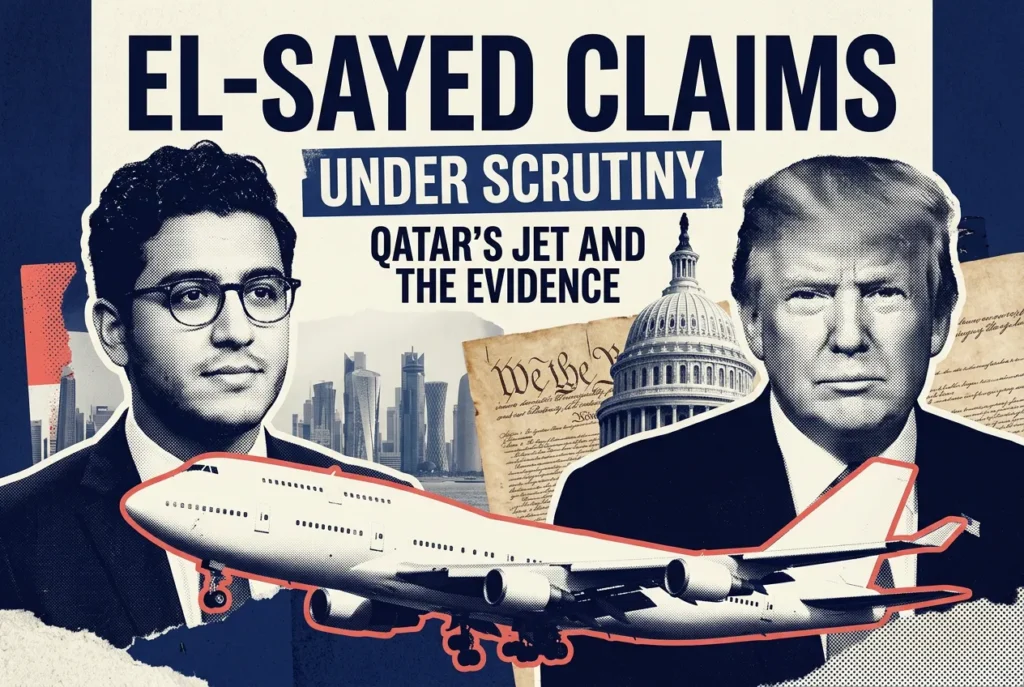
Donald Trump has accused Democratic US Senate candidate Dr Abdul El-Sayed of belonging to the Muslim Brotherhood. At a rally in Michigan on Sunday, 25 October, the president went further, invoking the September 11 attacks while urging voters to reject the Muslim American candidate.
Yet the central allegation has a fundamental evidential problem: no substantiated public evidence has established that El-Sayed is a member or financial backer of the Muslim Brotherhood. He denies the allegation and has explicitly disavowed the organisation. The question is not whether a candidate should face scrutiny, but whether the standards applied to him resemble those applied to the Middle Eastern governments with which Trump maintains close relationships.
That comparison leads from El-Sayed’s political history to Qatar, which supported Egypt’s Muslim Brotherhood-linked government, and Saudi Arabia, whose connections to the financing networks surrounding al-Qaeda have been investigated for decades. It also reaches a luxury aircraft accepted from Qatar and billions of dollars of Saudi investment in a business owned by Trump’s son-in-law.
Trump invokes 9/11 in his attack on El-Sayed
Speaking in Port Huron on 25 October, Trump said he was there to stop a “jihadist, Muslim Brotherhood member” from becoming a US senator. Reuters reported that he compared El-Sayed with the hijackers of United Airlines Flight 93. The Republican candidate, former congressman Mike Rogers, has made related allegations in Michigan’s Senate election campaign.
There is an immediate distinction worth making. The September 11 attacks were carried out by al-Qaeda, not the Muslim Brotherhood. Conflating the organisations, or connecting a candidate to the attacks because he is Muslim, is not evidence of terrorist involvement. El-Sayed, an American-born physician and former public health official, has rejected the allegations and questioned why his religion is being used to challenge his loyalty to the United States.
What evidence is there against Abdul El-Sayed?
The allegations are not entirely without identifiable material behind them, but that material does not prove the claim Trump has made. A Washington Post examination published on 23 October identified a 2011 article by El-Sayed about Egypt’s uprising, a 2012 statement supporting the legitimacy of Mohamed Morsi’s elected presidency, his past leadership of a Muslim Students Association campus chapter, and statements attributed to relatives. It found no evidence establishing that El-Sayed had belonged to the Brotherhood.
Critics have also highlighted donations from individual people associated with Muslim civil rights and religious organisations, including the Council on American-Islamic Relations (CAIR) and the Islamic Society of North America (ISNA). Some donors and organisations have faced disputed allegations concerning links to Islamist movements. PolitiFact examined Rogers’s claims and described his selection of donations and associations as cherry-picking. The involvement of an individual donor with an organisation does not establish a payment from the Muslim Brotherhood to El-Sayed, or from El-Sayed to the Brotherhood.
Another allegation concerns El-Sayed’s birth mother’s employment with the Islamic American Relief Agency, an organisation the US Treasury designated for supporting terrorism in 2004. Michigan Public investigated the claim: court records raised issues about transactions during her employment, but she was not charged with a crime, and the records did not establish that she financed terrorism. A parent’s employment history is not proof of a candidate’s involvement in an organisation.
El-Sayed has denied Brotherhood ties and, when asked at a campaign event whether he would disavow the group, replied: “Sure. Yeah, absolutely.” The relevant distinction is simple: documents establishing membership or financial support have not been produced, even though some of his past statements, family associations and campaign donors can be examined and debated.
The Mohamed Morsi connection explains the Gulf divide
Morsi was Egypt’s first democratically elected president following the 2011 uprising. He came from the Muslim Brotherhood’s political movement and took office in 2012, before the military removed him in July 2013 amid large protests. El-Sayed’s 2012 statement supporting an elected president’s legitimacy has been cited against him. But endorsing a democratic outcome is not automatically endorsing the winning politician’s organisation, and it does not demonstrate that someone funded that organisation.
It is here that the history of Qatar and Saudi Arabia matters. A US Congressional Research Service account records that Qatar supported Morsi’s government and reportedly provided as much as $5 billion in assistance. It also describes Qatari support for Brotherhood-linked factions in Libya. The figure refers to assistance to Egypt’s government; it is not proof of a $5 billion transfer directly into Brotherhood coffers. Nor does it establish that Qatar is presently the movement’s largest source of finance.
Saudi Arabia took a different position. Alongside the United Arab Emirates, it strongly backed the military removal of Morsi and then supported the replacement Egyptian authorities. Saudi Arabia has treated the Brotherhood as a domestic political threat and has banned it. It would therefore be inaccurate to describe today’s Saudi government as a leading Brotherhood sponsor merely because both are based in the Middle East.
Trump’s own Egyptian relationship offers another useful distinction. In April 2017 he warmly welcomed President Abdel Fattah el-Sisi, the former military leader who had removed Morsi, declaring that the United States and he personally stood behind Sisi. Contemporary reporting recorded Trump’s praise. There is no comparable basis for claiming Trump supported Morsi. The relevant comparison is between the evidence used to accuse El-Sayed and Trump’s willingness to work with governments involved in the region’s Islamist political conflicts.
Trump condemned Qatar’s terrorism funding. Then came the jet
On 9 June 2017, Trump was unequivocal about Qatar. Speaking at the White House, he said the Gulf state had historically funded terrorism “at a very high level” and demanded an end to such financing. His words are preserved in the official White House transcript. Qatar rejected accusations that it sponsored terrorism and has also been a significant US military and diplomatic partner. The president’s 2017 accusation did not, by itself, prove that Qatar financed every organisation later mentioned in this debate.
By May 2025, the US Department of Defense had accepted a luxury Boeing 747 provided by Qatar for presidential use. The plane was refurbished and Trump began flying aboard it in July 2026, according to Reuters. It is commonly described as a $400 million gift, although the headline valuation does not establish what a used aircraft of that age would have fetched on the market. The gift was to the US government, not a $400 million cash payment to Trump personally.
That legal distinction does not remove the questions about who benefits. Trump promoted the aircraft, used it as presidential transport and repeatedly suggested that it would eventually be transferred to his presidential library. But ownership after his presidency is not settled. On 6 August 2026, ABC News reported a White House official saying no final decision had been made. Claims that Trump has already taken personal ownership, or will definitely keep flying the jet privately, go beyond the verified facts. Its proposed library transfer, potential cost to American taxpayers and security implications nevertheless raise legitimate questions about accepting such a substantial gift.
There is a clear shift in the record: in 2017 Trump publicly condemned Qatar over alleged terrorism finance; later he accepted and used an aircraft from the same government. Diplomatic relationships can change, and the president has subsequently praised Qatar’s cooperation. The shift is documented even though it is not evidence that Trump has personally financed the Muslim Brotherhood.
Why Saudi Arabia and 9/11 belong in this story
At his Michigan rally, Trump invoked September 11 while attacking El-Sayed. Yet the established history of those attacks points elsewhere. According to the FBI, 15 of the 19 hijackers were Saudi nationals. They were al-Qaeda operatives. Their nationality does not prove that the Saudi state directed or paid for the attacks.
The 9/11 Commission described Saudi Arabia as fertile ground for al-Qaeda fundraising, including through wealthy private donors and charities with insufficient oversight. Crucially, the commission said it found no evidence that the Saudi government as an institution or senior Saudi officials funded al-Qaeda, and no evidence that a foreign government financed the specific 9/11 operation. Its findings therefore do not justify saying as established fact that the Saudi government paid for September 11.
That is not the end of the matter. Families of the victims have pursued a long-running civil case alleging that Saudi-linked individuals assisted two hijackers, including allegations concerning Omar al-Bayoumi. Saudi Arabia denies responsibility. On 7 October 2026, an American appeals court heard arguments about whether the families’ case could proceed towards trial. CBS News reported that the judges had not yet decided the issue. These remain serious allegations under legal examination, not a final judicial finding against the Saudi government.
The distinction matters because Trump’s rhetoric connects El-Sayed to the tragedy without establishing a factual link. By contrast, Saudi-based fundraising networks, the nationality of the hijackers and allegations involving Saudi-linked individuals are part of the documented historical record, even though state responsibility is disputed.
Trump’s praise for Saudi leaders and Kushner’s $2 billion investment
Trump has nevertheless made strengthening ties with Saudi Arabia a central part of his Middle East policy. When he hosted Crown Prince Mohammed bin Salman at the White House on 18 November 2025, he called the prince a close friend and praised his leadership. The recorded remarks include Trump’s praise for Saudi achievements on human rights, while the White House announced defence and investment agreements. Those are foreign-policy relationships, not proof of sympathy for al-Qaeda or the Brotherhood.
There is also an identifiable private financial relationship close to the president. Saudi Arabia’s Public Investment Fund committed $2 billion to Affinity Partners, the investment firm established by Trump’s son-in-law and former White House adviser Jared Kushner. A 2024 US Senate Finance Committee investigation documented the investment and fees charged to the Saudi fund. The committee, led at the time by Democrat Ron Wyden, questioned potential conflicts and the use of foreign funds; those concerns were allegations and oversight findings, not criminal convictions.
The questions are still current. In March 2026, Democratic lawmakers sought information about potential conflicts between Kushner’s fundraising from Gulf states and his role in US Middle East discussions. Affinity is a private investment business, and investment capital is not the same thing as money paid directly to Trump. No corrupt exchange involving those funds has been established by the material cited here. Nonetheless, the transactions are documented, and so is the political access that makes their scrutiny important.
El-Sayed himself drew attention to the contrast. Reuters reported on 25 October that, while rejecting Trump’s allegations, he pointed to the Saudi backing for Kushner’s fund and the Qatari aircraft. The comparisons do not prove that any of the people involved support terrorism. They do ask why proof of actual financial or organisational wrongdoing appears secondary in one accusation yet essential when other relationships are examined.
What the Constitution requires, and what the evidence does not show
The United States Constitution prohibits religious tests for federal office under Article VI, and the First Amendment protects religious freedom. Those protections do not prevent politicians or journalists investigating a candidate’s real actions, associations or financing. They do mean that being Muslim cannot itself establish disloyalty, membership of an extremist organisation or involvement in terrorism.
There is another part of Trump’s public record worth remembering. In December 2022 he claimed that alleged widespread fraud in the 2020 election could allow the termination of rules, including those found in the Constitution. He later disputed the interpretation that he wanted the Constitution terminated. PolitiFact documented both statements and the lack of evidence for the election-fraud premise.
The strongest conclusion does not require assuming guilt on either side. Trump has made explicit claims about Abdul El-Sayed’s Brotherhood membership without substantiating them. Qatar’s historical backing of a Brotherhood-linked Egyptian government, the Qatari aircraft, Saudi-linked 9/11 questions and the Saudi investment in Kushner’s firm are separately documented, but none proves that Trump himself backs the Brotherhood or that Saudi Arabia financed 9/11.
The test is consistency: if association, money and loyalty are serious enough to raise against an American Senate candidate, the same care with evidence and the same scrutiny of financial relationships should apply to the president and the governments with which he deals.
Sources: Reuters, Michigan rally, 25 October 2026; Washington Post, El-Sayed claims; PolitiFact, debate fact-check; Michigan Public, family allegations; Congressional Research Service, Qatar and Egypt; White House transcript, Qatar remarks; ABC News, future of aircraft; 9/11 Commission; FBI investigation; CBS, 7 October Saudi litigation; Trump’s remarks on Mohammed bin Salman; Senate Finance Committee, Kushner investment; Congressional inquiry, March 2026; US Constitution.