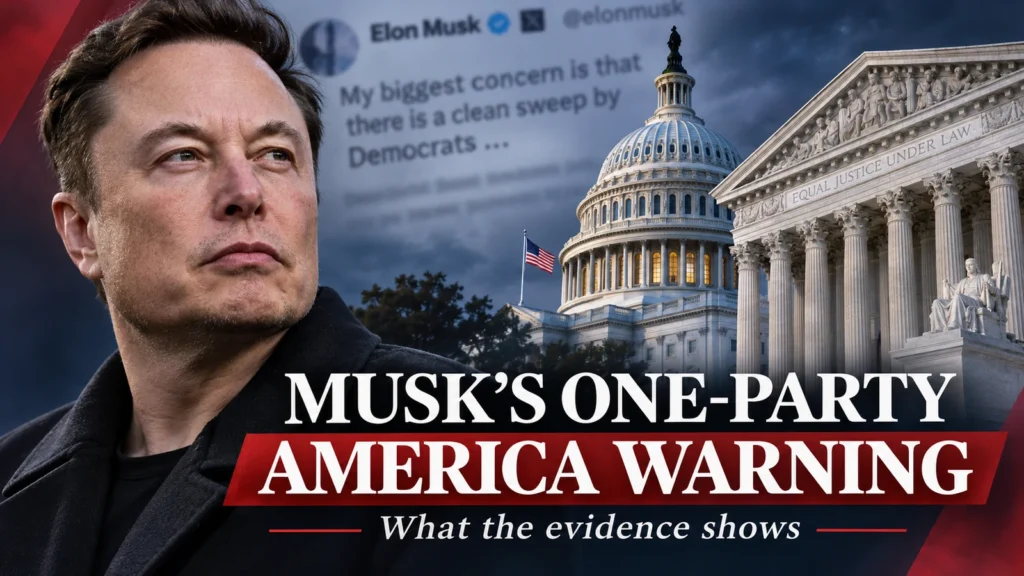
Elon Musk has warned that a Democratic takeover of the White House and Congress in 2028 could end meaningful democracy in the United States. His warning refers to real political proposals, but his prediction of a permanent one-party state is not established by the evidence.
Writing on X on 30 October, ahead of the 3 November 2026 midterm elections, the billionaire urged voters to elect Republican senators. He identified three feared developments: statehood for Washington DC and Puerto Rico, a sweeping immigration legalisation programme and an expansion of the Supreme Court. He later said it would be “game over for America”. Read Musk’s original post on X.
The timing matters. Senators elected this November will normally serve six-year terms through January 2033, and would still be serving when a president elected in 2028 takes office. But a hypothetical Democratic victory in 2028 would not itself enact any of the measures Musk lists. European Parliament election briefing.
1. Could DC and Puerto Rico become states?
There is a genuine Democratic policy basis for part of this claim. The party’s 2024 platform unequivocally supported Washington DC statehood, while backing a process for Puerto Ricans to determine their political status. The platform is evidence of the party’s position at that time, not proof of what a future Democratic administration would do in 2029.
Puerto Rico’s certified 2024 status vote gave statehood 58.61% of valid votes cast among three options. The vote was non-binding: admission as a state requires action by Congress. Statehood advocates point to the lack of voting representation in Congress for residents who are US citizens. Opponents dispute the constitutional and political implications of admitting DC, and both territories’ futures remain contested.
If both became states, four additional Senate seats would be created. Yet Musk’s assumption that all four would deliver enduring Democratic control is unproven. Puerto Rican politics do not map neatly onto mainland party lines: the island elected Republican-affiliated governor Jenniffer González Colón in 2024, while its resident commissioner is Democratic-affiliated Pablo José Hernández Rivera. Certified election analysis.
Washington DC statehood also raises specific questions about the federal district and the Constitution’s 23rd Amendment, which provides presidential electors for the district. Congressional Research Service analysis.
2. Would legalising undocumented migrants create a permanent voting majority?
Musk predicts Democrats would open the borders and give legal status to everyone living in the country unlawfully. The published Democratic platform supports border enforcement and some pathways to citizenship. The party also currently says it believes in secure borders. Those positions do not amount to a commitment to open borders or instant legalisation of everyone. Democratic Party policy statement.
More fundamentally, legal immigration status and US citizenship are not the same thing. US government voting guidance explicitly states that non-citizens, including lawful permanent residents, cannot vote in federal elections. For many applicants, naturalisation requires five years as a permanent resident, alongside other conditions. US government naturalisation guidance.
A future Congress could debate immigration reforms, but neither a blanket legalisation programme nor a resulting permanent Democratic electoral majority has been established. The claim conflates a possible change in immigration status with the separate legal requirements for voting.
3. Could Democrats expand the Supreme Court?
This concern also has an identifiable legislative foundation. In May 2026, Democratic Representative Al Green introduced H.R. 8647, a bill proposing to increase the number of Supreme Court justices from nine to 13. The measure was referred to the House Judiciary Committee and had not become law at the time of Musk’s post.
The Court currently consists of one chief justice and eight associate justices under 28 USC §1. Congress can legislate on its size, although proposed expansion is disputed, including among Democrats. Introducing a bill is not evidence that all party lawmakers would support it, or that a Democratic government would enact it.
Would 51 Republican senators be decisive?
A Republican Senate majority could block legislation supported only by Democrats. But Musk’s suggestion that 51 seats are all that is needed omits how Senate voting works. Most contested ordinary bills face a 60-vote threshold to end debate under the filibuster, unless the chamber changes its rules. A simple majority can, however, determine control of the chamber and handle other matters. US Senate explanation.
Nor would any combination of additional states, immigration reform and court appointments automatically prevent competitive elections. The longer-term consequences would depend on the actual laws passed, constitutional constraints, court decisions and future voters. Calling the outcome a permanent one-party state goes beyond what the available evidence proves.
What about the issues voters face now?
Musk’s warning asks voters to prioritise a scenario two years ahead. There are also immediate policy disputes over healthcare, prescription costs, abortion restrictions and public safety. Those disputes can be examined without assuming they explain every voter’s choice.
On healthcare, a Congressional Research Service summary of the Republican-backed 2025 reconciliation law cites a Congressional Budget Office estimate that its health coverage provisions will leave 10 million more people uninsured by 2034 than projected under the previous baseline. Republicans have argued that stricter eligibility and programme rules are needed to control costs and improper enrolment. Meanwhile, KFF reports that the expiry of enhanced Affordable Care Act tax credits has increased what many marketplace customers pay.
Prescription pricing is more complicated than a claim that all prices are rising or falling. The Trump administration has pursued voluntary manufacturer agreements aimed at reductions, while a temporary subsidy for some Medicare Part D plan premiums is ending for 2027, potentially increasing premiums for affected beneficiaries. Actual costs vary by medicine, insurance and patient. Peterson-KFF analysis; FactCheck.org.
Reproductive rights are also a live policy divide. KFF’s October 2026 tracker records 19 states with abortion bans or early gestational limits in effect, with varying exceptions. On gun violence, Johns Hopkins analysis of 2024 mortality data records 2,214 firearm deaths among children aged one to 17 that year. Such figures establish the seriousness of policy questions, not that any one politician personally intends harm.
Women’s right to vote is protected by the Constitution’s 19th Amendment. Assertions that Musk wants to abolish that right require evidence of his own position, rather than being inferred from his support for Republicans. Debates over proposed voter-identification rules and their potential effects are distinct from repealing women’s suffrage.
What is established, and what remains speculation?
- Established: Musk posted the warning; Democratic support for DC statehood is documented; a bill to expand the Supreme Court exists; US non-citizens cannot vote in federal elections.
- Not established: That Democrats would immediately legalise every undocumented immigrant, that future Puerto Rican senators would necessarily be Democrats, or that the Supreme Court would be expanded under a future administration.
- Prediction: Musk’s assertion that these developments would permanently end meaningful multiparty democracy is his political interpretation, not an outcome already demonstrated by evidence.
The larger democratic question is not only what a future majority might legislate, but how elected officials respond to citizens’ current concerns. The durability of any party’s support ultimately remains subject to elections, public debate and the institutions that safeguard them.