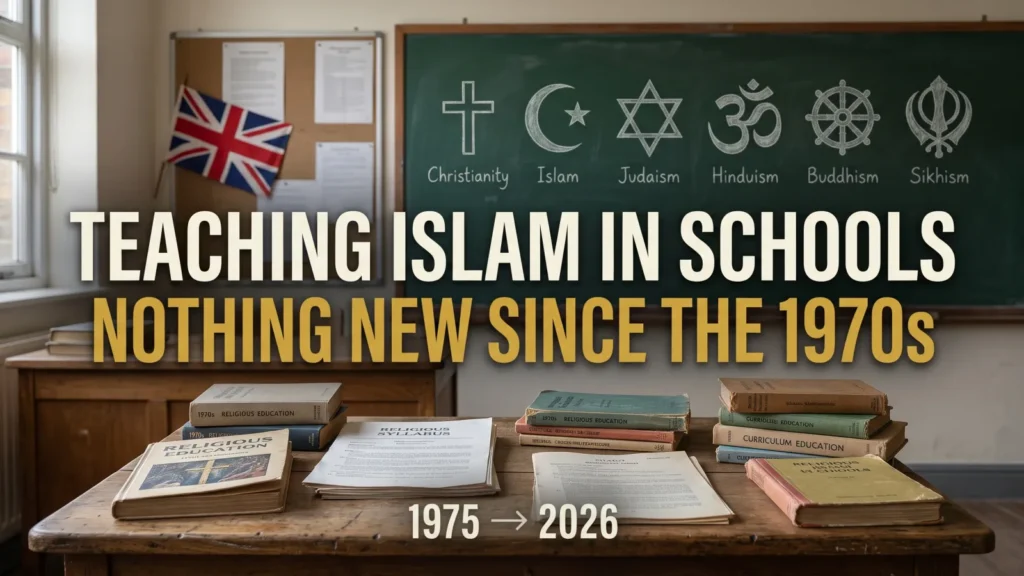
Schools in England were teaching children about Islam alongside Christianity and other religions in the 1970s, decades before the latest online argument about religious education. Parliamentary records from 1976 confirm it.
A social media post featuring a British teenager objecting to lessons about Islam asks whether schools should teach Islam or put “English culture and Christianity first”. But the question overlooks half a century of documented multi-faith religious education in England. Teaching about Christianity and teaching about Islam have not been mutually exclusive.
Parliament was debating Islam in schools in 1976
On 19 March 1976, MPs held a House of Commons debate on religious education. One MP criticised Birmingham’s agreed syllabus for younger children precisely because it included the Christian, Hindu, Jewish, Muslim and Sikh faiths.
This was not a proposal being floated for the distant future. The MP said he had part of the Birmingham syllabus in front of him, including its provisions for children aged three to eight. The discussion is recorded in the official House of Commons Hansard transcript for 19 March 1976.
Birmingham’s multi-faith approach was associated with its 1975 agreed RE syllabus. In other words, Islam and several other religions were part of a documented English school curriculum more than 50 years ago. That does not establish that every school in England taught every faith, because approaches differed between local authorities.
And in 1978, an education secretary defended multi-faith learning
In a parliamentary answer on 13 January 1978, Education and Science Secretary Shirley Williams said religious education could prepare children for life in a multi-faith society, while Christianity should continue to occupy a major part of agreed syllabuses.
Hampshire also adopted a significant new syllabus in 1978. Its approach included studying Christianity and other religious commitments found in British society, and later informed Oxfordshire’s 1981 syllabus. The history is described in an account of agreed syllabus development in Hampshire and Oxfordshire.
The schools and syllabuses differed, but the historical record establishes the essential point: children learning about more than one religion was already a well-established educational approach in parts of England in the 1970s.
What does the law say today?
Section 375(3) of the Education Act 1996 says that locally agreed religious education syllabuses must reflect Britain’s religious traditions as principally Christian while also taking account of the teaching and practices of other major religions represented in Britain.
That is a requirement about religious education content. It does not mean pupils are required to become Muslims, Christians or followers of any other faith. Nor does it mean schools must replace English history or culture with religious education. The exact RE requirements depend on the type and religious character of the school.
Parents also have a statutory right to withdraw their children from religious education, subject to the rules applying to the pupil’s circumstances. Teaching about a religion is different from compelling a pupil to practise it.
Is Christianity being pushed out?
There is no basis in this viral post for claiming that Islam has replaced Christianity in English schools. In its April 2024 religious education subject report, Ofsted found that Christianity was the most frequently studied religious tradition among the schools it visited, with Jewish and Muslim traditions the next most frequently studied overall.
The watchdog did identify significant concerns about the depth and quality of RE in many of the schools it inspected. Its findings came from a sample, not a census of every school. They nevertheless do not support the idea that teaching Islam is a newly imposed replacement for Christianity.
What can be verified about the teenager’s video?
The social media graphic attributes the teenager’s comments to a viral interview, including the claim that he wants to learn about his own culture rather than Islam and the Prophet Muhammad. His words in an interview, if accurately reproduced, are an expression of his view. They are not evidence of what every school teaches.
Fish 4 News has not independently established the teenager’s school, the full circumstances of the alleged dispute or the school’s account. Nor does the screenshot establish that the interview is a new incident. These details should not be presented as confirmed.
The post also cites Euronews, which published a separate fact-check in April 2025 debunking claims that UK pupils were being newly forced to study Islam as a main subject. That article should not be mistaken for independent verification of this teenager’s individual claims.
The verdict
Teaching Islam alongside other religions in English schools is not new. The 1975 Birmingham syllabus, the 1976 Commons debate and the 1978 ministerial statement provide unusually clear historical evidence. Whether this teenager’s particular school handled religious education appropriately is a separate question that cannot be resolved from a short viral clip.
Children can learn about Christianity, Islam, Judaism, Hinduism, Sikhism, Buddhism and non-religious worldviews without being asked to subscribe to any of them. Learning about different beliefs, and critically examining them, has been part of the purpose of multi-faith religious education for decades.