The Environment Agency plans to introduce new permit rules for temporary industrial boilers in England by April 2027, following a consultation that attracted nine responses.
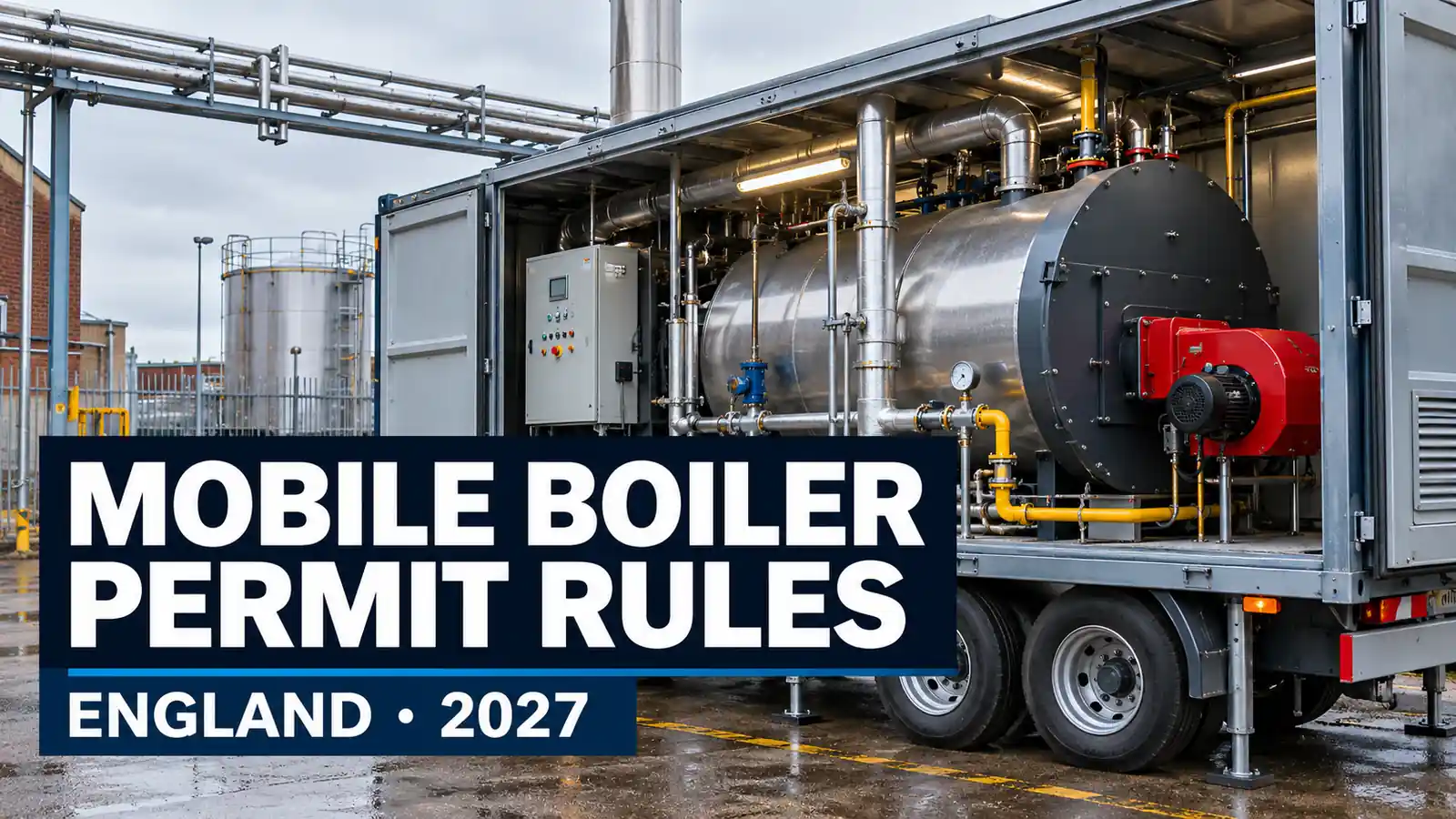
The agency published its consultation response on Friday 20 November 2026. The proposals are intended to make it easier to deploy hired mobile boilers while maintaining controls on air pollution. The rules are not yet in force.
Who would be responsible for mobile boiler permits?
Under the proposed system, owners of mobile boiler fleets would hold environmental permits rather than the businesses hiring the equipment. A single permit could cover a fleet, with individual boilers identified separately.
The consultation, held from 15 June to 30 August, revealed disagreement between boiler owners and hirers. Owners said they cannot fully control how equipment is used at a customer’s site, including operating hours, fuel and location. Hirers, in turn, cannot control the equipment’s maintenance, condition or investment in emissions compliance.
The Environment Agency believes fleet owners are better placed to oversee maintenance and emissions testing, and says this approach would reduce administration and enable faster deployment. It intends to allow fleet changes to be managed through compliance arrangements instead of fresh permit variation applications.
What changes are proposed for temporary industrial boilers?
The proposed standard rules permit, known as SR2026 No 1, is designed for qualifying mobile medium combustion plant used to provide temporary steam or hot water. These are industrial-scale boilers, not ordinary household central heating systems.
- Allow a single permit to cover a fleet of mobile boilers.
- Allow specified like-for-like replacements at regulated facilities without a separate deployment assessment.
- Include hydrogen and liquefied petroleum gas (LPG) among the permitted fuel options.
- Allow horizontal exhaust stacks and certain caps or cowls, where required.
- Permit some longer deployments or replacements with the Environment Agency’s written agreement.
Environmental screening would still be required for relevant deployments. The agency proposes that either boiler owner or hirer could undertake the assessment, but the permit holder would be responsible for keeping evidence.
What about pollution and costs?
Medium combustion plant regulations are intended to control air pollutants including nitrogen oxides, sulphur dioxide and dust. Some consultation respondents raised concerns about wider risks, including oil storage and wastewater. The agency said these are not addressed by the medium combustion plant rules themselves, although other environmental requirements may apply.
Several respondents also questioned compliance costs. The agency says it will retain a proposed two-tier application charging system based on fleet size and expects to audit emissions monitoring and selected deployments. It has not quantified the overall national cost or emissions benefit in the published consultation response.
When would the new rules take effect?
The agency aims to publish the final rules, updated application forms and guidance by 1 April 2027. That is an intended publication date, not confirmation that the rules have already taken effect.
For now, qualifying operators may be covered by the RPS 354 regulatory position statement. This says the agency will not normally take enforcement action for operating without the required permit when specified conditions are met and no pollution or harm is likely. It does not remove the underlying legal requirement to hold a permit.
The existing statement is due for review by 7 July 2027. Separately, the general medium combustion plant requirements contain emissions-compliance deadlines, including 1 January 2030 for smaller existing plant. These should not be confused with the proposed new mobile boiler permit.