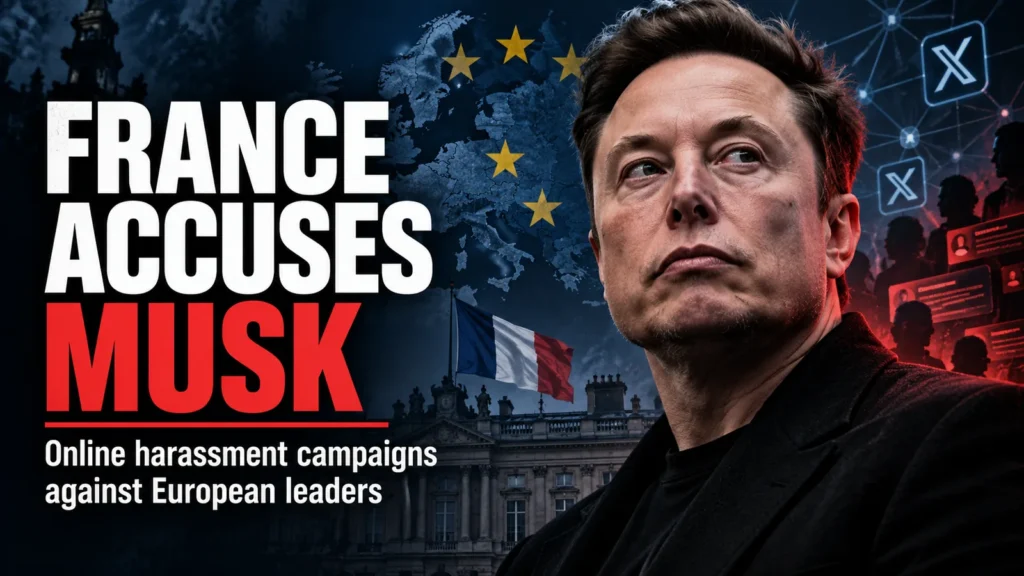
French foreign minister Jean-Noël Barrot has accused billionaire Elon Musk of conducting large-scale online harassment campaigns against European political leaders, alleging that the owner of X is exploiting his platform’s enormous reach to influence national political debates. The accusation comes amid growing concern about foreign interference ahead of France’s 2027 presidential election.
France Warns of Threats to Democracy
Speaking at an Organisation for Economic Co-operation and Development (OECD) conference on 13 October 2026, Barrot warned that democratic institutions were coming under increasing pressure from foreign actors exploiting social divisions and digital platforms.
In his official speech, published by the French foreign ministry, Barrot specifically accused Musk of engaging in what he described as campaigns of mass online harassment against European leaders to influence national debates through his social network’s viral reach.
He placed those allegations alongside wider concerns about disinformation, foreign political interference and attempts to inflame divisions over immigration, secularism and the Israel–Palestine conflict.
With France’s next presidential election scheduled for 2027, Barrot argued that hostile actors were seeking to undermine confidence in democratic institutions.
His remarks represent a serious accusation from one of Europe’s most senior diplomats.
However, the publicly available speech did not identify specific Musk-led harassment campaigns, the European leaders allegedly targeted or evidence establishing that any such activity was coordinated.
That distinction matters. Musk’s direct involvement in European political debates is well documented. Whether that involvement constitutes organised harassment or unlawful interference is a separate question.
Germany: Musk’s Political Influence Is Documented
One of the clearest examples of Musk’s political involvement came ahead of Germany’s February 2025 federal election.
Musk publicly endorsed the far-right Alternative for Germany (AfD), promoted the party on X and hosted an online conversation with its leader, Alice Weidel.
On 25 January 2025, he also appeared by video at an AfD election rally in Halle, addressing thousands of supporters.
His intervention went beyond expressing a passing political opinion. He actively supported a particular party during another country’s election campaign.
But how much difference did his involvement actually make?
Research published in February 2025 by the Atlantic Council’s Digital Forensic Research Lab and AlgorithmWatch provides an important answer.
The researchers found that Musk’s public support significantly increased engagement with AfD content on X, particularly posts from Weidel.
They also discovered that much of the increased engagement came from English-language accounts rather than German-language users.
That suggests Musk’s international audience helped amplify the party’s message well beyond its traditional supporters.
However, the researchers found no evidence of systematic manipulation of X’s recommendation algorithms in favour of the AfD or systematic suppression of anti-AfD accounts.
Their findings show that Musk’s personal influence had a measurable effect on the visibility of political content without establishing that the platform’s algorithms had been secretly altered to favour the party.
It is a distinction that should not be overlooked.
Britain Has Faced Similar Political Interventions
Musk’s involvement has not been confined to Germany.
In Britain, he has repeatedly used X to attack political leaders and comment on contentious domestic issues, including immigration, policing and child sexual exploitation.
In September 2025, Musk addressed a London anti-immigration demonstration organised by far-right activist Tommy Robinson via video link.
During his appearance, he warned that violence was coming and called for Parliament to be dissolved.
British political leaders, including then-prime minister Keir Starmer, condemned the remarks.
Musk has presented his political interventions as an exercise of free expression. Political criticism, including criticism from overseas, is not automatically illegitimate or unlawful.
The controversy arises because Musk is not simply another commentator.
He owns the platform on which he publishes his views, giving him an unusual combination of personal influence, technological control and an enormous international audience.
France’s Protests Become Another Political Battleground
Barrot’s warning also comes against the background of major protests in France.
Demonstrations initially driven by concerns about school conditions, teacher shortages and inadequate educational resources have developed into wider political unrest.
According to The Guardian’s reporting on 14 October, Musk and US president Donald Trump had commented on the protests in ways that placed immigration at the centre of the discussion, rather than the education issues that triggered the demonstrations.
Barrot argued that hostile narratives associated with Russia, China, Iran and the US MAGA movement were exploiting the unrest.
Those claims warrant scrutiny. The existence of misleading online narratives does not, by itself, establish a coordinated foreign operation or demonstrate that every political commentator repeating them is participating in one.
Nevertheless, the episode illustrates how quickly domestic political grievances can become material for international political campaigns.
European Regulators Are Already Examining X
Questions about X’s responsibilities are not confined to political speeches.
In December 2025, the European Commission fined X €120 million for breaches of transparency obligations under the Digital Services Act.
The Commission identified problems involving the platform’s paid verification system, advertising transparency and access to public data for researchers.
In July 2026, the Commission accepted an X action plan designed to address transparency and research-access requirements.
Separately, regulators have continued examining risks associated with X’s recommendation systems and other platform features.
These regulatory proceedings are important, but they must not be confused with evidence proving Barrot’s allegation.
A transparency violation does not establish that Musk personally organised harassment campaigns against European politicians.
What Has Been Established and What Hasn’t?
The available evidence supports several conclusions.
Musk has openly intervened in European political debates. He has endorsed parties, amplified political figures, addressed campaign events and publicly attacked elected leaders.
Independent researchers have demonstrated that his involvement can substantially increase the visibility of selected political figures on X.
European authorities have also identified transparency failures at the platform and have pursued regulatory action.
What has not been publicly established through Barrot’s speech is that Musk orchestrated a coordinated harassment operation against European leaders, deliberately manipulated X’s algorithms to achieve political outcomes or broke election laws through the activities described.
Musk did not respond to The Guardian’s request for comment on the French minister’s accusations.
The Bigger Question: Who Controls Political Influence Online?
The argument is not simply about whether Elon Musk should be allowed to express political opinions.
Like other individuals, he has a right to take positions, criticise governments and support political parties.
The more difficult question concerns the concentration of influence when the person expressing those opinions also owns a major platform through which political information circulates.
The ability to reach millions of people instantly is itself a form of political power, even without evidence of covert manipulation.
For European governments, the challenge is to protect democratic debate from genuine interference without treating disagreement, criticism or unpopular opinions as offences.
For X, the challenge is transparency: providing sufficient independent access to establish how political content is distributed, promoted and moderated.
And for France, Barrot’s allegations raise an obvious question that still requires a detailed answer.
If the government believes Musk has organised harassment campaigns intended to influence European politics, what specific evidence can it make public?
That evidence, rather than the political standing of either Musk or his critics, should determine how seriously the allegation is judged.
Sources
- French Foreign Ministry: Jean-Noël Barrot’s OECD speech, 13 October 2026
- The Guardian: French minister accuses Elon Musk of online harassment campaigns, 14 October 2026
- Atlantic Council DFRLab: The Musk Effect: Assessing X’s impact on Germany’s election discourse
- European Commission: Commission fines X €120 million under the Digital Services Act