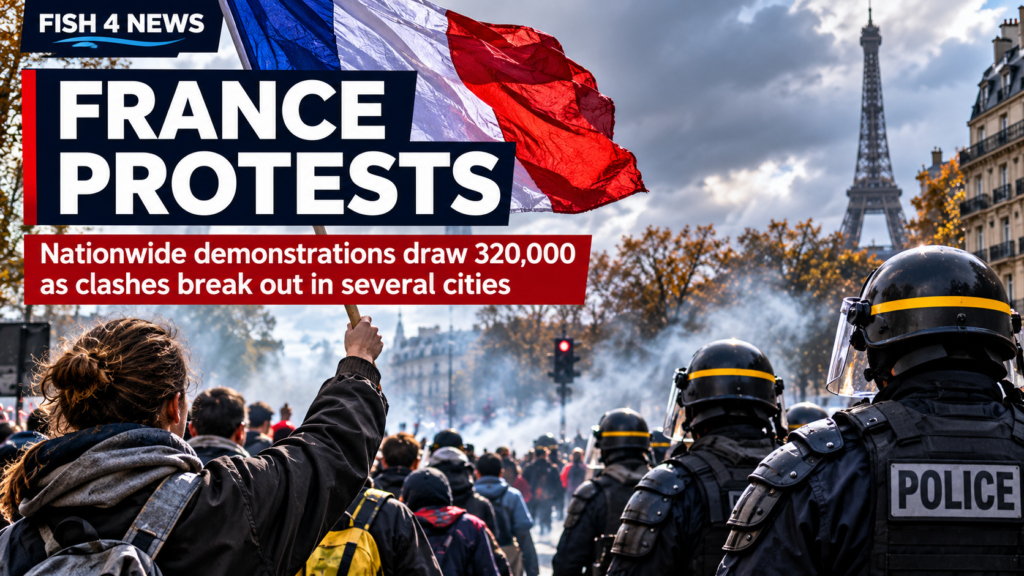
Hundreds of thousands of people demonstrated across France on Saturday 31 October, largely peacefully, before clashes involving smaller groups broke out in Paris and several other cities. Police reported hundreds of arrests, while Paris prosecutors have opened an attempted-homicide investigation following an incendiary attack on officers.
The French Interior Ministry estimated that 320,000 people joined the third consecutive Saturday of nationwide protests, including 70,000 in Paris. Youth and union organisers estimated around 500,000 nationally, including 200,000 in the capital. Neither estimate is an independently verified count.
A Sunday national police account put arrests at 779 across Saturday’s demonstrations and the associated Halloween-night policing. The Interior Ministry reported 565 arrests by 9pm and a further 214 after 9pm. The combined figure must not be described as 779 arrests solely for taking part in protests, and arrests do not establish guilt.
What happened across France
The marches brought together school and university students, trade unions, climate campaigners, Yellow Vest supporters and people protesting against the cost of living and pressure on public services. The great majority of those attending did not take part in violence, according to eyewitness reporting by Reuters, AP and Le Monde.
In Paris, demonstrators marched from Porte de Bagnolet to Porte de Charenton on an approved route along the capital’s eastern side. Clashes erupted near the end of the procession. People threw bottles, paving stones, fireworks and incendiary objects towards security personnel, while police responded with tear gas and dispersal measures. Further confrontations were reported elsewhere in the capital.
Local and national reporting also recorded confrontations after marches in Marseille, Lyon, Toulouse, Grenoble and Bordeaux. In Marseille, police used tear gas as barricades and fires appeared around La Plaine. Marseille police told Reuters on Sunday that there had been 18 arrests and 19 police officers suffered minor injuries. In Lyon, a provisional prefectural account reported nine arrests and five minor injuries, four of them among police. In Toulouse, local reporting described bin fires, use of tear gas and water cannon, with 45 arrests.
These were separate local incidents. Describing every demonstration, or every participant, as part of a nationwide riot would misrepresent the evidence.
Paris prosecutors open attempted-homicide investigation
On Sunday 1 November, the Paris public prosecutor announced an investigation into suspected attempted homicide against public officials following the throwing of incendiary or explosive objects at a group of about 15 gendarmes and police officers near Porte de Charenton. Images circulated of a gendarme’s leg catching fire. The officer later spoke to French broadcasters about the incident.
The Paris police prefecture reported five injured security personnel, four police officers and a gendarme. The precise extent of the injuries was still being clarified. As of the prosecutor’s Sunday statement, nobody had been arrested specifically in connection with the incendiary attack. The opening of an investigation is not a finding that any named person is guilty.
The prosecutor’s 11am Sunday update recorded 105 arrests in Paris associated with Saturday’s events: 88 in connection with the demonstrations and 17 with Halloween-night incidents. Of those arrested, 89 were then in police custody. These Paris numbers form part of the broader situation and must not simply be added to the national arrests figure.
Why are people protesting?
The movement began with pupils raising concerns about neglected school buildings, teacher shortages and France’s Parcoursup university admissions system. It has broadened to include wages, housing, living costs, public services and criticism of President Emmanuel Macron’s government.
On 26 October, education ministers Édouard Geffray and Philippe Baptiste announced a package of proposed changes, including a phased limit of 28 pupils in certain secondary-school classes, 500 additional teaching posts proposed for the 2027 budget and a plan to replace Parcoursup in 2028. Those promises do not mean all the changes have already taken effect. Student organisations said the measures fell short of their demands.
Police deployment and the right to protest
The government deployed approximately 70,000 police officers and gendarmes across France. Authorities restricted some routes and central-city access, citing violence and damage during demonstrations on 17 and 24 October. Paris also imposed overnight restrictions in specified areas amid concern about gatherings after dark.
The restrictions were contentious. Some demonstrators criticised the heavy security presence and argued that police tactics and route restrictions undermined freedom of assembly. The Interior Ministry said its objective was to protect peaceful demonstrations and prevent attacks and looting. Both concerns form part of the story.
What we know and what remains unclear
- Established: Large demonstrations took place on 31 October, most were peaceful and violent confrontations occurred in some cities.
- Official estimate: 320,000 demonstrators nationwide; organisers claimed a larger turnout.
- Reported arrests: Sunday’s figure of 779 included 565 arrests counted by 9pm and 214 further arrests during Halloween-night policing. These are not all necessarily protest-related.
- Under investigation: The Paris incendiary attack is the subject of a criminal inquiry. Responsibility and any subsequent charges are not established by the inquiry itself.
- Not yet final: National injury totals, city-by-city arrest breakdowns and the outcomes of individual detentions may change.
More action planned
French student organisations have called for school blockades after the autumn break, including from Monday 2 November, and further action on Tuesday 3 and Thursday 5 November. Trade unions have also called for demonstrations and strikes on Thursday. These are planned actions, not confirmation that new disturbances will take place.
Saturday’s turnout was lower than the government’s estimates of 550,000 on 17 October and 410,000 on 24 October, but the dispute remains unresolved. Fish 4 News previously reported on security arrangements for 31 October and the demonstrations on 24 October.
Sources
- French Interior Ministry: national security deployment and demonstration arrangements
- French Education Ministry: measures announced on 26 October
- Associated Press: 1 November police and arrest update
- Reuters: eyewitness reporting on 31 October protests
- Le Monde: Paris prosecutor statement and local reporting, 1 November
- Reuters French-language update, 1 November: overnight policing and local figures
- Reported Interior Ministry breakdown: 565 arrests by 9pm and 214 afterwards