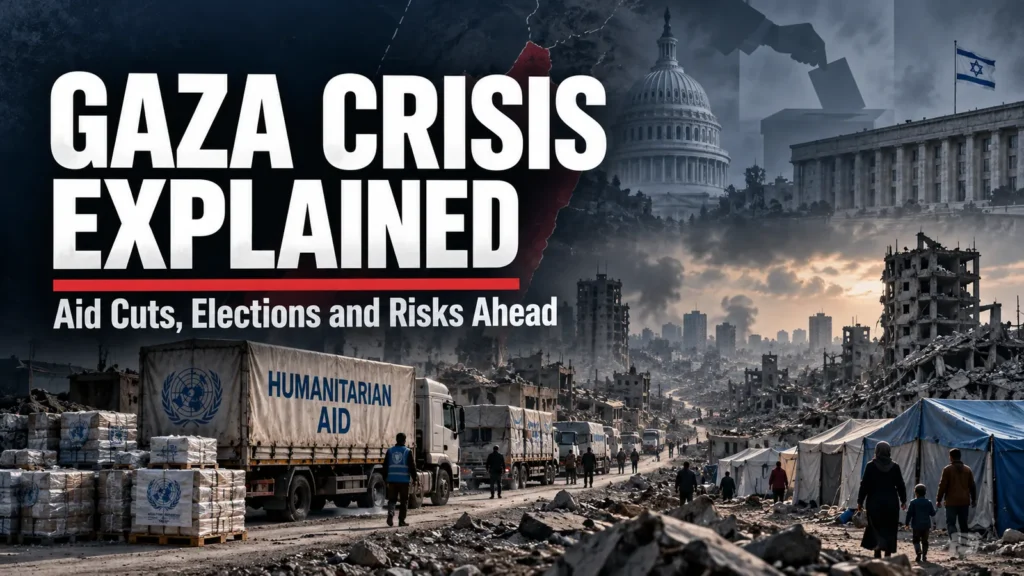
One year after a ceasefire was agreed, Gaza remains devastated by violence, displacement and a deepening humanitarian crisis. With Israel heading to the polls on 27 October and the United States voting a week later, what could the two elections mean for Palestinians, regional stability and the future of international aid?
Gaza remains trapped in a humanitarian emergency despite the ceasefire agreed in October 2025, with continuing Israeli military strikes, severe shortages of food and shelter, and growing uncertainty over the territory’s future. As Israel prepares for a general election on 27 October and the United States approaches its midterm elections on 3 November, the political decisions made over the coming months could have far-reaching consequences for Gaza, the occupied West Bank and international efforts to secure a lasting peace.
A ceasefire that has not ended the violence
The ceasefire that came into effect on 10 October 2025 was intended to provide a pathway towards ending the war in Gaza, securing a more stable security arrangement and eventually allowing reconstruction to begin.
It followed two years of devastating conflict triggered by the Hamas-led attacks on southern Israel on 7 October 2023, which killed approximately 1,200 people and resulted in 251 people being taken hostage.
Israel’s subsequent military campaign caused immense destruction across Gaza. By October 2026, Palestinian health authorities reported that more than 74,000 Palestinians had been killed since the conflict began.
Those figures are attributed to Gaza’s health authorities and have been reported internationally, although the circumstances of individual deaths cannot always be independently established.
The ceasefire significantly reduced the intensity of fighting compared with the preceding war. It has not, however, brought an end to deadly military activity.
On 22 October, Israeli strikes and gunfire killed at least four Palestinians in separate incidents across Gaza, according to local medical officials.
Israeli authorities said the military had targeted Hamas militants in several locations. Israel accuses Hamas of rebuilding military capabilities and violating the ceasefire. Hamas denies those accusations and says Israel has undermined the agreement.
The following Sunday, 25 October, Palestinian medical sources reported seven more deaths from attacks across Gaza, including strikes involving the Islamic University in Gaza City.
According to Gaza’s health authorities, more than 1,500 Palestinians have been killed since the October 2025 ceasefire began.
These continuing deaths demonstrate the distinction between a reduction in large-scale warfare and a secure, lasting peace.
Read Reuters’ 22 October report on continuing Gaza violence.
Why has the ceasefire not become a permanent peace agreement?
The central disagreement concerns the future governance and security of Gaza.
Israel insists that Hamas must be disarmed and prevented from rebuilding a military organisation capable of attacking Israeli territory.
Hamas has resisted demands to surrender its weapons under the arrangements proposed so far.
Questions surrounding Israeli military withdrawal, the future administration of Gaza, border controls, reconstruction and the security guarantees required by both sides remain unresolved.
The ceasefire agreement envisaged a transition towards a more permanent settlement, but implementing that transition has proved exceptionally difficult.
One of the greatest obstacles is the absence of a fully agreed political framework for governing Gaza after the conflict.
Who would administer its institutions? Who would provide policing and security? How would reconstruction funding be controlled? What guarantees would prevent further hostilities?
These are not merely administrative questions. They concern competing claims of security, national rights, sovereignty and political legitimacy.
Without agreements on these issues, humanitarian assistance continues to operate alongside an unresolved military and political confrontation.
Gaza’s humanitarian crisis is getting worse
Even in areas where fighting has diminished, conditions for civilians remain extremely difficult.
Homes, hospitals, schools, roads, sanitation facilities and water infrastructure have suffered extensive damage.
Large numbers of families remain displaced, many living in tents, temporary shelters or damaged buildings.
On 19 October, the United Nations Office for the Coordination of Humanitarian Affairs (OCHA) published an assessment highlighting the scale of the approaching winter emergency.
Its findings included:
- Approximately 950,000 displaced people living in sites at medium or high risk of flooding.
- More than 400,000 people living in locations assessed as being at high risk of flooding.
- Around 294,250 families requiring assistance with winter shelter.
- Available supplies sufficient to provide only partial assistance to approximately 18% of those families.
- Approximately 44,000 people living in more than 2,300 structurally unsafe buildings.
For families already displaced multiple times, the arrival of winter brings another threat.
Rainwater can flood temporary camps, damage bedding and essential supplies, contaminate water sources and increase the risk of illness.
Meanwhile, buildings weakened by repeated bombardment may remain dangerous even when there is no active fighting nearby.
The International Organization for Migration estimates that approximately 1.98 million people across Gaza require shelter-related assistance.
The figures underline a significant point: ending military operations would not immediately end Gaza’s humanitarian emergency.
The physical damage will take years to address, even under favourable political and economic conditions.
Read the UN OCHA humanitarian situation report, published 19 October 2026.
World Food Programme cuts assistance to half a million people
Another major deterioration was confirmed on 19 October.
The United Nations World Food Programme (WFP) announced that funding shortages had forced it to reduce food assistance across Gaza by approximately one-third.
The number of people receiving its food and cash assistance has fallen from around 1.6 million to 1.1 million.
That means approximately 500,000 fewer people receiving assistance from the programme.
The cuts are extensive.
WFP has halved food rations, with families now receiving one food parcel instead of two, alongside a smaller allocation of wheat flour.
Its daily provision of hot meals has been reduced from approximately 250,000 to 150,000.
Some households in difficult-to-reach locations will receive hot meals every other day instead of daily.
These numbers describe WFP’s own programme. Other humanitarian organisations also provide meals and food distributions, so they should not be confused with Gaza-wide totals.
The agency says more than 80% of people in Gaza are unemployed and that only one in five children consumes a sufficiently diverse diet.
Food may be available in some markets, but many families lack the income needed to purchase it.
WFP says it urgently requires $450 million to sustain critical operations in Gaza and the West Bank from October 2026 through March 2027.
The funding crisis comes at a particularly difficult time. The agency warns that improvements in food security since the ceasefire could be reversed.
Read the World Food Programme’s official announcement.
Why can humanitarian organisations not simply deliver more supplies?
The problems involve both insufficient funding and restrictions on the movement of goods and personnel.
Humanitarian organisations rely on border crossings, inspection procedures, transport arrangements, permission to move through particular areas and functioning local distribution networks.
Israel says security checks are necessary to prevent weapons or materials that could be used for military purposes from entering Gaza.
Humanitarian agencies argue that restrictions, delays and uncertainty have prevented essential supplies from reaching civilians quickly enough.
Some items needed to repair infrastructure, including machinery and equipment, are subject to particularly complicated approval procedures because of their potential military applications.
OCHA has reported that inspections, cargo handling limitations and coordination requirements continue to slow deliveries.
An additional problem is that bringing supplies across a border does not guarantee they can be distributed safely.
Damaged roads, fuel shortages, security restrictions, local insecurity and the destruction of storage and distribution infrastructure can all interfere with delivery.
The humanitarian situation therefore depends on more than financial donations.
It requires stable access, predictable movement arrangements, functioning infrastructure and sufficient protection for aid workers and civilians.
What is happening in the West Bank?
While Gaza remains the centre of the humanitarian emergency, violence has also escalated in the occupied West Bank.
The latest serious incident occurred on Friday 23 October.
Two Palestinian gunmen killed two Israeli soldiers and wounded three others in a shooting near Hebron. Israeli forces subsequently killed both gunmen.
Israel launched a major military operation, saying it was seeking to dismantle militant infrastructure and prevent further attacks.
By Sunday 25 October, Israeli military officials said forces had operated in more than 400 locations and arrested approximately 40 Palestinians suspected of links to Hamas or Palestinian Islamic Jihad.
Palestinian officials said more than 2,600 people had been displaced in and around Hebron.
The Israeli military has carried out searches, imposed movement restrictions and demolished structures it described as security threats or unauthorised buildings.
Palestinian residents and human rights organisations have challenged the scale of the response and warned about civilian displacement.
Israeli authorities have also announced restrictions affecting Palestinian workers and crossings ahead of the country’s 27 October election.
These measures have disrupted employment, transport and access to essential services.
The Israeli government presents the operation as a response to a deadly attack and a necessary security intervention.
Critics argue that the demolitions and displacement raise serious questions about proportionality and the protection of civilians.
The competing claims require careful scrutiny, particularly where allegations concern collective punishment or the legality of particular demolitions.
Hebron is in the West Bank, not Gaza. The operations should not be described as taking place inside Gaza.
Nevertheless, they matter to the wider political situation because they may influence Israeli electoral debate, increase tension between Israelis and Palestinians, and further undermine trust in negotiations.
Read the Associated Press report on the Hebron operation, 25 October.
Israel goes to the polls on 27 October
Israel’s general election is scheduled for Tuesday 27 October 2026.
It is the first national election since the Hamas-led attacks of October 2023 and comes after years of political division, war and disputes over the government’s responsibility for security failures.
Prime Minister Benjamin Netanyahu leads the Likud party and has governed through alliances with right-wing, religious and far-right parties.
His principal challenger is Gadi Eisenkot, a former Israeli military chief who leads the centrist Yashar party.
Under Israel’s proportional electoral system, parties compete for seats in the 120-member Knesset.
A governing coalition normally requires support from at least 61 members.
Polls indicate a closely divided political landscape, with no guaranteed parliamentary majority for either main bloc.
Even if opposition parties collectively win more seats than Netanyahu’s allies, forming a government may be difficult because of disagreements between those parties.
The election will determine parliamentary representation. Negotiations after the vote will determine who can form a government.
European Parliamentary Research Service: Israeli election briefing.
What do ordinary Israelis think?
It would be misleading to assume that the policies of Israel’s current government represent the views of every Israeli citizen.
The country remains deeply divided over Netanyahu’s leadership, government accountability, the judiciary, military service, security and the events of 7 October 2023.
Recent polling by the Israel Democracy Institute indicates that security and foreign affairs remain especially important to Jewish Israeli voters.
Among Arab Israeli voters, concerns about crime within Arab communities have emerged as particularly important.
Opinions also differ substantially on the future of Gaza, the occupied West Bank and the possibility of Palestinian statehood.
A Reuters investigation published on 25 October found that some traditional Likud supporters were considering voting for Eisenkot, while other longstanding Netanyahu supporters remained strongly loyal to their party.
The report cited Israel Democracy Institute research indicating that approximately 13% of voters remained undecided.
But dissatisfaction with Netanyahu does not necessarily mean support for withdrawal from Palestinian territories or an independent Palestinian state.
Israel’s security concerns have been profoundly shaped by the October 2023 attacks, while Arab Israeli citizens and Palestinian communities in the occupied territories experience the conflict in very different ways.
An election result can therefore reveal public dissatisfaction with a leader without necessarily demonstrating support for an entirely different policy towards Palestinians.
Read the Reuters investigation into Israeli voters, 25 October.
Would removing Netanyahu transform relations with Palestinians?
Not necessarily.
Netanyahu and Eisenkot differ on several significant domestic and territorial policies, particularly the approach to Israeli settlements in the occupied West Bank.
Netanyahu’s existing political alliances include figures who advocate expanded Israeli sovereignty over occupied Palestinian territory.
Eisenkot has opposed certain unauthorised settlement outposts and the proposed E1 settlement expansion.
However, Reuters reported on 22 October that both men oppose the establishment of an independent Palestinian state under current conditions.
Both insist that Hamas must be disarmed.
Both have retained the possibility of further military operations in Gaza if security arrangements fail.
This means an alternative Israeli government could adopt different diplomatic, administrative or settlement policies without necessarily agreeing to a comprehensive Israeli withdrawal or Palestinian statehood.
Coalition partners would also influence the direction of any new government.
Consequently, the identity of Israel’s next prime minister is only one part of the question.
The composition of the government and its eventual policies will be equally important.
Reuters analysis: How a change of Israeli government could affect Palestinian policy.
The US midterms could introduce another major political complication
One week after the Israeli election, American voters will go to the polls on 3 November 2026.
All 435 voting seats in the House of Representatives and a portion of the Senate are being contested.
The outcome will determine whether Republicans retain control of Congress or whether Democrats secure one or both chambers.
That could have important consequences for the relationship between Washington and Israel.
The United States is Israel’s most significant international military and diplomatic partner.
American military assistance, weapons transfers and diplomatic support have played a central role in Israeli security policy for decades.
President Donald Trump has maintained close political relations with Netanyahu and has been involved in diplomatic efforts concerning Gaza.
However, American foreign policy is not controlled by the president alone.
Congress has important powers concerning federal spending, legislation, scrutiny of government decisions and aspects of foreign assistance.
If Democrats take control of either congressional chamber, they could increase scrutiny of the administration’s policies towards Israel and Gaza.
Control of both chambers would give them additional opportunities to shape legislation, hearings and funding negotiations.
But it would not automatically transfer foreign-policy control away from the president.
Trump would remain president, with substantial authority over diplomacy and executive decisions, regardless of which party controls Congress.
Could Congress reduce military assistance to Israel?
Potentially, although doing so would involve legal and political obstacles.
The existing US-Israel military assistance framework covers the financial years 2019 to 2028 and provides for $38 billion in assistance, subject to congressional appropriations.
Congress could scrutinise arms transfers, propose conditions linked to humanitarian access or introduce legislation affecting particular types of military assistance.
Committees could hold investigations into the use of American-supplied weapons and compliance with US law.
But members of Congress would need sufficient support to pass binding legislation, and a presidential veto could prevent proposed changes becoming law unless Congress secured the necessary majority to override it.
Democrats themselves do not hold identical positions on Israel.
Some favour maintaining extensive military cooperation, while others support attaching more conditions to military assistance.
Consequently, Democratic control of Congress would create new possibilities for oversight and legislative action rather than guaranteeing a particular outcome.
A more immediate effect could be increased public debate and pressure over humanitarian access and the protection of civilians.
Chatham House made a similar distinction in its analysis published on 22 October: the midterms could shape the longer-term direction of American policy without immediately changing the president’s approach.
Read Chatham House’s analysis of the US midterms and Israel-Palestine policy.
What happens if Israel and America move in different political directions?
The two elections could produce several different political arrangements.
A Netanyahu-led coalition might continue governing Israel while Democrats control one or both chambers of Congress.
Alternatively, Israel could have a new governing coalition while Republicans continue controlling Congress.
Both countries could also experience simultaneous political changes, or one or both elections could leave significant policy continuity.
The consequences would depend on the policies pursued by the resulting governments and parliamentary majorities.
For example, an Israeli coalition seeking greater international cooperation over reconstruction might find opportunities to negotiate humanitarian arrangements with US lawmakers interested in expanding oversight and assistance.
A government prioritising extensive Israeli military control could face different pressures if Congress attempted to introduce restrictions on assistance.
Neither outcome would automatically settle disputes over Hamas’s disarmament, Palestinian political representation, Israeli withdrawal or the status of the West Bank.
There is also the possibility that the Israeli election produces prolonged coalition negotiations, delaying decisions on important security and diplomatic issues.
These are possible political pathways, not predictions about which parties will win.
Why the wider Middle East matters
Israel and Gaza cannot be considered in isolation from the wider region.
The governments of Egypt, Jordan, Qatar and other countries have important diplomatic or practical roles, particularly in mediation, border arrangements, humanitarian access and regional security.
Tensions involving Iran, Lebanon and other regional actors may also affect Israeli security calculations and American foreign policy.
Any substantial regional escalation could disrupt diplomatic progress, divert attention from Gaza’s reconstruction and complicate humanitarian operations.
Conversely, arrangements that reduce regional hostilities could provide more space for negotiations and long-term economic assistance.
The central challenge is creating an agreement that the parties involved can implement and sustain, rather than simply announcing another temporary reduction in fighting.
What are the risks for international aid volunteers?
With Gaza’s humanitarian needs continuing, international volunteers and aid organisations remain interested in providing supplies, medical assistance and reconstruction support.
However, humanitarian intentions do not remove the dangers of operating in a conflict zone.
For British nationals, the Foreign, Commonwealth and Development Office continues to advise against all travel to Gaza, including its coastal waters.
The government warns that borders may close without notice and that routine British consular assistance is not available inside Gaza.
The risks include renewed military operations, gunfire, unexploded munitions, damaged infrastructure, inadequate medical care and difficulties evacuating during an emergency.
The risks also differ depending on the type of mission.
Aid delivered through established humanitarian channels
International organisations may operate through approved logistical arrangements and established local partners.
Such arrangements can provide professional risk assessments, security procedures and coordination with the authorities responsible for crossings.
However, they do not make operating inside Gaza inherently safe.
Aid flotillas attempting to enter Gaza by sea
A maritime mission seeking to challenge Israel’s naval restrictions carries additional legal and security risks.
The British Foreign Office explicitly advises against entering Gaza by sea, including aboard a humanitarian flotilla.
Israeli forces have previously intercepted flotilla vessels and detained participants.
In April and May 2026, international activists taking part in the Global Sumud Flotilla were detained following Israeli naval interceptions. Some were subsequently deported.
Israel maintains that its naval blockade is lawful and necessary for security.
Flotilla organisers and some governments have challenged the legality of interceptions conducted in international waters.
The legal disputes do not remove the immediate possibility of interception, detention, deportation or confiscation of equipment.
These types of missions should therefore be distinguished from humanitarian deliveries coordinated through established organisations.
Humanitarian work in the West Bank
The West Bank presents a different set of security risks.
Aid workers and visitors may face checkpoints, sudden movement restrictions, violent incidents, military operations or attacks by extremist settlers.
The restrictions imposed around Hebron in October 2026 demonstrate how quickly access conditions can change.
The suitability of a humanitarian visit depends on its precise location, the organisation involved and the security arrangements in place.
Read the latest UK Foreign Office advice for Palestine.
Could Gaza be safer by the end of 2027?
There is no reliable way to forecast the precise security situation more than a year ahead.
However, several broad possibilities can be identified.
Scenario one: A more durable ceasefire and reconstruction
A negotiated agreement establishes more reliable security arrangements, sustained humanitarian access and an accepted framework for Gaza’s administration.
Reconstruction funding increases, border crossings become more predictable and international organisations expand their work.
Even under these conditions, unexploded weapons, damaged buildings and poor infrastructure could remain significant dangers.
Scenario two: Continued instability without full-scale war
The current fragile ceasefire largely continues, punctuated by strikes, clashes and movement restrictions.
Some humanitarian programmes operate, but funding shortages and unreliable access prevent substantial recovery.
This would leave civilians facing prolonged hardship and aid organisations managing persistent security concerns.
Scenario three: Renewed major hostilities
Negotiations fail and large-scale military operations resume.
Border crossings could close, civilian displacement could increase and international aid missions could be suspended or severely restricted.
Regional escalation could make the situation still more complicated.
Scenario four: A broader political settlement
Israeli and Palestinian representatives, supported by regional and international partners, reach a longer-term agreement addressing governance, security, civilian rights and reconstruction.
Such an agreement could provide a more durable foundation for recovery.
It would nevertheless require compromises and implementation measures that have repeatedly proved difficult to achieve.
None of these scenarios follows automatically from the result of either election.
What would need to change before humanitarian travel became safer?
For international humanitarian missions, several practical developments would be particularly important.
First, the ceasefire would need to demonstrate sustained effectiveness rather than simply a reduction in the scale of military operations.
Second, humanitarian crossings would need to function predictably, with dependable arrangements for entry and exit.
Third, established relief organisations would need adequate funding, trained personnel and credible evacuation procedures.
Fourth, hospitals, transport routes, water systems and essential services would need to recover sufficiently to support safe operations.
Finally, official travel advice would need to reflect a meaningful improvement in security.
The passage of time alone would not establish that conditions had become safe.
A mission planned for late 2027 would need a fresh assessment based on the situation at that point, rather than assumptions made during 2026.
The next six weeks could reveal the political direction
Israel’s election on 27 October is the first major milestone.
The US midterms follow on 3 November.
After those votes, attention will turn to the formation of an Israeli government, the organisation of the new US Congress and whether renewed diplomatic efforts produce meaningful agreements.
The next few months will also reveal whether the ceasefire can withstand continuing attacks and whether urgently needed humanitarian funding can be secured.
Meanwhile, Palestinian civilians continue to live with the immediate consequences of the conflict.
For displaced families, the central concerns are food, clean water, shelter, healthcare, education and personal safety.
For Israelis, questions of security, accountability and the possibility of renewed attacks remain prominent.
For international governments, the challenge is finding arrangements that address security concerns while protecting civilians and creating a sustainable pathway towards peace.
The two elections could influence the direction of the conflict, but political change is not the same as peace.
The more meaningful test will be whether the months that follow produce fewer civilian deaths, more reliable humanitarian access, progress towards reconstruction and a political settlement capable of lasting beyond the next election cycle.
Until then, the humanitarian emergency in Gaza remains immediate, while its long-term future remains unresolved.
Primary sources and further reading
- UN OCHA: Humanitarian Situation Report, 15 October 2026, published 19 October
- World Food Programme: Funding cuts force reductions in Gaza assistance, 19 October
- International Organization for Migration: Gaza winter shelter crisis
- Associated Press: Israeli operation in Hebron, 25 October
- Reuters: Israeli election campaign and shifting voter loyalties, 25 October
- European Parliamentary Research Service: Israeli election briefing
- Chatham House: How the US midterms could affect Israel and Palestine
- UK Foreign Office: Palestine travel advice
Reporting cut-off: 25 October 2026. Election outcomes and future scenarios are not presented as established facts.