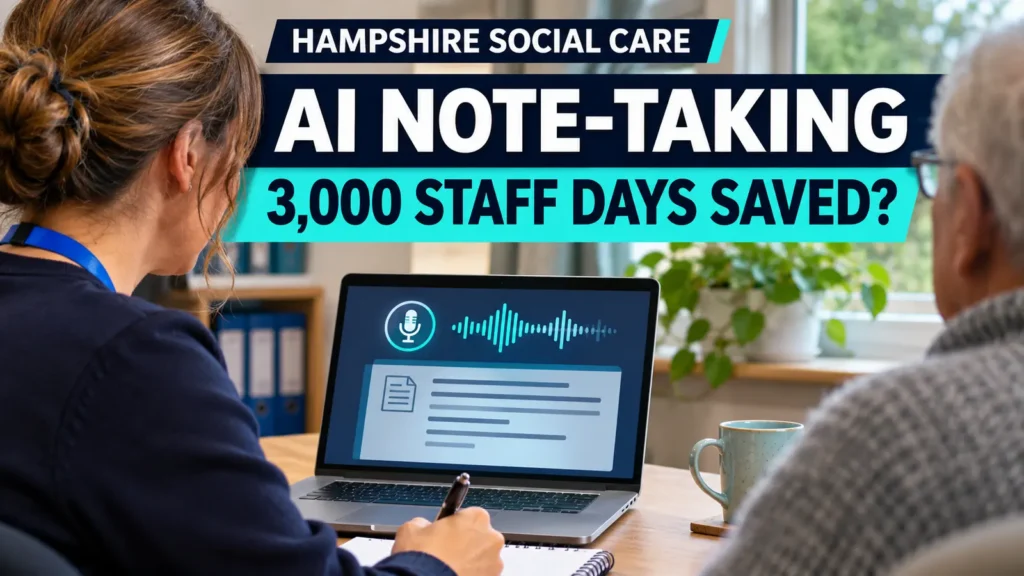
Hampshire County Council says AI note-taking has improved social-care case recording by around 20%, with its own estimates suggesting more than 3,000 staff days could be saved each year. The figures have not established that residents are receiving more face-to-face care.
The council announced on 5 November 2026 that its use of Beam Notes, an artificial intelligence tool that prepares draft case records, had won the Public Sector Partnership Award at the Sovereign AI Awards. More than 1,800 staff across adult and children’s social care are using the system, according to the authority.
That is potentially significant in a sector where paperwork can consume valuable working hours. But there is an important distinction between time saved on recording information and evidence of better care for the people whose conversations are being recorded.
How the AI note-taking system works
With a resident’s consent, social-care practitioners can record conversations using Beam Notes. The software prepares draft case notes and assessments in templates used by the council. Practitioners must check the material before it is filed as an official record.
Hampshire says the technology was introduced at the end of 2025. The award organisers’ account gives 2,387 registered staff accounts and 1,864 active users, following a six-week pilot.
What does the 3,000-day saving actually mean?
Hampshire’s announcement reports an approximately 20% improvement in note-recording productivity and estimates more than 3,000 staff days saved. The award organisers describe that figure as an annual estimate, based on analysis by the council itself.
Neither announcement demonstrates that an equivalent number of additional days has already been spent directly with residents. It also does not provide a published breakdown of the calculation, whether time spent reviewing AI drafts is fully included, or independent evidence of improved care outcomes.
Councillor Roz Chadd, the authority’s Cabinet Lead Member for Children’s Services, said the aim was to strengthen relationships and improve care. Councillor Zoe Huggins, Cabinet Lead Member for Adult Social Care and Public Health, said reducing paperwork should allow practitioners to focus on conversations and relationships with the people they support.
A £450,000 contract for the technology
A public contract award notice shows that Hampshire County Council awarded Beam Up Ltd a contract worth £450,000 excluding VAT on 1 December 2025 for a system described in the procurement paperwork as Magic Notes.
The procurement followed a pilot in adult and children’s services and used the Government’s G-Cloud 14 framework. The published award figure is a contract value, not evidence that the full amount has already been paid. The notice does not specify how much of the council’s claimed staff-time benefit converts into a cash saving.
What independent research says about AI in social care
Research published by the Ada Lovelace Institute in February 2026 presents a more complicated picture. Researchers interviewed 39 social workers across 17 local authorities in England and Scotland. Almost all reported meaningful benefits from AI transcription, particularly less time spent on administration.
But the study also found inconsistent safeguards and examples of inaccurate AI-generated information, including a false reference to suicidal thoughts in one person’s draft case notes. The report does not identify that incident as occurring in Hampshire.
The researchers said evidence remains limited on whether AI transcription actually improves people’s experiences and outcomes in social care. They called for better evaluation, transparency and professional oversight.
What about consent and sensitive personal information?
Conversations in adult and children’s social care can include detailed information about health, families, safeguarding concerns and other highly sensitive matters. Hampshire says recordings are made with residents’ consent and that practitioners review drafts before filing them.
However, the council’s announcement does not spell out how long audio files or transcripts are kept, who can access them, whether they are used to train AI models, or what happens when a resident declines recording.
The Information Commissioner’s Office says organisations handling sensitive personal data must identify an appropriate lawful basis and an additional condition for processing special-category information. Consent to being recorded and the legal basis for processing personal data are related but distinct questions.
The questions that remain
- How was the annual 3,000-staff-day estimate calculated and independently checked?
- Has extra time actually been spent with people receiving care, and has the council measured any improvement in their experience?
- What retention, deletion, access and security rules apply to recordings and AI-generated notes?
- What safeguards apply when someone declines recording or an AI draft contains a material mistake?
- How is the contract’s cost assessed against measurable service improvements?
AI note-taking may give stretched social-care teams more time to do the human part of their jobs. Hampshire’s early figures make that possibility worth examining. The stronger test will be whether residents receive better care, whether the records about them remain accurate and whether their information is protected.
Sources
- Hampshire County Council: AI in social care award announcement, 5 November 2026
- Sovereign AI Awards: Hampshire nomination and judges’ assessment
- Public contract award notice: Magic Notes, Beam Up Ltd, December 2025
- Ada Lovelace Institute: Scribe and prejudice?, February 2026
- Information Commissioner’s Office: special-category data guidance