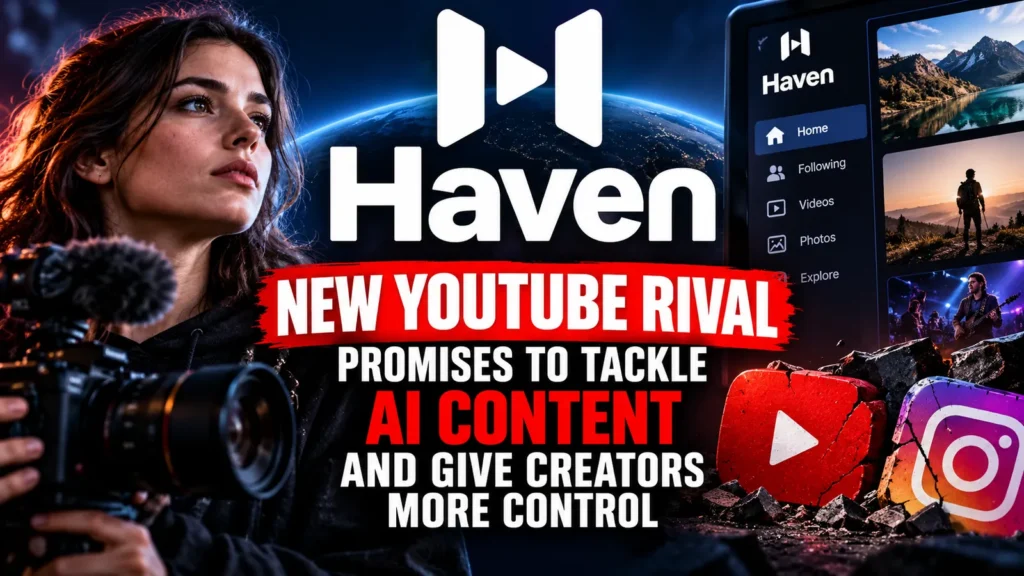
An ambitious new social media platform wants to challenge YouTube and Instagram with stronger privacy protections, transparent algorithms and restrictions on AI-generated content. But can Haven deliver on its promises?
A proposed new social media platform called Haven is attracting attention with plans to challenge YouTube and Instagram, promising greater control for creators, protection against unauthorised AI training and restrictions on AI-generated content. Founded by William Lavelle, the project has already exceeded its $10,000 crowdfunding target, but its ambitious features and planned 2027 launch remain to be delivered.
What is Haven?
Haven is an ambitious attempt to create an alternative to two of the internet’s biggest social media platforms.
The project aims to combine YouTube’s long-form video capabilities with Instagram’s image-sharing features, while changing how content is recommended, moderated and monetised.
Its central argument is that existing platforms have become increasingly hostile to the people who create the material that attracts their audiences.
Creators frequently complain about unpredictable algorithms, unexplained reductions in visibility, copyright disputes and the growing volume of automatically generated content competing for attention.
Haven’s proposed solution is a platform where users have more control over what they see and creators have clearer rules governing how their work is distributed and protected.
The project is outlined on Haven’s official website and its Kickstarter campaign.
A social platform that wants to restrict AI-generated content
One of Haven’s biggest selling points is its opposition to what has become widely known as AI slop: large volumes of low-quality, predominantly AI-generated material produced to attract views and engagement.
Haven proposes restricting this content rather than encouraging its proliferation.
According to the project’s published plans, automated detection would be combined with viewer feedback and decisions made by human moderators.
Users could be asked to assess whether a particular upload is substantially AI-generated, with small rewards available to direct towards creators they support.
However, enforcing such a policy presents considerable difficulties.
AI detection tools can produce false positives, incorrectly identifying genuine human-created material as artificial. They can also fail to recognise generated content.
There is also a distinction between work created predominantly by generative AI and material where AI has been used as an assisting tool.
Haven’s published explanations focus on whether AI-generated material forms the main substance of a post. The practical boundaries of that policy will only become clear when the platform begins operating.
For creators, that distinction could become particularly important.
Protecting artwork from AI training
Haven is proposing something more technically ambitious than simply removing AI-generated uploads.
It wants to make original artwork harder to exploit for unauthorised AI model training.
The platform plans to apply protective alterations to uploaded images, using techniques intended to interfere with the way machine-learning systems interpret them.
Haven says it is currently using a tool called Mist and hopes eventually to incorporate other technologies, including Glaze and Nightshade, subject to licensing.
The idea is that an image would remain recognisable to human viewers while becoming less useful to an AI system attempting to learn from it.
Haven also proposes using facial-recognition protection technology to make images more difficult for surveillance systems to process.
These proposals could appeal to artists, photographers and other creators concerned about their work being collected without permission.
However, such protections should not be mistaken for guarantees.
In June 2025, researchers at the University of Cambridge reported weaknesses in Glaze and Nightshade, demonstrating techniques capable of circumventing existing image protections.
That research was not an independent evaluation of Haven itself, but it illustrates the difficulty of offering lasting protection against rapidly developing AI systems.
Whether Haven can maintain effective defences will depend on continued technical development and independent testing.
Bringing back the chronological feed
Another proposed feature could appeal to users frustrated by the way social media platforms decide what they should see.
Haven intends to give people a choice between an algorithmic discovery feed and a straightforward chronological feed showing posts from accounts they follow.
Its developers also promise to explain how recommendations work rather than leaving creators guessing which factors influence their visibility.
The project says it wants to discourage engagement bait and deliberately inflammatory material by changing the signals used to recommend posts.
For example, it proposes excluding comments from certain engagement calculations and allowing users to remove the recommendation benefit a post might otherwise receive from their interaction.
This approach could reduce the incentive to create outrage simply to attract attention.
It remains an untested proposal, however, and the effectiveness of the recommendation system will depend on how it performs with a substantial audience.
Easier migration from YouTube and Instagram
One of the biggest obstacles facing any new social network is convincing people to move somewhere their audience does not yet exist.
Haven hopes to address part of that problem with tools designed to import existing content from other platforms.
Its plans include transferring images and videos while preserving their original publication dates.
It also wants to help users reconnect with accounts they already follow elsewhere.
If successfully implemented, this could make the initial transition considerably easier.
But importing a library of videos is not the same as transferring an established audience.
Viewers must still choose to join the new service, use it regularly and engage with the creators they follow.
There are also practical questions about access to other platforms’ data, permissions and technical restrictions.
Those issues may prove just as important as the migration software itself.
Can creators earn money on Haven?
Haven’s proposed business model includes several ways for content creators to generate income.
These include advertising, subscriptions, direct audience support and sponsorship arrangements.
The project has also outlined plans for more creator-friendly copyright decisions and human involvement in monetisation disputes.
It has proposed retrospectively compensating eligible creators for qualifying views accumulated before they were formally accepted into its monetisation programme.
That could be attractive to smaller creators who struggle to earn money while building an audience.
But none of these payment arrangements has yet been demonstrated at scale.
Creators will need clear information about revenue sharing, eligibility requirements, payment schedules and dispute resolution before they can properly assess the financial benefits.
Crowdfunding success – but can Haven afford to compete?
Haven’s latest Kickstarter campaign launched on 13 October 2026 with an initial funding target of $10,000.
By 21 October, crowdfunding tracker BackerKit was reporting approximately $124,000 pledged by more than 1,500 supporters.
The campaign is scheduled to close on 12 November.
That represents considerable early interest, although the funding totals may continue to change.
Haven previously cancelled an earlier Kickstarter campaign after it became apparent that the fundraising target would not be reached.
The team says it subsequently revised its marketing approach, expanded its mailing list and worked more closely with content creators to promote the relaunched campaign.
There is, however, a substantial difference between securing initial crowdfunding support and financing a global video-sharing service.
Video hosting requires considerable infrastructure, bandwidth, storage, moderation and technical support.
Haven’s published FAQ identifies a team of just two people, with plans to recruit further developers.
It also explains that the Kickstarter funding is intended to help move the project towards additional private investment, rather than finance the entire operation.
The company says it wants to become financially self-sufficient quickly and remain privately owned.
Whether it can achieve those ambitions while offering competitive creator payments and strong privacy protections is one of the biggest unanswered questions.
Could Haven face problems with UK online safety laws?
There is another issue that may become particularly important if Haven attracts users in Britain.
The project’s founder has expressed strong opposition to invasive age-verification requirements, arguing that such systems can create additional privacy risks.
Haven’s FAQ discusses resisting mandatory verification where possible, including potentially relocating servers.
However, moving servers abroad does not automatically remove a company’s obligations under British law.
The UK’s Online Safety Act can apply to services based outside the country when they fall within the legislation’s scope.
Ofcom’s guidance makes clear that regulated services must comply with applicable measures designed to protect users, particularly children.
The precise requirements depend on the nature of the service, its content and its assessment of risks to children.
This is not evidence that Haven has breached any law. The platform has yet to launch.
It does mean that its approach to privacy, adult content and age assurance will require careful consideration before a UK rollout.
When will Haven launch?
Haven is not currently available as a fully operational alternative to YouTube or Instagram.
Content creator Justin Bryant, who has examined the proposal, reports that the project’s development roadmap targets a private beta in May 2027, followed by a public launch in August 2027.
These are proposed milestones rather than guaranteed release dates.
The project will need to demonstrate that its features work reliably, its moderation policies can be enforced and its financial model is sustainable.
Could Haven genuinely challenge YouTube?
The fundamental idea behind Haven is not particularly difficult to understand.
Creators want their work protected, their income treated fairly and greater clarity over the systems deciding whether their content reaches an audience.
Viewers want control over their feeds, less unwanted material and confidence that the platforms they use respect their privacy.
Haven has identified genuine concerns and proposed a number of potentially attractive responses.
But creating a successful social network requires more than identifying what existing platforms do badly.
It requires reliable technology, a financially sustainable service and, most importantly, enough active users to make the platform worthwhile for creators and audiences alike.
YouTube and Instagram benefit from enormous existing audiences. That advantage cannot be overcome simply by offering better policies.
For now, Haven is a promising proposal with growing crowdfunding support, rather than a proven competitor.
Its real test will come in 2027, when the project’s ambitious promises must become working features that ordinary users and creators can judge for themselves.
Sources
- Haven – official website and project plans
- Haven Kickstarter campaign and FAQ
- BackerKit crowdfunding tracker (21 October 2026)
- University of Cambridge – research on AI art protection tools
- Ofcom – Online Safety Act guidance
Watch: HUGE New YouTube Alternative Coming Soon
Content creator Justin Bryant discusses Haven’s proposed features, its founder and the challenges involved in launching a new competitor to YouTube.