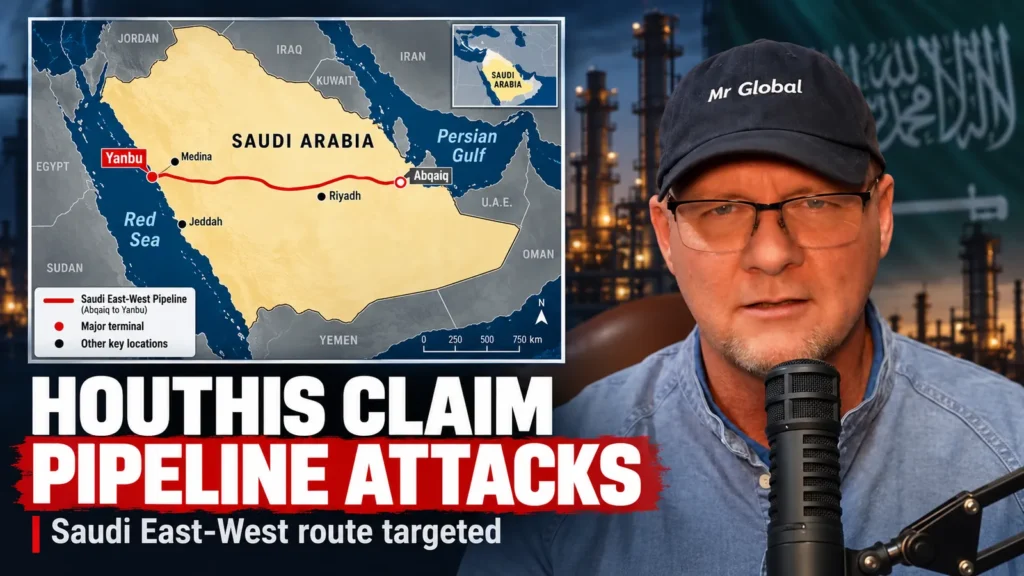
Yemen’s Iran-aligned Houthi movement has claimed responsibility for a series of attacks targeting Saudi Arabia’s East-West Oil Pipeline, crude oil pumping stations and major energy facilities, raising fresh concerns about global oil supplies as fighting intensifies across the Middle East. Saudi Arabia confirmed intercepting missiles on Saturday, 24 October, but has not independently confirmed that the pipeline or other oil installations were damaged.
Latest developments: 26 and 27 October 2026
Tuesday, 27 October: The Saudi-led coalition said it intercepted three Houthi ballistic missiles headed towards Saudi Arabia’s Eastern Region and four drones directed at the Southern Region. Saudi Civil Defence issued early-warning alerts for the Eastern Region and Al Kharj, subsequently saying the danger had passed. These interceptions do not establish damage to the East-West Pipeline.
Tuesday, 27 October: In a separate announcement, the Houthis claimed a ballistic missile attack on the Ras Tanura oil refinery on Saudi Arabia’s Gulf coast and said it caused a fire. Saudi authorities had not confirmed the claimed attack. Reuters separately reported that Bloomberg, citing a person familiar with the matter, said a fire near the Ras Tanura oil terminal had been contained. That report does not independently establish the cause of the fire.
Monday, 26 October: The Houthis claimed further attacks on pumping stations along the East-West Pipeline and on King Khalid International Airport in Riyadh. The Saudi-led coalition said it intercepted a missile directed towards Riyadh and destroyed ballistic missile launchers in Sanaa. Reuters reported no immediate Saudi confirmation of the claimed hits on the pipeline or airport.
Oil market context: Brent crude was trading at $116.26 per barrel at 09:18 GMT on Tuesday, 27 October, according to Reuters. The price reflected competing concerns about regional supply disruption and diplomatic talks; it should not be attributed solely to the latest Houthi claims.
Houthis Claim Attacks on Saudi Oil Infrastructure
Houthi military spokesperson Yahya Saree announced on Saturday that the group had conducted multiple operations against Saudi Arabian infrastructure.
According to the Houthi statement, the intended targets included an oil facility operated by Saudi Aramco at Yanbu, the Rabigh oil refinery, crude oil pumping stations and the East-West Pipeline itself.
The group also claimed attacks against King Khalid International Airport in Riyadh, King Fahd International Airport in Dammam, an airport in Najran and an airbase in Khamis Mushait.
Saree claimed the operations achieved their objectives. However, those claims have not been independently verified.
Reuters reported that the Saudi-led coalition intercepted two ballistic missiles directed towards Yanbu and Taif.
Saudi civil defence authorities also reported debris from intercepted missiles falling in several locations, including Rabigh, Jeddah and areas around Mecca and Medina.
The Houthis denied deliberately targeting the Islamic holy cities, maintaining that their operations were directed against Saudi oil infrastructure and military installations.
Crucially, the Saudi government has not confirmed whether the claimed strikes damaged the pipeline, its pumping stations or the Yanbu and Rabigh facilities.
Why the East-West Pipeline Matters
Saudi Arabia’s East-West Pipeline, also known as Petroline, is one of the most strategically important pieces of energy infrastructure in the Middle East.
Stretching approximately 1,200 kilometres across Saudi Arabia, it transports crude oil from the Abqaiq processing complex in the country’s Eastern Province to the Red Sea port of Yanbu.
The pipeline allows Saudi Arabia to export oil without sending tankers through the Strait of Hormuz, the narrow shipping passage between Iran and Oman that has experienced severe disruption during the regional conflict.
According to the US Energy Information Administration, the pipeline system has an expanded capacity of approximately seven million barrels per day.
Not all that capacity is available for exports, and maximum theoretical throughput should not be confused with the amount of oil actually moving through the system.
Nevertheless, the pipeline has become particularly important as Saudi Arabia seeks alternative routes to international markets.
If attacks were to disable key pumping stations, the consequences could extend beyond Saudi Arabia.
A prolonged interruption would reduce the country’s ability to move crude oil to the Red Sea, potentially worsening existing supply constraints and creating further pressure on international oil prices.
September Pipeline Attack Shows the Potential Risk
This is not the first time Saudi Arabia’s East-West Pipeline has faced a serious threat during the current conflict.
On 11 September 2026, the pipeline was temporarily shut down following drone attacks that Saudi authorities said originated from Iraqi territory.
The earlier incident caused damage and injuries and interrupted a major alternative route for Saudi oil exports.
Reuters reported at the time that the pipeline had been transporting approximately four to five million barrels of crude oil per day during the preceding months.
The September attack should not be attributed to the Houthis without further evidence. Saudi Arabia identified Iraq as the origin of the drones but did not establish that the Houthis were responsible.
The US Energy Information Administration subsequently reported that the disruption helped push Brent crude oil prices as high as $131 per barrel on 15 September.
That previous shutdown demonstrates why even an interruption lasting several days can have consequences for global energy markets.
However, there is currently no independently verified evidence that the latest Houthi claims have resulted in a comparable disruption.
Oil Markets Already Under Pressure
Global oil prices were already rising sharply before Saturday’s announcement.
Brent crude futures settled at $116.72 per barrel on Friday, 23 October, an increase of $3.55, or 3.14%, during the session.
According to Reuters’ energy market reporting, the rise reflected growing concerns over Middle Eastern energy supplies, attacks on infrastructure and disruption to shipping routes.
Saturday’s reported attacks came after that settlement and therefore cannot be presented as the cause of Friday’s price increase.
Financial markets in the Gulf nevertheless showed further signs of concern on Sunday.
Saudi Arabia’s benchmark stock index closed 2.7% lower on 25 October, while shares in Saudi Aramco declined by 0.9%.
The wider regional conflict and disruption to shipping routes have contributed to investor uncertainty.
The key question for oil markets is whether the claimed attacks caused measurable damage or reduced Saudi Arabia’s ability to maintain crude oil exports.
Without confirmation of damage or reduced throughput, predictions of another major oil-price increase would be premature.
Further Missile Attacks Reported on Sunday
The security situation continued to deteriorate on Sunday, 25 October, as Saudi authorities reported intercepting additional missiles and drones.
According to Reuters, Saudi air defences responded to threats over Riyadh and several southern locations.
Saudi civil defence officials said fragments from intercepted ballistic missiles injured two people and damaged residential buildings and vehicles around Khamis Mushait and Ahad Rafidah.
Meanwhile, Riyadh’s King Khalid International Airport began partially reopening following an earlier Houthi-claimed attack on 10 October that killed 13 people.
Despite the partial reopening, the Houthis renewed their warning to airlines and travellers against using the airport.
The continuing attacks demonstrate that the fighting extends beyond energy infrastructure and poses risks to civilian transport and residential areas.
How the Attacks Fit Into the Wider Iran Conflict
The latest escalation comes against the backdrop of the wider conflict involving Iran, Israel and the United States.
The Houthis, who control Yemen’s capital Sanaa and substantial territory elsewhere in the country, are aligned with Iran and have increasingly targeted Saudi Arabia during the renewed fighting.
Saudi Arabia has responded with military operations against Houthi positions in Yemen.
The confrontation has disrupted a United Nations-brokered truce that had substantially reduced cross-border hostilities since 2022.
The Houthis have also advanced along Yemen’s Red Sea coastline, increasing concerns about maritime security near the Bab el-Mandeb Strait.
This creates a particularly difficult situation for Saudi Arabia.
The East-West Pipeline offers an alternative to the Strait of Hormuz, but oil exported through Yanbu may still have to navigate threatened Red Sea shipping routes depending on its destination.
With both major maritime corridors affected by regional instability, the security of Saudi Arabia’s overland oil infrastructure has become increasingly important.
There is also concern that further attacks and retaliation could draw additional regional powers deeper into the conflict.
However, reports of possible future US or Israeli strikes against Iran should not be treated as confirmed military plans without independent evidence.
What Remains Unconfirmed?
As of Tuesday, 27 October, despite repeated Houthi claims and confirmed Saudi missile and drone interceptions, several important questions remain unanswered.
There has been no independently verified assessment establishing whether the East-West Pipeline was physically damaged during Saturday’s reported operations.
It is also unclear whether pumping stations, the Yanbu export facilities or the Rabigh refinery suffered operational interruptions.
Saudi Aramco has not publicly confirmed a new East-West Pipeline shutdown arising from the attacks claimed on 24 or 26 October.
Satellite imagery, tanker movements, export figures and official operational statements may eventually provide a clearer picture of the impact.
Until that evidence becomes available, claims that the pipeline has been destroyed, disabled or forced to suspend operations would go beyond the established facts.
A Critical Test for Saudi Arabia’s Oil Exports
Saudi Arabia’s East-West Pipeline has become a vital route for maintaining oil exports during the continuing disruption to Middle Eastern shipping.
The Houthi announcement highlights the vulnerability of infrastructure that has taken on even greater importance during the conflict.
Whether the strikes claimed on 24 and 26 October caused significant physical damage remains uncertain.
What is clear is that the continuing exchange of missile and drone attacks has increased pressure on Saudi Arabia’s energy and transport networks at a time when international oil markets are already sensitive to further disruption.
For global energy supplies, the decisive development will not be the Houthi claim itself, but confirmation of whether Saudi Arabia can continue moving oil through the East-West Pipeline at its previous operating levels.
Sources
- Reuters, 27 October: Saudi coalition reports further missile and drone interceptions
- Reuters, 27 October: Houthis claim Ras Tanura attack
- Reuters, 26 October: Houthis claim further pipeline pumping station attacks
- Reuters, 27 October: Oil prices and regional diplomacy
- Reuters, 24 October: Houthis say they targeted Saudi oil sites
- Reuters, 25 October: Riyadh airport and renewed Houthi threats
- Reuters, 25 October: Gulf stocks decline
- Reuters, 23 October: Oil prices and regional supply fears
- Reuters, 11 September: Pipeline shutdown following drones from Iraq
- Saudi Press Agency, 25 October: Missile debris injuries and damage
- US Energy Information Administration: Oil transport infrastructure
- US Energy Information Administration, October 2026 outlook: September pipeline disruption and Brent prices
Related Video
The video offers commentary on the reported attacks and possible consequences. Claims about damage and future military action have not all been independently verified.