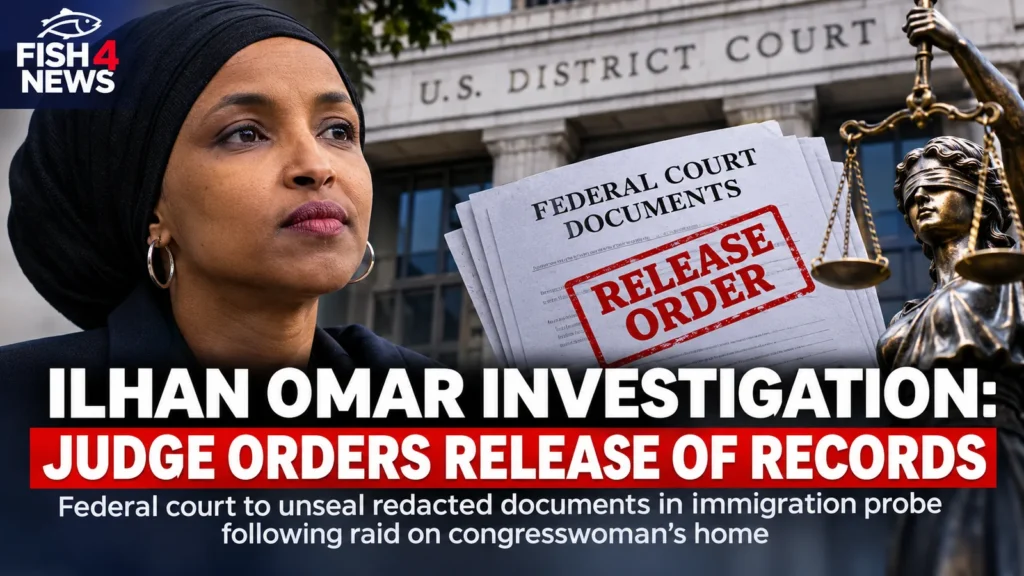
A US federal judge has ordered prosecutors to prepare court records for possible public release following the October search of Democratic Congresswoman Ilhan Omar’s Washington home. The documents could shed light on legal arguments surrounding the investigation, but a 67-page affidavit setting out the evidence behind the search will remain sealed for now.
Chief US District Judge James E. Boasberg issued the order on Tuesday 17 November 2026 following applications by news organisations and the legal group Judicial Watch. The investigation concerns possible immigration fraud involving paperwork connected to Omar and members of her family. Omar denies wrongdoing and has not been charged with a crime.
What the judge has ordered
In an order in case 1:26-mc-00144-JEB, Boasberg instructed the US government to provide the court with versions of the sealed search-warrant records showing proposed redactions by Friday 20 November.
The judge said redacted documents could be placed on the court’s website no earlier than 5pm Washington time on Monday 23 November, provided there is no stay and after the court has spoken to the government about their release.
The order expressly excludes the 67-page search-warrant affidavit, which contains evidence investigators presented to obtain permission to search Omar’s home. Its continued sealing means the public will not yet see the central evidential basis for the warrant.
- 20 November: The government must submit the search-warrant docket documents, excluding the affidavit, with proposed redactions.
- 23 November: The court may publish redacted records no earlier than 5pm Washington time (10pm UK), unless the order is stayed. Prosecutors must also address the treatment of records in a related sealed case.
- 30 November: Applicants may file responses challenging the proposed redactions.
Why federal agents searched Ilhan Omar’s home
Homeland Security Investigations agents searched Omar’s Washington, DC, residence on 12 October, about three weeks before the 3 November US midterm elections. The search was authorised by a federal magistrate judge. Omar subsequently won re-election to the House of Representatives for Minnesota.
According to Associated Press reporting, investigators are examining possible fraud involving the family’s immigration paperwork. AP reported that members of Omar’s family have received grand jury subpoenas. Omar has said agents seized 17 items, including phones, notebooks, a children’s book and a camera.
The allegations being investigated are not findings of guilt. No publicly available court ruling has established that Omar committed immigration fraud, and no charges had been announced as of 18 November.
Why Congress’s constitutional protections matter
The records being considered for release include arguments about the US Constitution’s Speech or Debate Clause. This protects lawmakers from certain executive-branch scrutiny of their legitimate legislative work. The protection does not give members of Congress blanket immunity from criminal investigation.
The question in this case is whether investigators properly protected material connected with Omar’s work as a congresswoman when seeking and carrying out the search warrant.
At Tuesday’s hearing, Boasberg questioned why legal filings about these safeguards should remain secret when the government has already acknowledged the investigation. Justice Department lawyers argued that wider disclosure before any charging decision could jeopardise investigative interests and affect the reputations of people involved.
What Ilhan Omar and the government have said
Omar, who came to the United States as a refugee from Somalia and became an American citizen in 2000, has rejected accusations of immigration wrongdoing. In comments reported by Minnesota Public Radio, she said: “I’m confident in the fact that I didn’t do anything wrong.”
She has described the investigation as politically motivated. Her lawyers have separately disputed aspects of how the search was conducted. The Justice Department rejects allegations that agents breached the judge’s restrictions, and said the search was approved by the attorney general and was not timed to influence the election.
President Donald Trump and senior administration officials have publicly raised allegations about Omar’s immigration status. Their statements do not establish whether a criminal offence occurred.
What the public may learn next
The first released documents may identify the legal issues considered by the court, the scope of the warrant and the precautions intended to safeguard congressional material. They may not establish the underlying facts of the immigration allegations.
The government could seek to delay publication by asking a higher court for a stay. Further decisions may be required over redactions and whether other documents can be disclosed.
F4N previously reported on the Trump administration’s scrutiny of Omar’s citizenship and the questions raised by an earlier 2019 review. The 17 November order is a separate development in that continuing story.
Watch: KING 5 Seattle reports on the court ruling
Watch the KING 5 report directly on YouTube if the embedded player is unavailable.