Large demonstrations took place across Italy on 30 October during a nationwide general strike over living costs, wages, housing and military spending. Most marches were peaceful, but police and protesters clashed in several cities, with investigations continuing over the weekend.
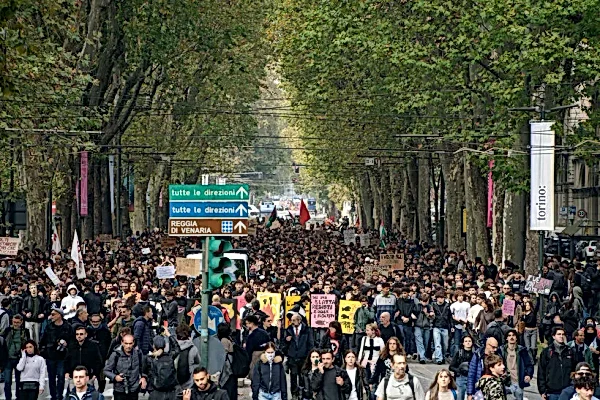
The 24-hour strike was called by the grassroots union Unione Sindacale di Base (USB). Students, workers, pensioners, housing campaigners and other groups joined marches in dozens of cities, including Rome, Milan, Turin, Genoa, Bologna and Naples. The protests opposed policies of Prime Minister Giorgia Meloni’s government as well as economic pressures facing households.
The scale of participation is disputed. Italy’s Interior Ministry counted approximately 255,000 demonstrators, according to ANSA, while USB claimed more than one million. The competing estimates have not been independently reconciled.
Where the protests took place
In Rome, a large march passed through the city centre towards the Colosseum. A smaller group broke away from the main demonstration and confrontations followed near the monument. ANSA reported that objects were thrown at police, rubbish containers were overturned to form barricades and bins and electric scooters were set alight. Further confrontations occurred around central Rome during the evening as police blocked groups seeking access towards government buildings.
In Turin, officers used water cannon and made charges after protesters approached a police cordon near the prefecture in Piazza Castello. There were further tensions later in the city centre.
In Vicenza, a group attempted to occupy the western bypass. Police used water cannon and tear gas following the throwing of smoke devices and fireworks. ANSA reported four injured police officers and three protesters with minor injuries.
Elsewhere, large marches and disruption did not necessarily mean violence. In Milan, demonstrators entered part of the ring road. Genoa saw a major port protest involving workers and students. In Bologna, protesters entered the ring road, but police subsequently said there had been no clashes. Reuters described the nationwide demonstrations as largely peaceful.
What police have said
On 31 October, police in Rome reported that 369 people had been identified and seven formally reported to prosecutors over alleged offences including resisting public officials, concealing identity, carrying objects considered potentially dangerous and obstructing roads.
In Turin, the police headquarters said 256 people had been identified, 11 taken to police offices for checks and 12 reported for alleged offences. Identification, being taken for checks and being formally reported are different procedures and do not necessarily amount to arrests or convictions.
Italian police also announced 60 searches in 23 cities on 31 October. The investigations concerned alleged messages encouraging violence in recent demonstrations through social media and online chats. The authorities have not established publicly that those searched were responsible for particular clashes, and the searches should not be described as 60 arrests.
Before the strike, Interior Minister Matteo Piantedosi convened public-security officials to coordinate policing. The ministry said the operation was intended to protect peaceful protest and isolate those seeking to commit violence. Following Friday’s events, Piantedosi maintained that peaceful demonstrators’ rights had been protected despite incidents involving smaller groups.
Why were people demonstrating?
USB and participating campaign groups raised demands relating to pay, rising prices, affordable housing, public healthcare, education and pensions. They also opposed increased military spending and arms shipments through ports. Not every participant necessarily supported every demand.
The pressure on household budgets is measurable. Italy’s statistics agency ISTAT said on 30 October that preliminary annual consumer-price inflation had reached 5.4% in October, up from 4.2% in September, with energy costs a major driver.
Protests continued into November
Students and activists remained in tents near the Colosseum over the weekend. At a national assembly in Rome on Sunday 1 November, USB announced a further national demonstration for 12 December 2026, calling for continued mobilisation over the cost of living, what it terms a war economy and government policies. ANSA reported the announcement on Sunday afternoon.
What we know and what remains unclear
- The 30 October national strike and widespread demonstrations are confirmed, as are localised clashes in Rome, Turin and Vicenza.
- The overall attendance is disputed, with a large gap between the Interior Ministry’s estimate and union claims.
- Published local police reports detail people identified and complaints referred to prosecutors. A verified nationwide total of arrests and injuries has not yet been established.
- The 60 searches concern alleged encouragement of violence and do not establish guilt or a coordinated nationwide plot.
- There is no basis to assume that demonstrations in other European countries formed a single coordinated movement merely because some happened in the same period.
A separate disturbance at a prison in Trapani on 30 October should not be conflated with the general strike: no evidence reviewed establishes a connection.
Sources and further coverage
- Reuters: nationwide demonstrations on 30 October
- ANSA: city-by-city reporting, turnout estimates and government response
- ANSA: Rome police update
- ANSA: Turin police update
- ANSA: police searches across 23 cities
- ISTAT: October preliminary inflation statistics
- ANSA: 12 December protest announced
- ANSA: city confrontations and injury reports
- ANSA: contemporaneous video reports and live updates