People across Kent are being urged to report suspected waste crime anonymously as the Environment Agency launches a new campaign against illegal dumping and the criminal networks behind it.
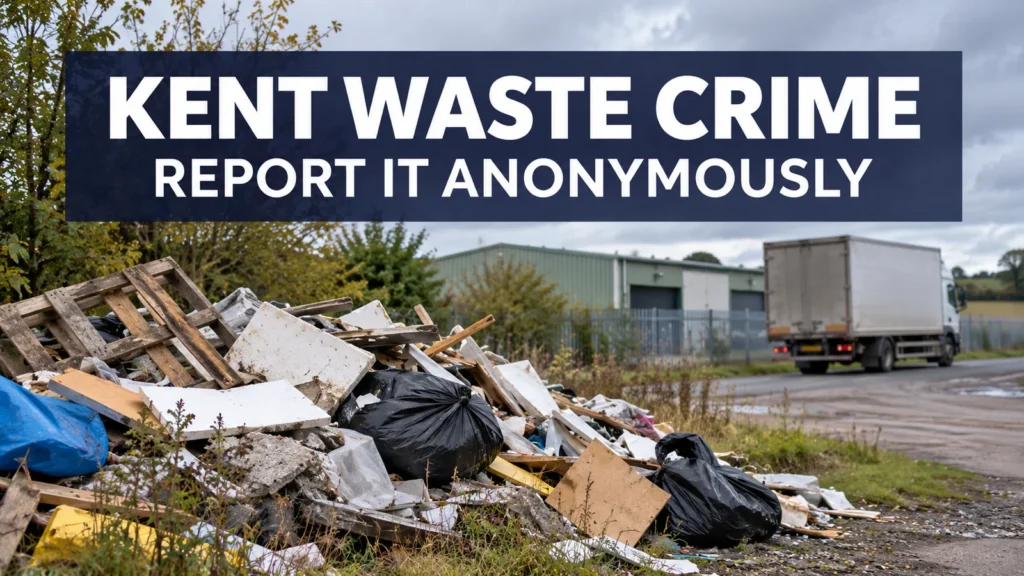
The Eyes on Waste Crime campaign, launched on Monday 23 November, encourages residents to share information about suspicious activity. The agency says fear of being identified may discourage people from coming forward, despite intelligence suggesting substantial levels of offending in Kent.
Warning signs can include waste lorries arriving at unusual times, strong odours and a sudden build-up of rubbish on previously empty land or inside buildings. Such signs are not, on their own, proof of a crime.
Kent County Council is backing the campaign, with its cabinet member for communities and regulatory services, Richard Palmer, encouraging residents to pass information to the authorities.
923 reports across three areas
The Environment Agency’s 2025 reporting heat maps cover the period from 1 January to 31 December 2025. The agency says it received 923 reports across its operational area covering Kent, South London and East Sussex.
That number does not represent 923 separate or proven offences in Kent. The data includes repeat calls about the same site and reports of smaller fly-tipping incidents referred to councils. The maps show the general locations of callers rather than the precise locations of offences.

How a public report helped shut a Ramsgate site
In March 2026, officers investigating reports from the public visited units 26 and 27 at Leigh Road on the Haine Industrial Estate in Ramsgate. The agency announced on 20 March that it had obtained a court order restricting access to the premises.
The agency confirmed on Monday that the restriction is still in force and the investigation continues. The order prevents further unauthorised access, but does not establish anyone’s criminal guilt.
Waste crime costs England an estimated £1 billion a year
The government’s Waste Crime Action Plan cites a £1 billion annual cost to the English economy, based on a 2021 industry estimate. Illegal operators can undercut legitimate businesses while leaving communities and landowners with the environmental damage and clean-up bills.
The 2025 National Waste Crime Survey gathered responses from 764 self-selecting participants, including waste businesses, farmers and landowners. Respondents estimated that around a fifth of waste may be handled illegally and only 27% of waste crimes are reported. These estimates reflect respondents’ experiences and perceptions, rather than a complete count of offences.
On 4 November, Environment Secretary Dame Angela Eagle established the Waste Crime Crackdown Group, bringing together police, regulators and local government. The government reported 36 arrests since April 2026. Arrests are not convictions, and the Kent announcement does not provide a breakdown of case outcomes.
How to report waste crime anonymously
The Environment Agency says residents reporting suspected waste crime through its Kent campaign hotline will have their identities protected.
- Large-scale illegal dumping or suspected illegal waste operations: Environment Agency, 0800 80 70 60 (24 hours).
- Anonymous reports can also be made through Crimestoppers on 0800 555 111.
- Small-scale fly-tipping, such as discarded furniture or a few bags of rubbish, should normally be reported to the local council.
Do not confront suspected offenders or enter a suspected illegal waste site. Full official guidance on reporting waste crime is available on GOV.UK.