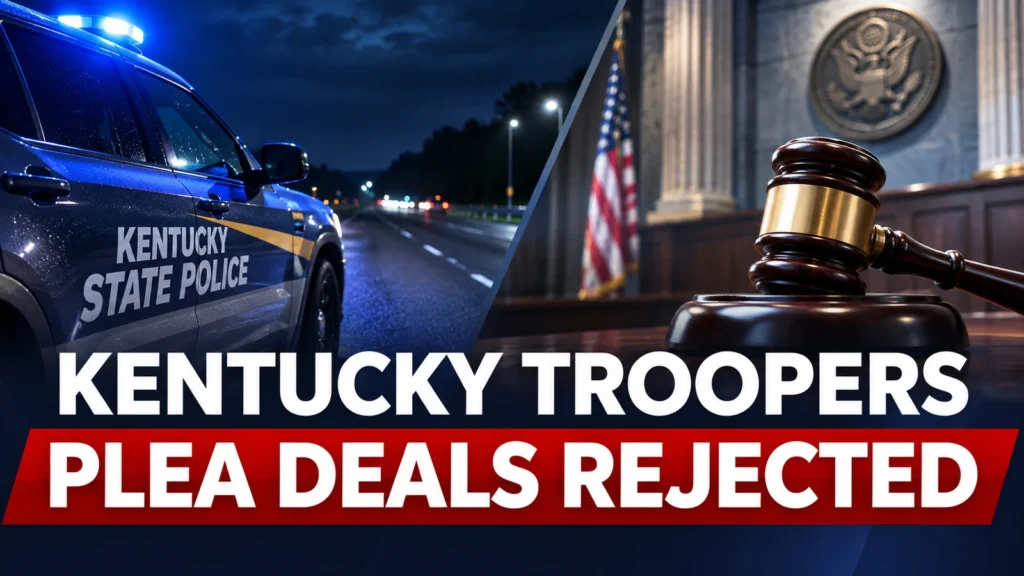
A US federal judge has rejected proposed plea agreements involving two Kentucky State Police troopers in a civil rights case arising from a violent roadside arrest in March 2020.
The decision follows years of questions over how officers treated Justin Halcomb after a police pursuit in Hardin County. Former trooper Thomas Czartorski has admitted using excessive force against Halcomb, while other alleged conduct remains the subject of federal proceedings.
What happened in court
On Monday 16 November 2026, US District Judge Rebecca Grady Jennings rejected Czartorski’s proposed plea agreement. According to WDRB+WAVE’s report of the court records, the judge found that the agreement did not meet federal sentencing considerations. The proposed outcome was expected to involve approximately 30 months in prison.
The broadcaster subsequently reported that a proposed agreement involving James Cameron Wright was also rejected. Wright’s planned sentencing on 16 November did not proceed. Rejecting an agreement should not be confused with overturning a conviction or imposing a new sentence; the precise consequences of the decisions require confirmation from the court’s orders.
A third defendant, Jarrod Lewis, had a status conference listed for 17 November. As of this report, Fish 4 News has not independently confirmed a sentencing outcome for Lewis. The court’s published calendar lists further status conferences on 14 December for all three men. The federal case is United States v. Czartorski et al., 3:25-cr-00030-RGJ.
The arrest that led to the charges
Kentucky State Police’s original March 2020 statement said Halcomb was stopped following a pursuit along Interstate 65 through several counties. Police said the incident began when a trooper observed a speeding pickup truck and attempted a traffic stop. Halcomb was arrested and charged with offences including fleeing or evading police and resisting arrest. The police statement establishes what he was charged with, not the final outcome of those charges.
However, any alleged offence during a pursuit is separate from whether force used after restraint was lawful. According to reporting by investigator Natalia Martinez in July, Czartorski admitted in federal court that he stomped and kicked Halcomb after the arrest, when Halcomb had already been restrained.
In a new interview with WDRB+WAVE published this week, Halcomb described being tasered, handcuffed and then assaulted by officers. He said the incident damaged his teeth and had lasting effects on his health, employment and family life. Those descriptions of his injuries and personal circumstances are his account; this report has not independently reviewed his medical records.
Halcomb told the broadcaster: “It was the most horrible experience of my life.”
What the federal case establishes
In March 2025, the US Department of Justice announced an indictment charging Czartorski, Lewis and Wright with federal civil rights offences connected to allegations of unreasonable force. Wright also faced a perjury charge arising from a separate civil case. The indictment concerned several incidents, not only Halcomb’s arrest.
Czartorski pleaded guilty in July 2026 to two counts of deprivation of rights under colour of law, according to WDRB+WAVE. The broadcaster also reported that Wright pleaded guilty in June. These admissions must be distinguished from allegations against any defendant which have not been established in court, and from questions about the actions of officers who were not charged.
Questions about police oversight
The case has also drawn scrutiny through WDRB+WAVE’s Gray Gods investigation led by Natalia Martinez. In earlier reporting the broadcaster described how former supervisor Jeremy Mabe questioned Wright about Halcomb’s arrest and reported that Mabe had considered force reasonable in some cases after brief internal interviews.
Those findings raise questions about the standard of internal scrutiny applied to serious allegations. They do not, on their own, establish that every officer present committed an offence or that an internal reviewer acted unlawfully.
In his latest interview, Halcomb said he wanted more accountability from officers at the scene beyond the three named defendants. Their individual conduct, and any decisions taken by supervisors, would require evidence specific to each person.
What happens next
The next published court dates are 14 December 2026. The key outstanding documents are the judge’s written orders on the rejected agreements, together with any subsequent decisions on the pleas and sentencing. Until those are available, it would be premature to say what punishment any particular defendant will receive.
The original footage and the continuing court case have brought renewed attention to the distinction between an authorised arrest and the lawful use of force during that arrest. Fish 4 News will report material developments as separate updates.
Watch the WDRB+WAVE report
Video: WDRB+WAVE. The station’s original Gray Gods investigation and Justin Halcomb’s interview provide the footage and first-hand testimony discussed in this report.
Sources
- US Department of Justice: March 2025 indictment announcement
- Kentucky State Police: initial March 2020 account of the pursuit
- WDRB+WAVE: 16 November decision on Czartorski’s agreement
- WDRB+WAVE: Halcomb interview and court updates
- WDRB+WAVE: July guilty plea reporting
- US District Court for the Western District of Kentucky: court calendar