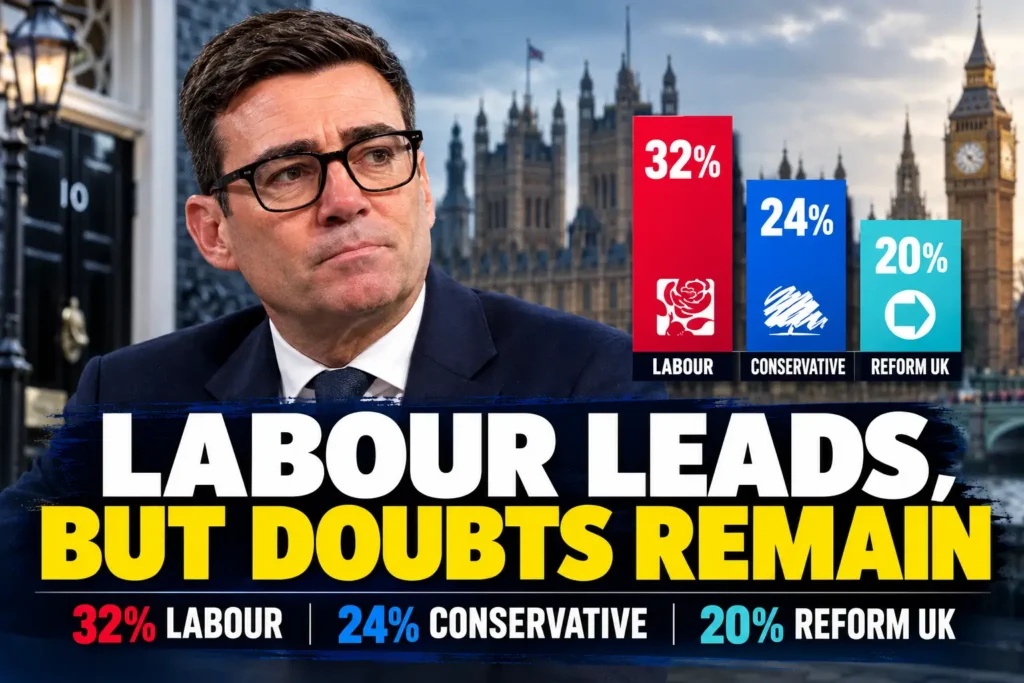
Labour has opened up a 12-point lead over Reform UK in a new Ipsos poll, with the Conservatives moving into second place. But the same survey shows that two-thirds of the public remain dissatisfied with how the government is running the country, complicating the picture for Prime Minister Andy Burnham three months after he entered Downing Street.
The Ipsos poll, published on 25 October 2026, places Labour on 32%, the Conservatives on 24% and Reform UK on 20%. The Liberal Democrats are on 9% and the Greens on 8%. Labour is therefore eight points ahead of its nearest rival, not 12: the larger gap is specifically between Labour and Reform.
The findings suggest an improvement in Labour’s voting intention, but they do not establish that a general election is imminent, that the government has won back public confidence or that a parliamentary majority is guaranteed.
What does the latest polling actually show?
Ipsos questioned 1,109 British adults aged 18 and over between 15 and 22 October. Labour’s share has risen five points since its September survey, with the Conservatives up three points and Reform down three. Ipsos cautions that individual voting-intention estimates have significant uncertainty, particularly when calculating the lead between parties.
A separate Opinium poll published on 24 October also showed Labour in front, but gave a different party order: Labour 30%, Reform UK 22% and the Conservatives 20%. This difference is a reminder that a single survey is a snapshot rather than a definitive account of national opinion.
Ipsos also found that 19% thought Reform UK ready to form the next government, compared with 24% for the Conservatives. Those figures should not be confused with how respondents intend to vote.
Why are people still unhappy with the government?
Despite the improved party polling, Ipsos found only 23% satisfied with the way the government is running the country and 66% dissatisfied. Asked specifically about Burnham’s performance as Prime Minister, 35% were satisfied and 45% dissatisfied. Just 30% believed the government deserved re-election, while 47% disagreed.
These measures ask different questions. Voting intention tests which party a person currently favours; government satisfaction tests whether people approve of its record. The figures can therefore move in different directions without contradicting each other.
The survey identified asylum and immigration, the economy, the cost of living, healthcare and defence among the issues worrying voters. Labour led on healthcare and reducing living costs, while Reform UK retained the lead when respondents were asked which party had the strongest policies on immigration and asylum.
What has Burnham’s government done since July?
Burnham became Prime Minister on 20 July 2026, after returning to Parliament and becoming Labour leader. His administration has made several early policy announcements, although implementation dates and measurable outcomes vary.
- Electricity bills: the government removed VAT from domestic electricity bills from 1 October. Its July announcement estimated savings of about £45 a year for a typical household. That is a government estimate rather than proof that wider living costs have fallen.
- Bus fares: Burnham announced the restoration of the £2 single-fare cap in England, but the revised cap is due to begin on 1 January 2027, not already in force.
- Local businesses: a 20% business-rates cut for eligible pubs, social clubs and live music venues in England was announced for April 2027.
- Devolution: the government opened ‘No10 North’ in Manchester in July and revived a National Economic Council involving regional mayors. The longer-term impact on regional investment remains to be assessed.
- Rough sleeping: on 25 October, Downing Street announced a further £432 million, to be confirmed in the forthcoming Budget, towards an ambition to offer everyone sleeping rough a route off the streets or other support by Christmas. This is a funding commitment and objective, not a verified outcome.
These are identifiable measures, but the early record is not the same as a comprehensive assessment of whether public services, household finances or economic productivity have improved under the new Prime Minister.
Will the polls prompt an early general election?
Burnham has publicly rejected that suggestion. During interviews on 25 September, he said he was not tempted to call an early election and indicated that the next contest would take place in 2029. There has been no announced reversal of that position.
Under UK law, a Prime Minister can request the dissolution of Parliament before its maximum five-year term expires, but polling alone does not trigger an election. Seat projections from national polls also depend on assumptions about constituencies, tactical voting and changes in support across the country. A voting-intention lead, even a substantial one, is not a parliamentary majority.
Different published electoral models currently give different pictures. Electoral Calculus and UK Fact Check’s polling tracker use different methods and produce materially different seat projections. Such models should be read as hypothetical exercises, not election results or assurances of what will happen.
The Budget is the next major test
The government is due to present its Budget on Wednesday 28 October. In Opinium’s October research, the NHS was the most frequently selected priority for additional spending, while many respondents expressed uncertainty about whether the Budget would be fair. The decisions announced, and their effect on households and services, offer more concrete measures for judging the government than the poll headline alone.
At this stage, the evidence supports two conclusions at once: Labour has improved its position in recent voting-intention surveys, and substantial dissatisfaction with the government persists. Whether policy announcements produce results will be a separate question requiring evidence over time.
Sources and further reading
- Ipsos: Voting intention and government satisfaction, 25 October 2026
- Opinium: Voting intention and Budget attitudes, 24 October 2026
- GOV.UK: Electricity VAT announcement, 21 July 2026
- GOV.UK: £2 bus fare cap announcement, 22 July 2026
- GOV.UK: No10 North and devolution plans, 23 July 2026
- GOV.UK: Business rates relief for pubs, social clubs and live music venues, 23 July 2026
- GOV.UK: Rough sleeping funding announcement, 25 October 2026
- The Guardian: Burnham rules out early election, 25 September 2026
- UK Parliament: How general elections are called