British endurance swimmer Lewis Pugh has completed a 15km swim through part of the Strait of Hormuz, drawing attention to the environmental damage caused by the Iran war as commercial ships continue to come under attack.
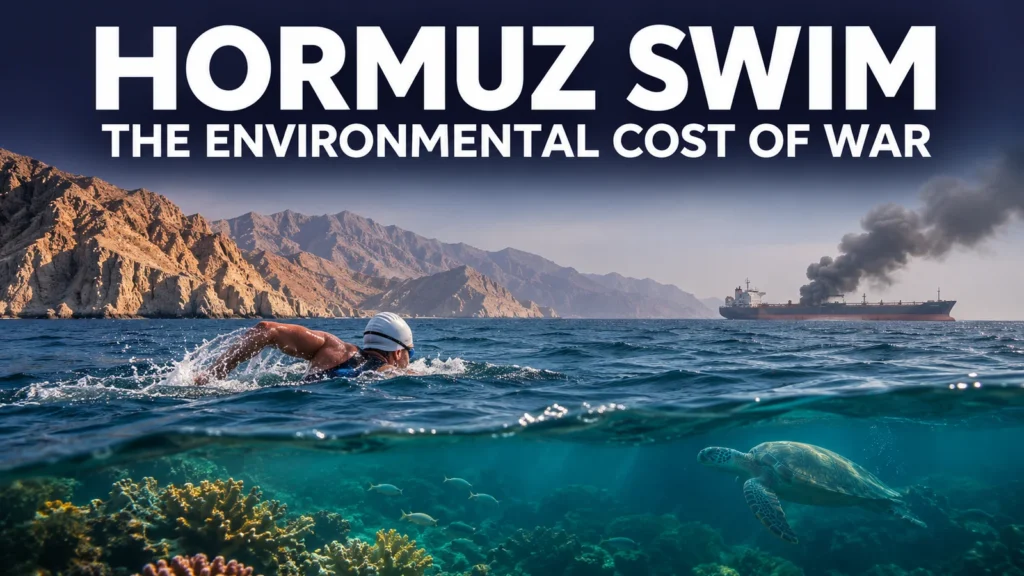
The 56-year-old ocean campaigner, who was born in Plymouth, announced the completion of his challenge on 21 November 2026. His expedition took place over three swimming days in waters off Oman’s Musandam Peninsula, where he reported witnessing explosions and burning ships.
While the disruption to oil supplies and the danger to seafarers have dominated headlines, satellite observations and maritime incident records also point to a growing environmental problem across the Gulf region.
Why did Lewis Pugh swim in the Strait of Hormuz?
Pugh covered approximately 9.3 miles along the Omani side of the strait, finishing by rounding the Cape of Hormuz. He completed the challenge in sections rather than swimming continuously across the waterway from Oman to Iran. In an interview with Associated Press, he said he spent around six and a half hours swimming in total.
His aim was to draw attention to the environmental consequences of the conflict that began with US and Israeli strikes against Iran on 28 February 2026. He has called for an end to hostilities, the reopening of the strait and action to tackle pollution.
In an account of the expedition on his official website, Pugh said: “Stop the fighting. Open the Strait. Clean up the pollution.”
A swim near burning tankers
Pugh described hearing explosions and seeing commercial vessels on fire during his expedition. One of those vessels was TARA GAS, a tanker carrying liquefied petroleum gas (LPG).
The Joint Maritime Information Center advisory dated 19 November confirms that TARA GAS was attacked on 16 November near Khasab, Oman, and struck again the following day. The crew abandoned the damaged vessel. Indian authorities reported two injured crew members and one missing.
Crucially, the maritime advisory says the environmental impact was unknown. Images of a burning gas carrier do not, on their own, establish the volume or nature of any pollution released.
Related: Strait of Hormuz: Tanker mine claims unverified as gas carrier attacked.
Watch video coverage of Pugh’s expedition from Euronews.
What satellites reveal about oil pollution
Research published by the University of South Florida on 8 June compared satellite observations of the Persian Gulf in February and March 2026 with those from the same months in 2025. Its researchers estimated that the area affected by oil spills in March 2026 was approximately four times that recorded in March 2025.
Researchers identified possible leaks from ships held in the region, alongside persistent contamination near oil facilities and wrecks. The university said in June that the scientific paper was undergoing peer review.
Separate United Nations University research released on 14 August identified two extensive oil slicks. Satellite images taken on 7 August showed roughly 300 square kilometres of contamination near the Hallaniyat Islands off southern Oman. Images from 10 August revealed another slick covering approximately 100 square kilometres near Iran’s Qeshm and Hengam islands.
These observations establish the presence and approximate surface extent of pollution at particular times. They do not determine the total quantity of oil released, nor establish that every spill was directly caused by an attack.
The Strait of Hormuz is more than an oil shipping route
The narrow passage between Iran and Oman links the Persian Gulf with the Gulf of Oman. Its strategic importance to energy markets is well known, but the surrounding waters also support coral reefs, seagrass beds and mangroves, as well as dolphins, turtles and dugongs.
Oil pollution can harm marine animals, damage sensitive coastal habitats and disrupt fishing. The consequences can extend beyond the site of a spill as currents carry contaminants into other waters.
In its statement on environmental damage arising from the Middle East conflict, the United Nations Environment Programme (UNEP) warned of threats to ecosystems, human health, food supplies and already strained water resources. It also highlighted the danger to communities reliant on desalination when water infrastructure is attacked.
How many maritime incidents have been confirmed?
The International Maritime Organization’s incident register recorded 141 confirmed incidents across the region as of 23 November. The register includes cases where pollution was reported, cases where its extent remains unknown and many where no pollution was recorded.
The 141 incidents should therefore not be interpreted as 141 oil spills or 141 separate damaged tankers. The eventual scale of the contamination cannot be calculated from that total alone.
Who is Lewis Pugh?
Pugh is a British endurance swimmer and ocean conservation campaigner who has undertaken expeditions in extreme environments around the world. UNEP appointed him Patron of the Oceans in 2013. His previous challenges have included swims in the Arctic and Antarctica to raise awareness of threats to the natural environment.
What happens next?
The long-term ecological consequences of the conflict remain uncertain. Assessing the damage will require continued satellite monitoring, water and sediment sampling and surveys of affected wildlife and habitats. Continuing hostilities make such work more difficult and can prevent clean-up teams from reaching contaminated areas.
Although Pugh has completed his swim, no new international clean-up agreement has been identified as a direct result of the expedition. His campaign highlights a problem for which the eventual environmental and economic cost has yet to be established.
Sources
- Lewis Pugh: Strait of Hormuz Swim
- Associated Press: Interview with Lewis Pugh, 21 November 2026
- JMIC / UKMTO: Advisory Update 115, 19 November 2026
- University of South Florida: Oil spill research, 8 June 2026
- United Nations University: Oil slick observations, 14 August 2026
- UNEP: Environmental damage arising from the Middle East conflict
- IMO: Confirmed maritime incidents, updated 23 November 2026