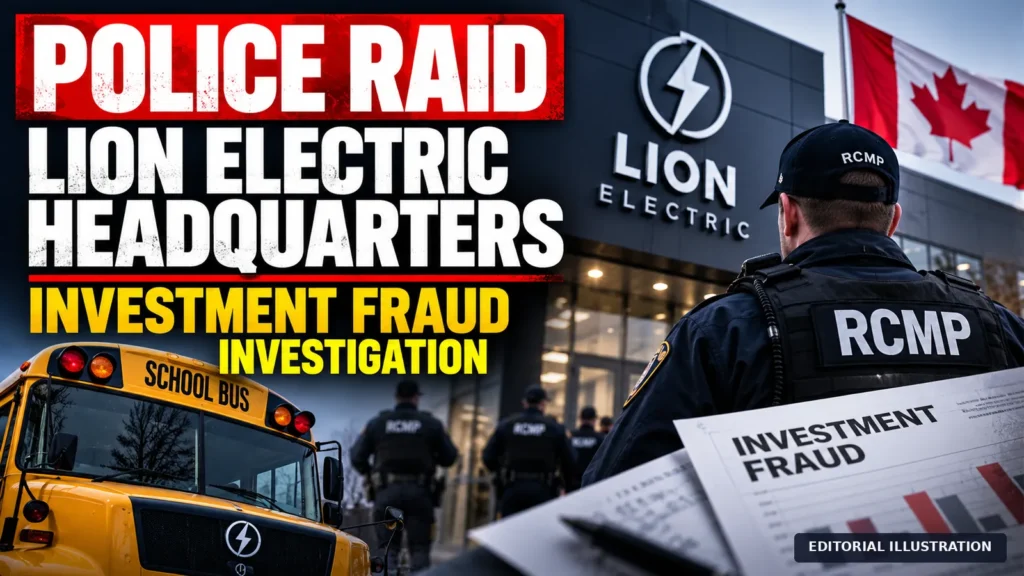
Canadian federal police have searched the headquarters of electric school bus manufacturer Lion Electric following complaints from more than 100 investors. The investigation follows the company’s financial collapse, substantial public funding losses and a separate history of school bus safety concerns.
The Royal Canadian Mounted Police (RCMP) searched Lion Electric’s headquarters in Saint-Jérôme, Quebec, on 21 October 2026, as part of an investment fraud investigation launched following complaints from more than 100 investors. The operation comes nearly two years after the electric school bus manufacturer sought creditor protection, leaving shareholders facing substantial losses and raising questions about millions of dollars in Canadian and US public funding.
Canadian police investigate Lion Electric’s former operations
The large-scale police operation began at approximately 10am local time on Wednesday, 21 October, when RCMP investigators arrived at Lion Electric’s headquarters north of Montreal.
Up to 75 officers were reportedly involved in the operation, which included searches of the company’s premises and examination of potential evidence.
According to The Canadian Press, RCMP spokesperson Corporal Martina Pilarova confirmed that the investigation began in February 2025 after police received complaints from more than 100 investors.
Investigators are examining suspected investment fraud connected to the company’s previous operations.
Police stressed that the investigation concerns activities before Lion Electric was acquired by new owners in May 2025 and does not target the company operating under its current ownership.
The searches were expected to continue for several days because of the size of the facilities.
At the time of the police announcement, no arrests or criminal charges had been announced.
Lion Electric’s current management said it was cooperating with authorities and emphasised that the investigation related to the company’s former structure.
The existence of an investment fraud investigation does not establish that a criminal offence has occurred. No findings of criminal liability have been announced in connection with the police operation.
From electric vehicle success story to financial collapse
Lion Electric was once promoted as a major player in North America’s transition towards cleaner public transport.
The Quebec-based manufacturer produced electric school buses and commercial vehicles, attracting substantial investment as governments increased spending on electric transportation.
In 2021, Lion Electric became publicly traded on the New York and Toronto stock exchanges.
However, the company struggled financially as it attempted to expand production and meet demand.
By December 2024, its financial difficulties had become severe enough for the company to seek protection from creditors under Canada’s Companies’ Creditors Arrangement Act.
Court-appointed monitor Deloitte confirmed that creditor protection was granted on 18 December 2024.
The company subsequently underwent restructuring and was acquired by a consortium of Quebec investors in 2025.
Canadian media reported that the new owners paid approximately C$6 million for the business, a fraction of its former market valuation.
The Quebec government, which had invested heavily in supporting the manufacturer, reportedly lost approximately C$140 million.
The collapse also affected private investors who had purchased shares during the company’s expansion.
Shareholders subsequently pursued legal action, alleging that investors had been misled about Lion Electric’s financial position.
Those allegations remain separate from the RCMP investigation and should not be treated as established findings of wrongdoing.
Investor receives C$1.1 million insider trading penalty
The police operation follows a separate regulatory case involving trading in Lion Electric shares before the company’s financial collapse.
On 13 October 2026, Quebec’s financial regulator, the Autorité des marchés financiers (AMF), announced that the Financial Markets Administrative Tribunal had approved a settlement involving investor Claude Roy.
Roy admitted carrying out transactions in Lion Electric shares during November and December 2024 while possessing privileged information concerning a potential acquisition and the company’s anticipated creditor protection proceedings.
According to the AMF’s official announcement, Roy conducted nine share-sale transactions, avoiding losses calculated at C$792,640.
The tribunal imposed an administrative penalty of C$1,109,691 and prohibited him from securities trading and certain financial market activities for two years.
This was a regulatory settlement relating to insider trading. It is not evidence that the allegations being examined in the separate RCMP investigation have been proven.
US government confirms approximately $160 million in funding
Lion Electric’s collapse also created problems for American school districts participating in the US Environmental Protection Agency’s Clean School Bus Program.
The programme was established to help replace older school buses with cleaner alternatives, including electric vehicles.
Lion Electric became a significant recipient of funding.
In an official announcement published on 19 February 2026, the EPA confirmed that the manufacturer had received approximately US$160 million directly through the programme.
The agency also acknowledged that school districts had used their own programme awards to purchase additional Lion Electric vehicles.
According to the EPA, some buses remained undelivered and others had not received adequate maintenance following the manufacturer’s financial difficulties.
The agency said it was examining potential options concerning the outstanding problems but could not comment further on matters connected to continuing litigation.
For affected school districts, the consequences extend beyond the loss of a promised vehicle.
Operators may face difficulties maintaining their fleets, obtaining replacement parts and keeping existing school transport services running.
The EPA’s concerns about deliveries and maintenance are documented, but its statement does not establish that the full US$160 million was lost or fraudulently obtained.
Lion Electric school bus fires and safety recalls
Alongside its financial difficulties, Lion Electric has faced separate questions about the safety of some of its school buses.
On 19 September 2025, Transport Canada issued a public safety warning following reports of three fires and one overheating incident involving LionC school buses during the preceding year.
The most recent reported fire had occurred on 9 September 2025.
At that stage, investigators had not established a definitive defect responsible for the incidents, partly because fire damage complicated their examinations.
However, attention focused on components associated with the vehicles’ low-voltage heating systems.
Lion Electric subsequently issued inspection instructions to operators.
In October 2025, Transport Canada published recall 2025528, identifying a potential problem with wiring in the heating, ventilation and air conditioning control panel on certain Lion-branded school buses.
The recall warned that improperly manufactured wiring could overheat and create a fire risk.
Owners were instructed to follow inspection procedures and arrange corrective work.
The recall covered specified Lion school bus models across multiple production years.
Importantly, the financial investigation and vehicle safety issues are separate matters.
There is currently no evidence that the RCMP raid concerns the bus fires or associated safety recalls.
What happens next?
The RCMP investigation now raises questions about what investors were told before Lion Electric’s original business collapsed and whether any criminal offences occurred.
Investigators will need to examine financial records, communications and other evidence before determining whether charges are justified.
The company’s current owners have sought to distance the restructured business from its former management and have pledged cooperation with the authorities.
Meanwhile, the wider consequences of Lion Electric’s financial difficulties remain significant.
Canadian taxpayers have faced substantial investment losses, shareholders have pursued legal action, and American school districts continue to deal with the consequences of delayed deliveries and maintenance difficulties.
The company’s documented vehicle safety problems have added another layer of concern.
None of those circumstances, individually or collectively, proves the investment fraud allegations now being investigated.
For the investors who complained to police, the central question is whether the company’s financial position and commercial prospects were accurately represented before its collapse.
The answer will depend on the evidence gathered by investigators and any subsequent legal proceedings.
As of the police announcement on 21 October, no criminal charges had been reported.
Sources
- The Canadian Press / CityNews: RCMP raid and company response
- Deloitte: Lion Electric creditor protection proceedings
- Autorité des marchés financiers: Claude Roy regulatory settlement
- US EPA: Clean School Bus Program announcement, 19 February 2026
- Transport Canada: LionC fire risk warning
- Transport Canada: Lion Electric recall 2025528
Watch: Lion Electric police raid and company background
In the following video, the StacheD Training YouTube channel examines the police operation, Lion Electric’s financial collapse, public funding and previous school bus safety problems.
The presenter also discusses his previous reporting on the manufacturer’s vehicles. His personal commentary should be distinguished from the official police, regulatory and government findings.