A US federal judge has allowed substantial parts of a lawsuit challenging McDonald’s McRib advertising to proceed, after consumers alleged that the rib-shaped sandwich misleads buyers about the meat it contains.
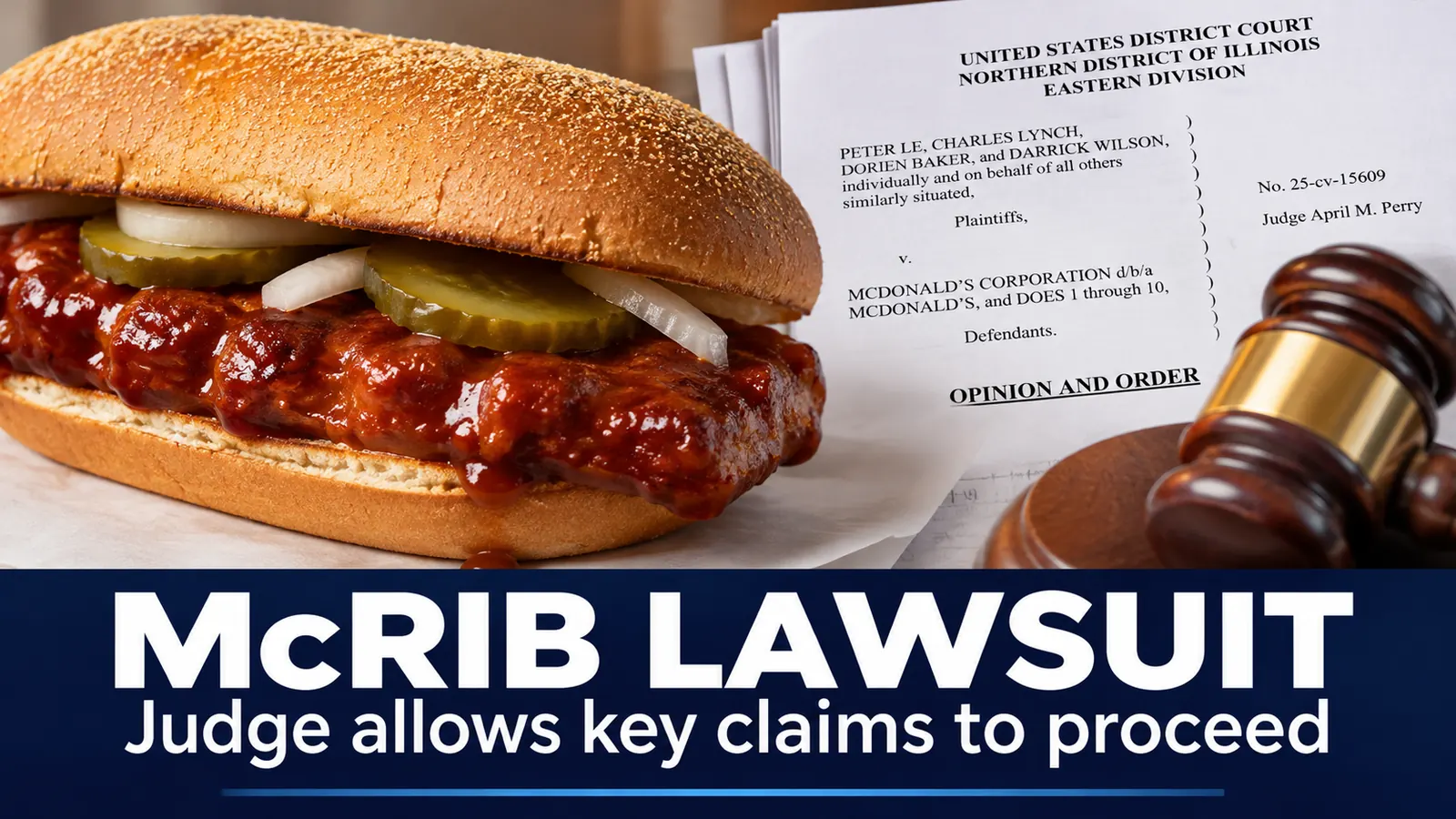
Judge April M. Perry, sitting in the US District Court for the Northern District of Illinois, issued her decision on Friday 30 October 2026. She rejected McDonald’s attempt to dismiss the proposed class action in its entirety, although some claims were dismissed.
The ruling is an early legal setback for the fast-food chain, not a finding that its advertising is deceptive. Whether the McRib contains the pork cuts consumers say they expected, and whether its marketing broke consumer-protection laws, remain disputed.
What the McRib lawsuit alleges
The case was filed in December 2025 by four consumers: Peter Le, Charles Lynch, Dorien Baker and Darrick Wilson. They say the name “McRib”, the shape of the boneless patty and advertising that emphasises its resemblance to a rack of ribs lead customers to expect actual pork rib meat.
The plaintiffs allege that the sandwich instead uses less expensive cuts of pork and that customers paid more than they otherwise would have. The lawsuit also makes allegations about ingredients including heart, tripe and stomach. Those ingredients have not been established as present in the McRib, and McDonald’s expressly denies using them.
The question is not whether the sandwich contains pork. It is whether the overall presentation could reasonably give buyers the mistaken impression that it contains pork rib meat.
What McDonald’s says
McDonald’s says its McRib is made with seasoned, boneless pork and that it has been transparent about its ingredients. The company disputes the claims and has described the lawsuit as meritless.
Its defence argues that a brand name and a shaped patty do not necessarily promise a particular cut of meat. In its view, customers are buying a product marketed as pork, not a specified portion of ribs.
The company has specifically denied that the patty contains hearts, tripe or scalded stomach. Its statement that the product contains pork does not by itself resolve the separate allegation about rib meat.
Why the sandwich’s shape matters
The McRib is a ground-pork patty moulded into a familiar rib-like shape, covered in barbecue sauce and served with pickles and onions on a roll. McDonald’s openly explains the design on its official website. Asked why the patty resembles a rack of ribs, the company says: “Easy…it’s fun.”
For the plaintiffs, that shape is central to the alleged deception. For McDonald’s, it is a distinctive presentation of an accurately described pork sandwich. The court has not decided which interpretation should ultimately prevail.
What the judge decided
According to Reuters’ report of the 30 October decision, Judge Perry considered it premature to rule that no reasonable customer could expect the McRib to contain rib meat. She said the plaintiffs’ interpretation was not “unreasonable or fanciful”.
The judge allowed major elements of the case to continue but dismissed others. At this stage, the court assesses whether claims are legally sufficient to be heard, not whether the allegations have been proved.
No class of McRib purchasers has yet been certified, there has been no finding of liability and no compensation has been awarded. Those questions would be considered only at later stages, if the case reaches them.
What happens next
The surviving claims can continue through the legal process. Evidence about the ingredients, marketing and what consumers understood when they bought the sandwich may become important. McDonald’s can continue challenging the allegations and any application to certify a class.
The dispute highlights a broader consumer-law question: when does a memorable product name and appearance become a misleading representation about what buyers are getting? For now, that question remains unanswered.
Video: the legal questions explained
Former Palm Beach County state attorney Dave Aronberg discusses the ruling and the difference between allowing a lawsuit to proceed and proving deceptive advertising in the video below.