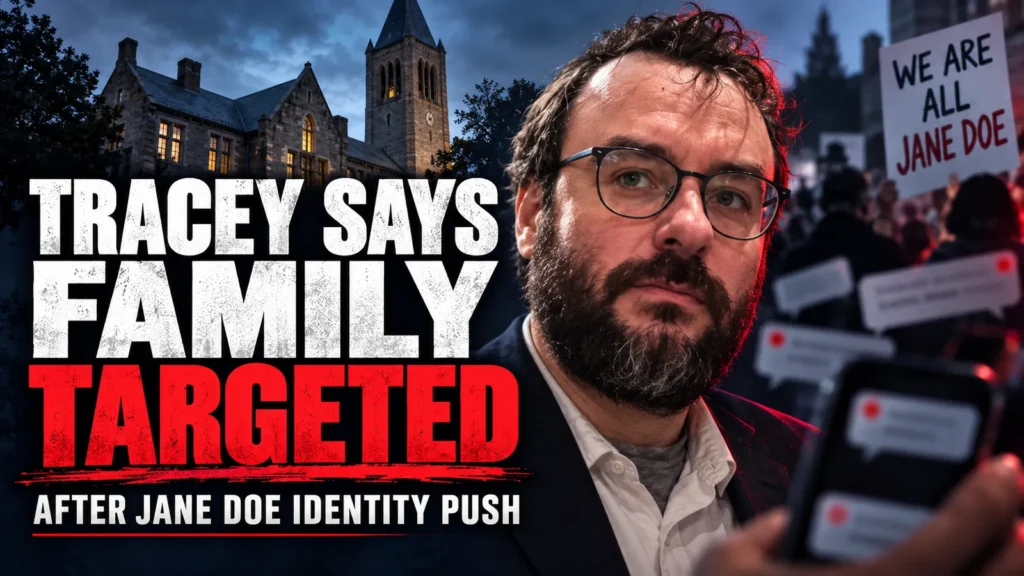
The independent journalist who publicly sought to identify the woman at the centre of Cornell University’s sexual assault lawsuit says his relatives and the occupants of his former home have been targeted. The controversy highlights how online harassment is spreading far beyond the people directly involved in the case.
American journalist and political commentator Michael Tracey, who publicly sought to identify the woman suing Cornell University over an alleged sexual assault, says his own family is now being subjected to harassment and threats. His complaints have attracted attention because he previously defended his efforts to expose the woman’s identity as an exercise of First Amendment rights. But the consequences of the online campaign have extended far beyond Tracey, with threats, false accusations and harassment affecting people who have no connection to the original allegations.
Michael Tracey and the effort to identify Jane Doe
The controversy began after a former Cornell University student, identified in legal proceedings as Jane Doe, filed a civil lawsuit on 16 September 2026.
She alleges that seven men sexually assaulted her at the Chi Phi fraternity house in Ithaca, New York, in October 2024, and that Cornell mishandled its response.
The men have disputed the allegations, and none has been criminally charged in connection with the alleged assault. Tompkins County prosecutors reopened the investigation on 28 September. On 1 October, New York Governor Kathy Hochul appointed Attorney General Letitia James as special prosecutor to take charge of the criminal case.
As the lawsuit attracted national attention, Tracey began publicly asking for information that could establish the identity of the woman bringing the case.
He argued that someone making serious allegations against identifiable defendants should not necessarily be able to remain anonymous throughout legal proceedings.
In one widely circulated social media post, Tracey described efforts to identify her as:
“100% permitted under the First Amendment.”
According to The New Yorker’s investigation, Tracey published what he believed to be Jane Doe’s name on 1 October before removing the information several hours later.
In a statement published on 2 October, Tracey confirmed removing the identifying information but defended the decision to publish it.
He said the action was intended to challenge the use of anonymity in lawsuits involving serious public allegations, but added that he did not want Jane Doe punished, humiliated or subjected to retaliation.
Tracey says his relatives are now being targeted
By 1 October, Tracey was publicly complaining that people were contacting members of his family, apparently mistaking them for him. The available accounts do not establish precisely when that harassment began in relation to his publication of Jane Doe’s purported identity.
In a statement published on 1 October, he said family members were receiving abusive calls and messages and asked critics to direct their complaints at him rather than his relatives.
The complaints were not limited to his family.
The New Yorker reported that the current occupants of Tracey’s childhood home in New Jersey contacted him on 8 October after receiving threats and unwanted deliveries.
The couple had reportedly purchased the property several years earlier and had no involvement in the Cornell controversy.
Tracey also said his father, who shares his first name, had received thousands of unwanted calls and messages. That figure is his own account rather than an independently verified total.
The distinction matters: whatever criticism may be directed at Tracey’s actions, his relatives and the people living in his former home are not responsible for them.
Targeting those individuals does nothing to resolve the Cornell allegations. It simply exposes more people to the kind of behaviour at the centre of the controversy.
Jane Doe has faced far more serious threats
While Tracey’s complaints have attracted attention, the woman he sought to identify has also faced a disturbing campaign of harassment.
Her lawyer, Thomas Giuffra, has described threats against her and her family, including an incident in which someone made a false emergency report that prompted armed police to attend the family home.
The incident, known as swatting, was documented in police records examined by CBS News and The New Yorker.
Officers responding to the false report detained two members of the household at gunpoint before discovering that the supposed emergency had not occurred.
The woman has also reportedly received threatening messages and calls after personal information circulated online.
Tracey has maintained that he did not publish her home address or private contact details. However, identifying someone publicly can make it easier for others to locate further information about them.
There is no established evidence that Tracey personally made or organised the threats against Jane Doe.
The people responsible for individual threats and swatting incidents must be distinguished from those who have commented on or reported the case.
More than 87 million views of posts attempting to identify her
The scale of the online activity is striking.
A Washington Post investigation published on 17 October found that posts on X attempting to reveal Jane Doe’s identity accumulated more than 87 million views over two weeks.
That figure represents reported views, not 87 million individual users.
The investigation also found that X’s artificial intelligence chatbot, Grok, had supplied the purported identity in hundreds of public responses.
Other major social media platforms had taken steps to restrict searches for the woman’s alleged name.
The findings raise questions about how social media platforms handle attempts to expose people involved in highly sensitive legal proceedings, particularly when the publication of personal information is followed by threats.
Innocent people have been caught in the crossfire
The consequences have not been confined to Jane Doe or Tracey’s family.
People with no connection to the alleged assault have also been wrongly identified online.
The Washington Post documented the experience of a graduate student who shared a name with one of the accused men but had never attended Cornell University.
He and his relatives received threatening communications after strangers mistakenly connected him to the case.
In another incident, a US Marine and his family were targeted because an incorrect address had appeared in publicly available court documents.
The problem became serious enough for Judge Phaedra Perry-Bond to order certain court filings sealed on 9 October, with redacted versions required to protect personal information.
Attempts to expose individuals online have therefore harmed people across the dispute, including the complainant, those wrongly associated with the accused and people connected to a commentator investigating the case.
What does the First Amendment actually protect?
Tracey’s argument has placed freedom of expression at the centre of the controversy.
The First Amendment to the United States Constitution provides substantial protection for speech and publication, including reporting on matters of public interest.
However, those protections are not unlimited.
Publishing a person’s name is not automatically unlawful, even when the person would prefer to remain anonymous. Whether a particular disclosure is legally actionable depends on the circumstances.
Credible threats, stalking and certain forms of harassment may fall outside constitutional protection.
There is also an important distinction between something being legally permissible and being editorially responsible.
Journalists regularly consider whether publishing information serves a genuine public interest, what harm it might cause and whether that harm is justified by the value of disclosure.
Tracey argues that transparency about anonymous litigants is a legitimate public-interest concern.
Critics argue that exposing an alleged sexual assault survivor can discourage people from bringing complaints forward and expose them to intimidation.
Those competing arguments deserve examination without suggesting that either side’s supporters have a right to threaten innocent people.
Judge urges action against threats and harassment
The courts have also confronted the consequences of the public controversy.
On 16 October, Judge Perry-Bond rejected a request by defendant Diego Sarabia to restrict public statements by the parties and their lawyers.
The judge concluded that the proposed restriction did not satisfy the demanding legal requirements for limiting protected speech.
However, she also recognised the risks created by online vigilantism.
According to Courthouse News Service, she encouraged those involved in the proceedings to cooperate in protecting individuals from threats, harassment and malicious attempts to expose personal information.
The ruling did not determine whether the underlying sexual assault allegations were true.
The danger of trial by social media
There is an uncomfortable irony in Tracey’s experience.
He publicly defended his attempt to identify Jane Doe, but now says members of his own family and entirely unrelated homeowners have suffered because people online have tried to locate him.
That irony is newsworthy. It does not make the harassment acceptable.
Equally, the threats faced by Jane Doe, the harassment of wrongly identified individuals and attacks against those accused in the case cannot be justified by public anger.
The courts, rather than social media campaigns, must ultimately determine the legal questions surrounding the allegations.
For now, the Cornell controversy has demonstrated how rapidly online outrage can move beyond those directly involved, exposing strangers to intimidation, reputational damage and potentially dangerous confrontations.
The principle should apply equally to everyone: criticising someone’s actions is legitimate. Threatening their family, exposing unrelated individuals or encouraging harassment is not.
Fish 4 News will continue following the Cornell civil proceedings, the renewed criminal investigation and significant developments involving online threats. The underlying allegations remain contested and no criminal convictions have been established in connection with the alleged assault.
Sources
- Michael Tracey: Troll me about “Jane Doe,” please — not others (1 October 2026)
- Michael Tracey: Note on Jane Doe (2 October 2026)
- The New Yorker: The Doxing of Jane Doe
- CBS News New York: Attorney for Jane Doe says he and his client are receiving threats against their families (9 October 2026)
- The Washington Post: The online campaign to unmask a Cornell rape accuser reached millions (17 October 2026)
- Courthouse News Service: Judge in Cornell Jane Doe suit declines to issue gag order on attorneys
- CBS News: Cornell investigation and appointment of New York’s attorney general as special prosecutor