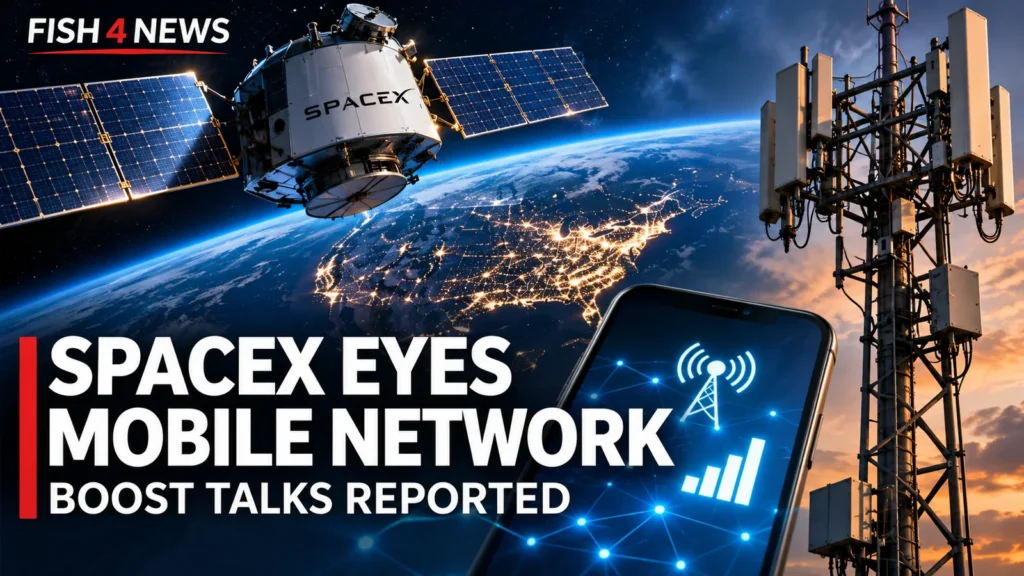
Elon Musk has raised the possibility of SpaceX buying an established telecommunications company, as separate reports reveal talks that could give its Starlink business a foothold in the American mobile phone market.
Speaking to investor Ron Baron on Friday 6 November, Musk suggested SpaceX could acquire a traditional operator if it believed it could use its wireless spectrum more effectively. His remarks, captured in the Baron Investment Conference recording, were hypothetical. He did not announce a takeover, identify a target or confirm a deal.
The comments followed a 2 November investigation by The Washington Post, which reported that SpaceX had been turned down by Verizon, AT&T and T-Mobile after seeking permission to use their mobile networks for a SpaceX-branded service. It said the company had since discussed buying Boost Mobile, or using its existing network arrangements, with Boost’s owner EchoStar.
Together, the developments point to a larger ambition than sending occasional satellite messages when a conventional phone loses its signal. SpaceX wants to combine its orbiting Starlink network with the towers and infrastructure that carry everyday mobile calls and data.
Why Boost Mobile could matter
Boost already has customers, a retail presence and agreements allowing it to provide mobile services through networks operated by AT&T and T-Mobile. That could be quicker than constructing a nationwide mobile system from scratch, particularly for indoor coverage and busy cities where satellite connections face technical limits.
EchoStar reported 7.193 million wireless subscribers as of 30 September 2026, primarily across Boost Mobile and Gen Mobile, in its quarterly filing submitted on 3 November. The total had fallen from approximately 7.38 million at the end of June. It is a substantial existing customer base, but far smaller than those of America’s three dominant carriers.
There is, however, a catch. Boost’s access to AT&T and T-Mobile networks is based on commercial contracts, not ownership of those operators’ towers. According to the Washington Post, such agreements are not normally transferable to a new buyer without consent. An acquisition would therefore not automatically give SpaceX the unrestricted network access it sought.
The discussions have been reported by Reuters as well as the Washington Post, but neither an acquisition nor a new access agreement has been announced. The price, terms and any necessary approvals remain unknown.
SpaceX has already committed billions to mobile spectrum
This push did not begin with the Boost discussions. In September 2025, EchoStar announced a $17 billion spectrum agreement with SpaceX, alongside plans to let Boost subscribers use Starlink’s next-generation direct-to-cell service. The spectrum deal was subsequently expanded, with EchoStar’s latest filing describing total consideration of approximately $20 billion.
In October 2026, Reuters reported that SpaceX had also agreed to acquire a nationwide low-band spectrum portfolio from Grain Management for around $8 billion, subject to regulatory approval. Spectrum is the licensed radio capacity on which wireless services depend. Owning it strengthens the technical foundations of a phone network, but spectrum alone does not put working masts in streets, buildings and transport hubs.
One apparent contradiction is worth clearing up. T-Mobile already works with SpaceX on T-Satellite, a service allowing compatible phones to connect to Starlink in areas without conventional coverage. The report that T-Mobile rejected an additional network-access request does not mean the two companies have stopped working together. A service delivered to T-Mobile’s customers and a rival SpaceX-branded mobile operator are very different propositions.
Could SpaceX become a fourth major US carrier?
Its satellite launches, manufacturing capacity and spectrum purchases give SpaceX resources that a typical challenger would struggle to match. But the established US operators have spent decades building coverage, negotiating sites, serving customers and maintaining networks where millions of devices connect at once.
Analysts cited in the original reporting argue that indoor reception, dense urban capacity and the cost of running a nationwide mobile business remain formidable obstacles. Even a purchase of Boost would leave questions about wholesale network rights, regulatory approval and the investment needed to compete at scale.
Musk’s comments suggest he is willing to consider a more ambitious route into the industry. For now, though, the confirmed picture is narrower: SpaceX has made significant spectrum investments, its chief executive has publicly discussed a possible telecom acquisition and reporting indicates talks involving Boost Mobile. No completed purchase or new nationwide service has been confirmed.
Sources
- The Washington Post: report on SpaceX and Boost Mobile talks, 2 November 2026
- Reuters: confirmation of the reported talks and contractual questions, 2 November 2026
- Baron Investment Conference: Musk’s remarks, 6 November 2026
- EchoStar quarterly filing (Form 10-Q), filed 3 November 2026
- EchoStar: SpaceX spectrum agreement, 8 September 2025
- Reuters: additional spectrum transaction, 8 October 2026
- T-Mobile: T-Satellite service details