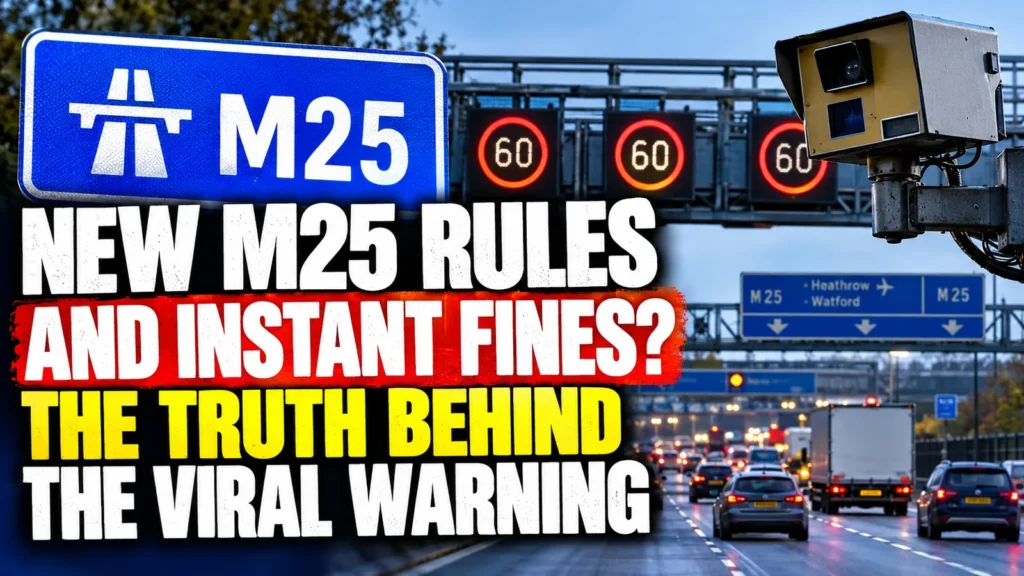
A viral YouTube video warns that millions of UK motorists could face instant fines under new M25 and motorway rules. But official guidance tells a different story, while a genuine speed camera controversy has raised serious questions about enforcement accuracy.
A YouTube video warning that millions of UK drivers could face instant fines under supposedly new M25 and motorway rules is attracting attention. But Fish 4 News has found no official evidence supporting the headline’s suggestion of a newly introduced, nationwide motorway crackdown. Existing speed-limit laws remain in force, while the government is dealing with a separate camera fault that has resulted in motorists being incorrectly accused of speeding.
What is being claimed about the M25?
The warning appears in a video from the YouTube channel Frank UK, using the headline:
New M25 and Motorway Rules Begin NOW – Millions of UK Drivers Could Be Hit With Instant Fines!
The presentation combines the M25, motorway enforcement and the threat of immediate financial penalties, creating the impression that a significant new set of rules has just taken effect.
However, a review of government guidance, the Highway Code and recent parliamentary answers has not established the introduction of a new blanket M25 enforcement regime corresponding to that warning.
This does not mean motorists cannot be fined for motorway offences. They certainly can. The important distinction is between existing rules, changes to camera operations and genuinely new legislation.
Fish 4 News has examined the video’s visible headline and associated claims, rather than independently verifying every statement in its full spoken content.
Have new M25 speed-limit rules been introduced?
Variable speed limits have operated on Britain’s smart motorway network for years.
When an electronic motorway sign displays a speed limit within a red circle, that limit is mandatory. Drivers must comply with it, even when the reason for the restriction is not immediately obvious.
The Highway Code makes the position clear through Rule 261, which prohibits exceeding a speed limit displayed within a red circle.
The familiar national motorway speed limit of 70mph generally applies to cars where no lower mandatory restriction is in force, subject to vehicle-specific limits and other restrictions.
There is no basis for treating these established obligations as newly introduced simply because a video presents them as an urgent development.
Is there really a 60-second grace period for motorway cameras?
This is one of the more interesting aspects of motorway enforcement, because there is a genuine technical requirement behind the claim.
The Home Office’s speed camera approval standards require variable speed cameras to wait until a displayed speed limit has been in place for at least one minute before enforcing that displayed limit.
The technical specification also requires the enforcement delay to be adjustable to at least five minutes.
These requirements are documented in the Home Office’s speedmeter and enforcement camera handbook amendments.
But there is an important distinction.
The one-minute requirement is a technical camera-enforcement safeguard, not a legal exemption allowing drivers to ignore a newly displayed speed limit.
Drivers are still required to comply with mandatory signs. The technical requirements also allow enforcement of the national speed limit in specified circumstances when the conditions for enforcing a displayed variable limit are not met.
Motorists should therefore never assume they have 60 seconds in which speeding is permitted.
What happens if a motorway speed camera catches you?
The term “instant fine” is misleading when applied to the ordinary process for camera-detected speeding offences.
According to the government’s speeding penalties guidance, a vehicle detected speeding will normally lead to a Notice of Intended Prosecution and a Section 172 notice being sent to the registered keeper within 14 days.
The Section 172 notice requires information identifying the driver. It must generally be returned within 28 days.
The case may then result in a fixed penalty, an offer of a speed awareness course where appropriate, or court proceedings.
The standard minimum speeding penalty is £100 and three penalty points. More serious offences can attract larger penalties, and a court can impose a fine of up to £2,500 for motorway speeding.
The camera may record an alleged offence automatically. That is not the same thing as an instant fine being imposed.
The genuine controversy: thousands of incorrect speed camera activations
While viral warnings focus on motorists being caught by cameras, an actual government investigation concerns motorists who may have been wrongly accused.
In December 2025, the Department for Transport publicly acknowledged a technical anomaly affecting the interaction between some variable speed cameras and motorway signs.
The problem involved delays in communication between systems. In some cases, vehicles were detected as speeding when the relevant displayed speed limit had already changed, or before sufficient time had been allowed for the change.
The government’s subsequent figures identified:
- 154 HADECS cameras affected by the technical anomaly, located across approximately 10% of England’s strategic road network.
- Around 2,650 erroneous camera activations identified since 2021.
- More than six million camera activations recorded on the affected roads during that period, meaning the erroneous activations represented fewer than 0.1%.
Crucially, 2,650 erroneous activations does not mean 2,650 motorists received incorrect fines. Not every camera activation leads to enforcement action.
The figures cover affected motorways and major A-roads generally. They do not establish that every M25 camera, or any particular M25 camera, suffered the fault.
The government said affected motorists would be contacted by the relevant police force, with financial reimbursement and the removal of penalty points where appropriate.
An independent review was commissioned in January 2026 to examine how the problem occurred and how it was handled.
October 2026: the camera problem is still being addressed
The issue is not simply an old technical fault that has disappeared from the news.
In a parliamentary answer on 14 October 2026, Home Office minister Sarah Jones confirmed that technical examination was continuing.
She said the Home Office had been working with National Highways on a proposed solution, and that enforcement using affected operational cameras would resume with police partners once the necessary work was satisfactorily concluded.
This followed a September parliamentary answer confirming that wider police speed enforcement was continuing, despite the suspension affecting the specific camera systems.
The distinction matters.
Some affected camera enforcement remains suspended, but this does not mean motorists can speed without consequences. Other enforcement methods remain available to police.
Tens of thousands of speed awareness courses cancelled
A further parliamentary answer on 16 October 2026 revealed the scale of the disruption caused by the camera controversy.
Transport minister Justin Madders confirmed that tens of thousands of speed awareness courses had been cancelled after wider enforcement activity in progress was stopped, including cases that were not necessarily affected by the technical anomaly.
The government described the cancellations as a small proportion of the approximately two million National Driver Offender Retraining Scheme courses delivered annually.
The confirmation raises questions about the consequences of the original camera fault, the handling of enforcement cases and the disruption to motorists and course providers.
These are demonstrable developments supported by the official parliamentary record.
They offer a considerably more substantial account of motorway enforcement than an unsupported suggestion of new instant fines.
Other motorway rules drivers should understand
Speeding is not the only offence that can result in enforcement action on a motorway.
A red X displayed above a lane means that the lane is closed. Under Highway Code Rule 258, drivers must not continue in that lane beyond the signal.
Drivers must also keep to the left unless overtaking, avoid unsafe lane changes and must not use the hard shoulder except where permitted.
These are established motorway requirements, not evidence of an entirely new enforcement system beginning in October 2026.
Drivers should pay particular attention to changing conditions, because motorway signs can warn of hazards that are not yet visible.
What should drivers do if they believe they were wrongly fined?
The Department for Transport’s guidance concerning the variable speed camera anomaly states that people identified as affected will be contacted directly by the relevant police force.
The government says appropriate reimbursement and removal of penalty points will follow where necessary.
Anyone who believes they may have been affected should retain their relevant records. The guidance currently advises motorists not to take separate action about the identified anomaly while police forces contact affected individuals.
However, anyone receiving a new Notice of Intended Prosecution or Section 172 request should not ignore it. Those documents carry their own legal requirements and deadlines.
Fish 4 News verdict: a misleading impression of new rules
The headline warning about new M25 regulations and millions of drivers facing instant fines is not supported by the official evidence examined.
Motorway speed cameras, variable speed limits and penalties for non-compliance are longstanding features of Britain’s road network.
The 60-second enforcement safeguard is real, but it does not give motorists legal permission to exceed a displayed speed limit.
The more significant verified story is that a technical anomaly in the enforcement system resulted in erroneous camera activations, an independent review, suspended enforcement activity and substantial disruption to speed awareness courses.
The message for drivers is straightforward: obey mandatory speed limits and motorway signs, but be sceptical of alarming online headlines that present longstanding requirements as newly introduced laws.
Motorists deserve accurate information about their legal responsibilities, and equally deserve confidence that the systems used to enforce those responsibilities operate correctly.
Both are matters of public interest.
Sources
- The Highway Code: Motorways (rules 253 to 273)
- Home Office: variable speed camera requirements
- GOV.UK: Speeding penalties
- Department for Transport: variable speed camera anomaly
- Independent review: terms of reference
- UK Parliament: 14 October 2026 written answer
- UK Parliament: 16 October 2026 written answer