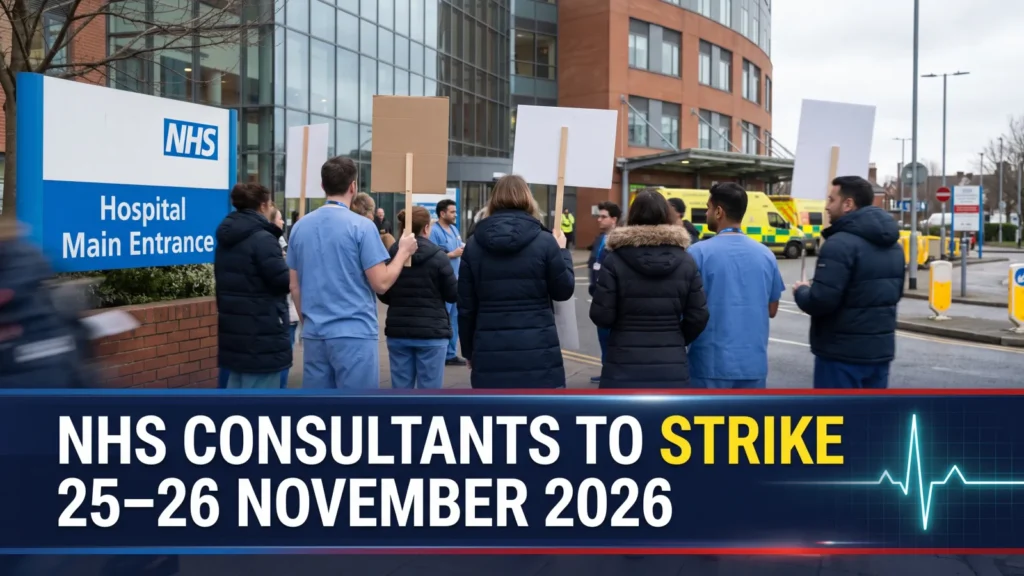
NHS consultants in England are planning a 48-hour strike on 25 and 26 November 2026 after a dispute over pay and working conditions failed to reach a resolution.
The British Medical Association (BMA) announced the walkout on Monday 26 October. Industrial action is scheduled to begin at 6:59am on Wednesday 25 November and end at 6:59am on Friday 27 November.
Consultants are among the NHS’s most senior doctors. The BMA says emergency care will continue, with hospitals operating at a level similar to Christmas Day during the strike. However, non-urgent appointments, planned operations and follow-up consultations could be postponed.
What should patients do?
Patients should not assume their appointments have been cancelled. NHS England’s standing advice for industrial action is to attend planned appointments unless the NHS contacts them to rearrange. Hospitals should tell affected patients directly if treatment needs to be rescheduled.
Emergency care will remain available. Anyone with a life-threatening emergency should continue to call 999 or attend A&E. For urgent medical problems that are not life-threatening, patients can use NHS 111 online.
Read NHS England’s guidance on industrial action for further advice.
Why are consultants striking?
The BMA says consultants have faced excessive workloads, burnout and a loss of pay relative to inflation. The union claims consultants’ pay has fallen by around 25% in real terms over 17 years. That is the BMA’s assessment, not a newly agreed pay settlement figure.
Consultants received a confirmed 3.5% basic pay increase for 2026/27. The latest flashpoint is the Government’s evidence to the independent doctors’ pay review body, which indicated that a 2.4% uplift for 2027/28 could be affordable. This is a government proposal to the review body, not a final pay award.
The BMA also wants improvements to working hours, recognition for demanding out-of-hours work, and protected time for teaching, training and improving services. It says discussions with ministers since the dispute began in May 2025 have not delivered meaningful progress.
In July 2026, 76% of consultants who voted in the BMA’s industrial action ballot backed strikes. That percentage refers to those participating in the ballot, not all NHS consultants.
How has the Government and NHS responded?
Health Secretary Yvette Cooper described the strike announcement as disappointing and urged the union to avoid adding pressure to the health service during winter. The Government maintains that it has been engaging constructively with the BMA.
Ben Morrin, chief executive of NHS Employers, warned that industrial action would put severe pressure on hospitals and called on the BMA to resume discussions. He said: “Now is not the time to walk away from ongoing talks.”
The NHS Alliance also warned that non-urgent outpatient appointments, elective surgery and follow-up care could be disrupted, while hospital leaders prepare for the winter period.
Could the strikes still be called off?
Yes. The BMA says the planned walkout could be avoided if ministers commit to adequately funded, formal negotiations on both pay and working conditions. Its consultants committee co-chairs, Dr Helen Neary and Dr Shanu Datta, said the Government has four weeks to prevent industrial action.
If the strikes proceed, they would be the first consultant strikes in England since 2023. The dates currently announced apply to consultants in England, not automatically to every NHS doctor or to hospitals across the whole UK.