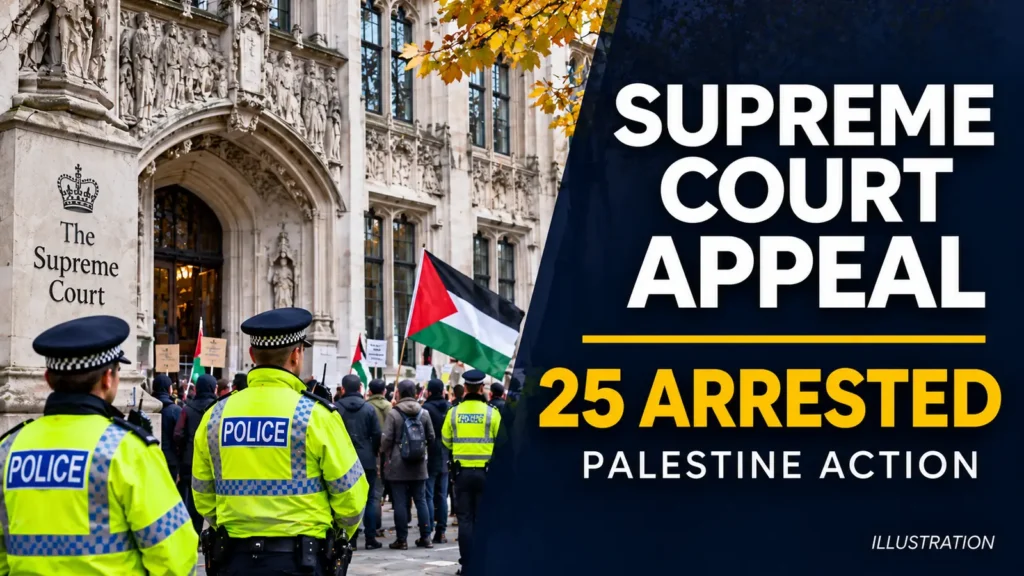
Police arrested 25 protesters outside the UK Supreme Court in London on Wednesday 4 November as judges began hearing a legal challenge to the ban on Palestine Action under terrorism legislation.
The Metropolitan Police said the 25 people were arrested on suspicion of expressing support for a proscribed organisation. Inside the court, Palestine Action co-founder Huda Ammori was challenging the decision to ban the group, arguing that it disproportionately restricts freedom of expression and assembly. The arrests are separate from those at the US embassy last weekend.
What happened outside the Supreme Court?
Demonstrators gathered outside the court in Parliament Square before the hearing. Some held placards referring to Palestine Action. Police officers were filmed lifting protesters from the pavement and carrying them to police vehicles.
The Metropolitan Police confirmed 25 arrests on suspicion of expressing support for a proscribed organisation. A spokesperson said the operation was continuing. The figure was reported by Sky News and Jewish News. Being arrested does not mean a person has been charged or convicted.
What is the court deciding?
Five Supreme Court justices are hearing Ammori’s appeal against the government’s July 2025 proscription of Palestine Action under the Terrorism Act 2000. According to the Supreme Court’s official case record, the question in this appeal is whether the ban is compatible with Articles 10 and 11 of the European Convention on Human Rights, protecting freedom of expression and assembly.
In February 2026, the Divisional Court ruled in Ammori’s favour on human-rights and government-policy grounds, but the Court of Appeal overturned that decision in June. The Supreme Court permitted a further appeal on the human-rights question alone. It refused permission to appeal on the separate ground concerning the Home Secretary’s application of published policy.
The ban came into force on 5 July 2025 and remains in force while the appeal is heard. No judgment had been announced on Wednesday.
What the challengers argued
Raza Husain KC, representing Ammori, told the court that officials had assessed just three of 385 Palestine Action activities over five years as meeting the definition of terrorism, and said these involved serious property damage. This is an argument put forward by the challengers, not a finding made by the Supreme Court.
Ammori’s lawyers compared the group’s direct-action tactics to those of earlier political protest movements, including the suffragettes. Amnesty International UK and Liberty argue that proscription has an unnecessarily broad chilling effect on protest, political speech and association. English PEN and PEN International have also intervened on free-expression grounds.
How the government defended the ban
Sir James Eadie KC, representing the Home Secretary, defended proscription as lawful and proportionate. The government argues that the legal definition of terrorism may encompass serious damage to property even in the absence of injury, and has pointed to Palestine Action incidents involving defence-sector businesses, including Elbit Systems.
The Home Office maintains that the ban restricts support for Palestine Action as an organisation, not support for Palestinians or criticism of Israel. The Community Security Trust and Jewish Leadership Council, also intervening, have warned of risks to Jewish communities if the ban is lifted. Civil-liberties groups dispute whether proscription is a proportionate response.
Why the arrests matter
The police operation unfolded as the judges considered the human-rights consequences of proscription. The 25 arrests follow 325 arrests outside the US embassy on 31 October, when police also used a coach to transport detainees. The two totals concern different demonstrations.
Proscription can criminalise certain forms of membership and support for an organisation. Whether any person arrested committed a criminal offence is a separate question for police, prosecutors and the courts. The Supreme Court is considering the lawfulness of the ban rather than the guilt of individual protesters.
What happens next?
The hearing was listed for 4 and 5 November. The Supreme Court said the afternoon session on 5 November would take place in private, without access for the public or press and without a livestream. Judgment is expected at a later date.
Watch Euronews footage of Wednesday’s arrests or read our earlier report about the 325 arrests at the US embassy.
Sources
- UK Supreme Court: Ammori appeal case record
- UK Supreme Court: hearing attendance and livestream arrangements
- Reuters: arguments heard on 4 November
- Sky News: arrests outside the Supreme Court
- Amnesty International UK and Liberty legal representatives
- Jewish News: police and interveners’ statements
- Euronews: video report