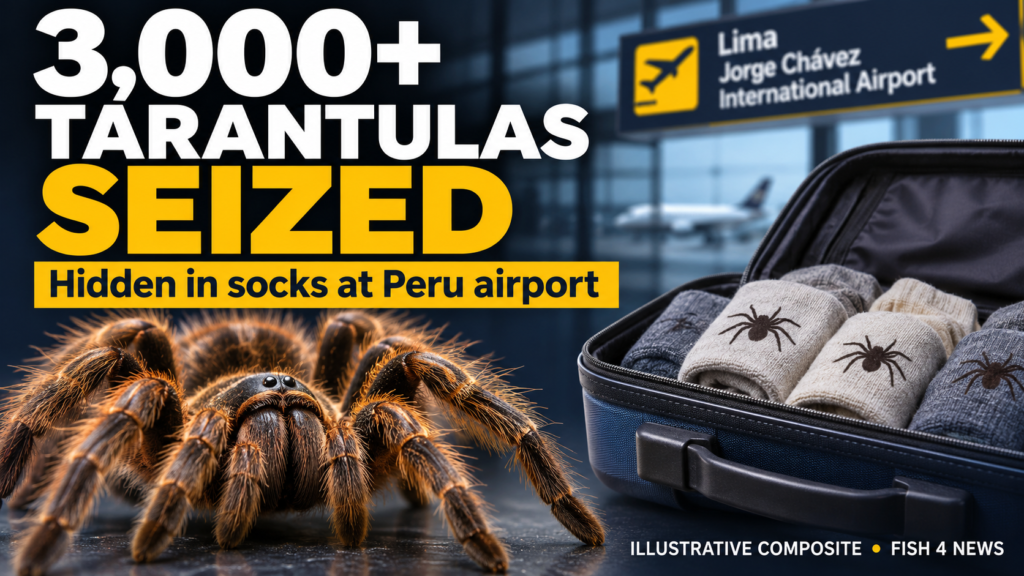
More than 3,000 tarantulas have been seized at Peru’s main international airport after officials discovered the spiders concealed in socks inside three suitcases bound for Germany.
Peru’s National Forestry and Wildlife Service (SERFOR) said the unusual discovery was made at Jorge Chávez International Airport in Lima. Two German citizens and a Polish citizen were detained in connection with the attempted shipment on Thursday 5 November 2026.
The discovery is not simply an unusual airport story. Some of the tarantulas belong to protected species, and wildlife officials say others could represent species that have yet to be formally described by science.
How were 3,000 tarantulas found in the luggage?
According to SERFOR, an anonymous report submitted through its Alerta SERFOR reporting system prompted an intelligence operation. Wildlife officers and customs officials intercepted the travellers as they were preparing to board a flight to Germany.
Inside three suitcases, officers found socks containing arachnids of different sizes and stages of development. Eggs, young spiders and fully grown tarantulas were among the specimens. The socks were reportedly labelled, suggesting the animals had been separated and organised.
AFP also reported that customs officers noticed movement inside the luggage during an inspection. The accounts agree on the seizure, but SERFOR’s description identifies the anonymous tip as the starting point of the operation.
Watch: Peru airport tarantula seizure
If the video does not appear, watch the report on YouTube.
Were the spiders rare or protected?
SERFOR says the spiders originated in several Peruvian regions, including Junín, Loreto, Cajamarca, Cusco and La Libertad. Officials have identified specimens in the Pamphobeteus genus, together with spiders preliminarily listed as Thrixopelma lagunas, Antikuna and Avicularia. Identification work is continuing.
Among those mentioned by the agency is Pamphobeteus antinous, which is listed as vulnerable under Peru’s national protected wildlife rules. SERFOR has also said some seized specimens may be from species not yet described by science. That is an assessment made by the agency, not a completed scientific classification of the whole shipment.
The wildlife authority said one of those detained may be a researcher known for work on tarantulas. That identification remains unconfirmed publicly, and it does not establish any individual’s role or intent.
What would the shipment have been worth?
A SERFOR wildlife control technician, Cora Suárez, told AFP that an individual tarantula could sell for about €500 in Europe. Using that figure across a shipment of more than 3,000 produces an illustrative value of roughly €1.5 million.
That is not an independently verified valuation of the seized animals. Prices differ by species, age, condition and market demand, and authorities have not established what these particular animals would have sold for.
Investigators are examining whether the animals were intended for private collections, research or the exotic pet trade. No final conclusion about the intended buyers has been announced.
What happens next?
The three travellers were detained by officers specialising in environmental crime. Peru’s specialised environmental prosecutor, known as FEMA, is handling the investigation, according to local reporting of SERFOR’s account. The allegations remain subject to legal proceedings, and no conviction has been reported.
The seized tarantulas will remain under official control while identification and assessments continue. SERFOR says they are then expected to be transferred to an authorised breeding facility for safekeeping.
Peru is home to diverse tarantula populations, including species sought by collectors overseas. Removing wildlife from its natural habitat without authorisation can damage local populations and undermine conservation work, particularly where animals are rare or their status is poorly understood.