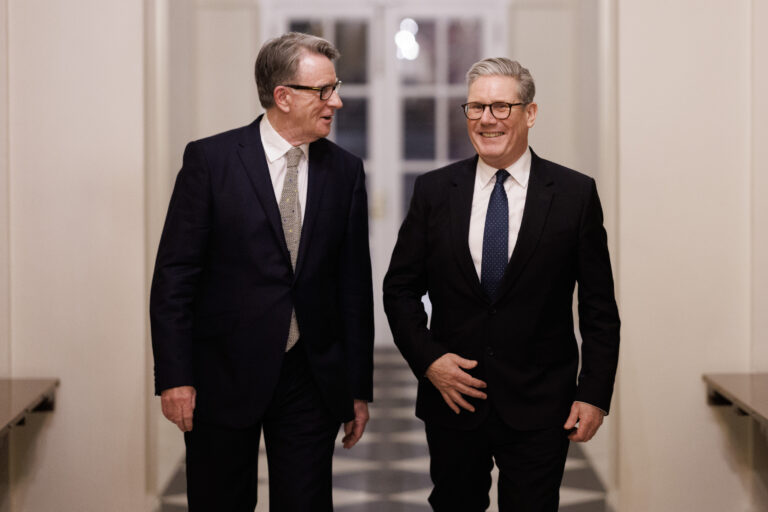
The government has strengthened safeguards for diplomatic appointments following the Peter Mandelson controversy, but the future of Britain’s security vetting system remains undecided and ministers have rejected a proposed parliamentary veto over political ambassadorial appointments.
Security Minister Dan Jarvis updated the House of Commons on Thursday, 26 November 2026, as the Cabinet Office released 32 further documents relating to Mandelson’s appointment and time as British ambassador to the United States.
The statement sets out progress on measures announced earlier this year, rather than a wholly new set of rules. It also confirms that two independent reviews commissioned after the controversy have yet to report.
What went wrong with Peter Mandelson’s appointment?
Mandelson’s appointment was announced in December 2024. He took up the role in February 2025 and was dismissed in September after further information emerged about his relationship with convicted sex offender Jeffrey Epstein.
In its report published on 9 July 2026, the Commons Foreign Affairs Committee concluded that Downing Street had driven the appointment without a sufficiently robust assessment of Mandelson’s suitability. MPs also criticised the lack of a formal procedure for political appointments to diplomatic posts.
On 20 April, then prime minister Sir Keir Starmer told Parliament that UK Security Vetting had recommended denying Mandelson developed vetting clearance on 28 January 2025. Foreign Office officials nevertheless granted clearance on 29 January 2025. Starmer said he had not known about the recommendation when Mandelson took up the post and accepted that appointing him had been a mistake.
What has the government changed?
The government’s formal response to the Foreign Affairs Committee, published on 16 October, accepted several of the committee’s recommendations. Jarvis confirmed on Thursday that changes to the process were already under way.
- Future diplomatic appointments will not be made or announced until the required security clearance has been granted. Heads of Mission employed by the Foreign Office must hold developed vetting clearance.
- The Foreign Office will apply the Cabinet Office guidance on direct ministerial appointments when relevant to the Diplomatic Service.
- The Foreign Office will conduct its own due diligence on proposed political appointees, assess reputational risks and advise ministers on how those risks could be managed.
- The Foreign Secretary will remain responsible for recommending Heads of Mission to the King.
Revised Cabinet Office guidance on direct ministerial appointments was published on 1 June. It establishes a clearer framework for deciding whether direct appointment is appropriate, assessing candidates and identifying risks before they take up a role. Where due diligence identifies concerns, the candidate should be interviewed and the appointing minister informed.
The reforms preserve the government’s ability to make political diplomatic appointments. They are intended to make the process more systematic, not to require every ambassador to be selected through a competitive civil service recruitment exercise.
Can security vetting recommendations still be overruled?
This is one of the most important questions left unanswered. Developed vetting is a high level of national security clearance. It is distinct from the checks carried out to assess an individual’s reputation and suitability for appointment.
Requiring clearance before an appointment is announced would prevent the sequence of events in which Mandelson’s selection became public before his vetting had concluded. It does not, by itself, prevent an adverse recommendation from being overturned.
In April, Starmer announced that the Foreign Office’s ability to make final developed vetting decisions had been suspended. An independent review of the national security vetting system, led by Sir Adrian Fulford, was commissioned to examine the wider process.
The October government response deferred its answers to the committee’s vetting recommendations, including questions about decision-making accountability and the information ministers should receive. Jarvis said on Thursday that Fulford’s review was nearing completion. The government has not yet set out the permanent arrangements for resolving disagreements over vetting recommendations. The committee also wants decision-makers to have access to appropriate vetting documents, while protecting confidentiality, if departments regain the power to make clearance decisions.
Why ministers have rejected a parliamentary veto
The Foreign Affairs Committee wanted political candidates for Head of Mission posts to appear before MPs before appointment, with the committee able to block an unsuitable candidate.
The government has rejected the proposed veto, arguing that ministers must ultimately be accountable for their choice. It has instead offered to explore a different form of pre-appointment parliamentary scrutiny.
One complication is that ambassadorial appointments require royal approval and the agreement of the receiving country. Candidates’ names are ordinarily kept confidential until those approvals are obtained.
Committee chair Dame Emily Thornberry said on Thursday that a proposed working group between her committee and Foreign Office officials had yet to become fully operational. She also called for publication of Fulford’s findings so that vetting reform could progress.
This means stronger parliamentary scrutiny is a government commitment, but its precise form has yet to be agreed.
In the Commons, Conservative shadow minister Charlie Dewhirst criticised the slow release of documents and pressed the government over safeguards. Liberal Democrat MP Lee Dillon questioned the handling of financial interests and unofficial communications.
Conflicts of interest and government records
The newly released documents show that officials identified potential conflicts arising from Mandelson’s continuing shareholding in Global Counsel, the political advisory firm he co-founded. Whether the safeguards put in place were effective remains disputed.
Jarvis told MPs that the Cabinet Office would shortly publish a strengthened policy governing the declaration and management of outside interests across government. The policy is not yet available for scrutiny.
The committee also sought better record keeping, regular audits and reporting to Parliament. The government’s October response noted those recommendations, referred to reminders issued to officials and described further review work, without explicitly accepting the proposed audit and reporting arrangements.
A separate independent review led by Sir Anthony Finkelstein is examining the use of unofficial communication channels for government business. Jarvis said it was due to report in January 2027.
What is happening with the police investigation?
The Metropolitan Police investigation into alleged misconduct in public office remains ongoing, Jarvis confirmed on Thursday. Further material relating to vetting, conflicts of interest and correspondence is being withheld at the police’s request.
Mandelson was arrested on 23 February 2026 on suspicion of misconduct in public office. Sky News reported on Thursday that the Metropolitan Police confirmed its investigation remained ongoing. Mandelson denies wrongdoing. No charges have been reported as of 26 November. The criminal investigation into his historical dealings with Epstein is separate from the examination of how he was appointed as ambassador. Findings about deficiencies in the appointment process are not evidence of criminal guilt.
What happens next?
The next substantive developments will be the publication of Fulford’s findings, the government’s response to those findings, the new outside-interests policy and agreement on the Foreign Affairs Committee’s future role.
The changes already announced address the timing of security clearance and the absence of a clear appointment process. Whether they address the central weaknesses identified by MPs will depend on how vetting disagreements are resolved, how conflicts are managed in practice and how effectively appointments can be scrutinised.
Sources
- Hansard: Peter Mandelson, response to Humble Address (26 November 2026).
- Foreign Affairs Committee: Chair’s response to Mandelson papers (26 November 2026).
- Foreign Affairs Committee: Government response (16 October 2026).
- Foreign Affairs Committee: Report on Mandelson’s appointment (9 July 2026).
- Cabinet Office: Guidance on direct ministerial appointments (1 June 2026).
- Prime Minister’s statement on the appointment of Peter Mandelson (20 April 2026).
- Sky News: Metropolitan Police confirmation that the investigation remains ongoing (26 November 2026).
- Archive image: Simon Dawson / No 10 Downing Street, 26 February 2025, Open Government Licence v3.0.
Follow the story
Read our earlier report: New Peter Mandelson files reveal business interests and security concerns during US ambassadorship.
Fish 4 News will follow the publication of the Fulford and Finkelstein reviews, the new conflicts-of-interest policy, the government’s response and confirmed developments in the police investigation.