A sophisticated US electronic warfare aircraft has taken part in an unusually large allied air exercise close to Russia’s Kaliningrad exclave, drawing attention to NATO’s growing ability to operate around one of Moscow’s most heavily defended regions.

A US Air Force EA-37B Compass Call spent around two hours operating over northern Poland close to the Russian territory of Kaliningrad on 18 August, as part of several days of US-led allied military activity across Poland and the Baltic region.
The aircraft remained in Polish airspace and there is no evidence that it entered Russian territory or actively jammed Russian military systems.
Its presence was nevertheless significant.
The EA-37B is one of the newest electronic warfare aircraft in the US military and is specifically designed to disrupt communications, radar, navigation systems and other parts of an adversary’s electronic network.
It flew alongside a wider collection of allied aircraft including fighters, aerial refuelling tankers and a NATO E-3A AWACS surveillance and command aircraft.
Up To 50 Aircraft May Have Been Involved
Stars and Stripes, an independent US military news organisation authorised by the Department of Defense to serve the overseas American military community, reported that estimates based on flight tracking suggested somewhere between 25 and 50 aircraft may have been involved, although officials declined to confirm an exact number for security reasons.
Despite its Department of Defense authorisation, Stars and Stripes is not an official government mouthpiece and states that its reporting does not represent or carry the endorsement of the US government.
Colonel Martin O’Donnell, spokesman for Supreme Headquarters Allied Powers Europe, confirmed that the training included American and Norwegian fighter aircraft, Polish ground forces and a NATO E-3A AWACS aircraft.
The operation was US-led and involved NATO and allied assets, although reporting by The War Zone said a NATO official described it as allied and US-controlled rather than a NATO-controlled operation.
The combination of aircraft involved attracted attention from military analysts because it brought together several capabilities that would be required during a major air operation.
AWACS aircraft can provide surveillance and command and control. Tankers allow combat aircraft to remain airborne for considerably longer periods, while fighter aircraft can carry out defensive or offensive missions.
The EA-37B adds another layer: electronic attack.
What Is The EA-37B Compass Call?
The EA-37B is based on the Gulfstream G550 business jet but carries highly specialised electronic warfare equipment.
The US Air Force describes it as a “wide-area airborne electronic attack weapon system”.
Its mission includes denying, degrading and disrupting enemy communications, information processing, navigation, radar systems and radio-controlled threats.
It is replacing the much larger EC-130H Compass Call, which has performed electronic warfare operations for the United States for decades.
The newer aircraft can operate at higher altitudes and greater speeds while carrying an updated version of the Compass Call electronic warfare system.
Its appearance close to Kaliningrad was particularly notable because the aircraft is only now moving into operational service.
Military aviation reporting described the August flight as apparently the first known EA-37B operation in the immediate Kaliningrad area.
Why Kaliningrad Matters
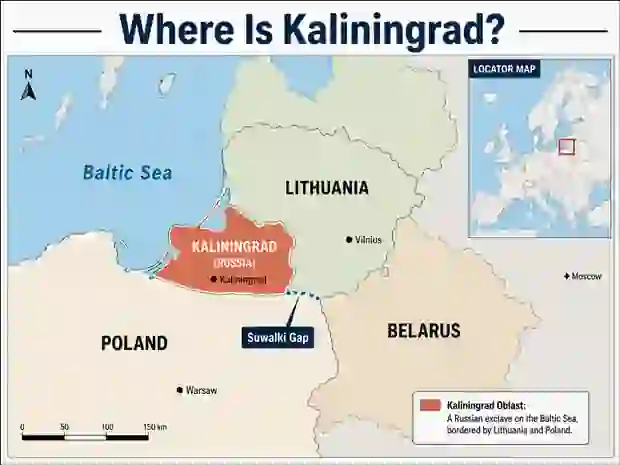
Kaliningrad is a Russian exclave on the Baltic Sea separated from the rest of Russia and positioned between NATO members Poland and Lithuania.
Despite its relatively small size, it has considerable military importance.
Russia has stationed air defence systems, missiles, ground forces and naval assets in the region, while Kaliningrad also supports Russia’s Baltic Fleet.
Its location means Russian forces based there could potentially threaten NATO aircraft, ships and reinforcement routes across the Baltic region during a conflict.
Kaliningrad is also situated close to the Suwalki Gap, the narrow stretch of territory between Poland and Lithuania that separates Kaliningrad from Russia’s ally Belarus.
For years, military planners have viewed the area as one of the most strategically sensitive locations on NATO’s eastern flank.
However, Kaliningrad’s geography also creates a potential weakness for Russia.
In the event of a wider NATO-Russia conflict, the territory would be surrounded by NATO countries and geographically isolated from mainland Russia.
Was NATO Practising An Attack On Kaliningrad?
There is no public evidence establishing that.
The presence of fighters, electronic warfare aircraft, airborne command systems and tankers means the exercise included capabilities that could be used to suppress or bypass sophisticated Russian air defences during a conflict.
That does not mean the August exercise was specifically a rehearsal for attacking Kaliningrad.
Polish military authorities said the activity was planned in advance and intended to improve cooperation between allied forces.
US officials separately described the wider activity as part of NATO’s deterrence posture.
There is also no evidence that the EA-37B used its electronic attack systems against Russian radar or communications during the flight.
The distinction matters.
Flying an aircraft capable of electronic warfare close to Russian territory demonstrates a military capability. Actively using that capability against Russian systems in peacetime would be a much more serious action.
No evidence has emerged that the latter occurred.
NATO Has Previously Discussed Kaliningrad’s Vulnerability
The latest exercise follows unusually direct comments from senior American military figures about what could happen to Kaliningrad if Russia attacked NATO.
In July 2025, US Army Europe and Africa commander General Christopher Donahue said allied forces had developed the capability to neutralise Russian defences in Kaliningrad from the ground in a timeframe faster than had previously been possible.
Former US Army Europe commander Ben Hodges later went further.
He said that if Russia launched an attack against a NATO member such as Poland, Russian military capabilities in Kaliningrad would be among those targeted during the opening hours of the conflict.
Those comments were made in the context of responding to a Russian attack rather than advocating an offensive against Russia.
Tensions Around Poland Have Increased
The exercise also comes against the background of continuing concerns about Russian military activity close to NATO territory.
At the end of July, Polish authorities said a Russian Kh-101 cruise missile entered Polish airspace during a major Russian attack on Ukraine before eventually crashing.
Polish Deputy Defence Minister Cezary Tomczyk described the incident as a provocation and a test of the alliance.
Recent US intelligence reporting has also raised concerns that Russia could attempt some form of limited action against a NATO member within the next few years to test the alliance’s response.
That assessment should not be confused with claims that US intelligence expects an attack imminently.
Large multinational military exercises involving specialist aircraft are also normally planned well in advance, making it difficult to link the 18 August operation directly to any single recent Russian action.
Russia Has Not Ignored The Flight
The operation has attracted attention inside Russia.
Russian senator Vladimir Dzhabarov accused Western countries of increasing tensions around Kaliningrad and warned that Russia would respond strongly to any genuine provocation against the territory.
Russian military commentators have also speculated that the EA-37B may have been examining or preparing ways to counter the region’s electronic and air defence systems.
Those claims remain speculation.
There has been no evidence of an extraordinary Russian military alert or any indication that the Kremlin regarded the flight as the beginning of an attack.
A Demonstration Without Crossing The Border
The significance of the 18 August operation is therefore more subtle than some of the more dramatic claims surrounding it.
An unusually sophisticated combination of allied aircraft operated close to one of Russia’s most strategically important military regions.
Among them was a new US electronic attack aircraft specifically designed to interfere with many of the systems that modern air defences depend upon.
Nothing currently proves that NATO was practising an attack on Kaliningrad and the aircraft did not enter Russian airspace.
But the exercise demonstrated capabilities that would become extremely important if NATO ever had to operate against Russian forces in the region.
For Moscow, that message is difficult to miss.