Reform UK MP Sarah Pochin was challenged on GB News about her failure to record a vote at the Sentencing Bill’s final Commons reading, despite publicly condemning the prison early-release policy it helped introduce. The exchange on Tuesday 10 November 2026 has prompted renewed scrutiny of the Runcorn and Helsby MP’s parliamentary record.
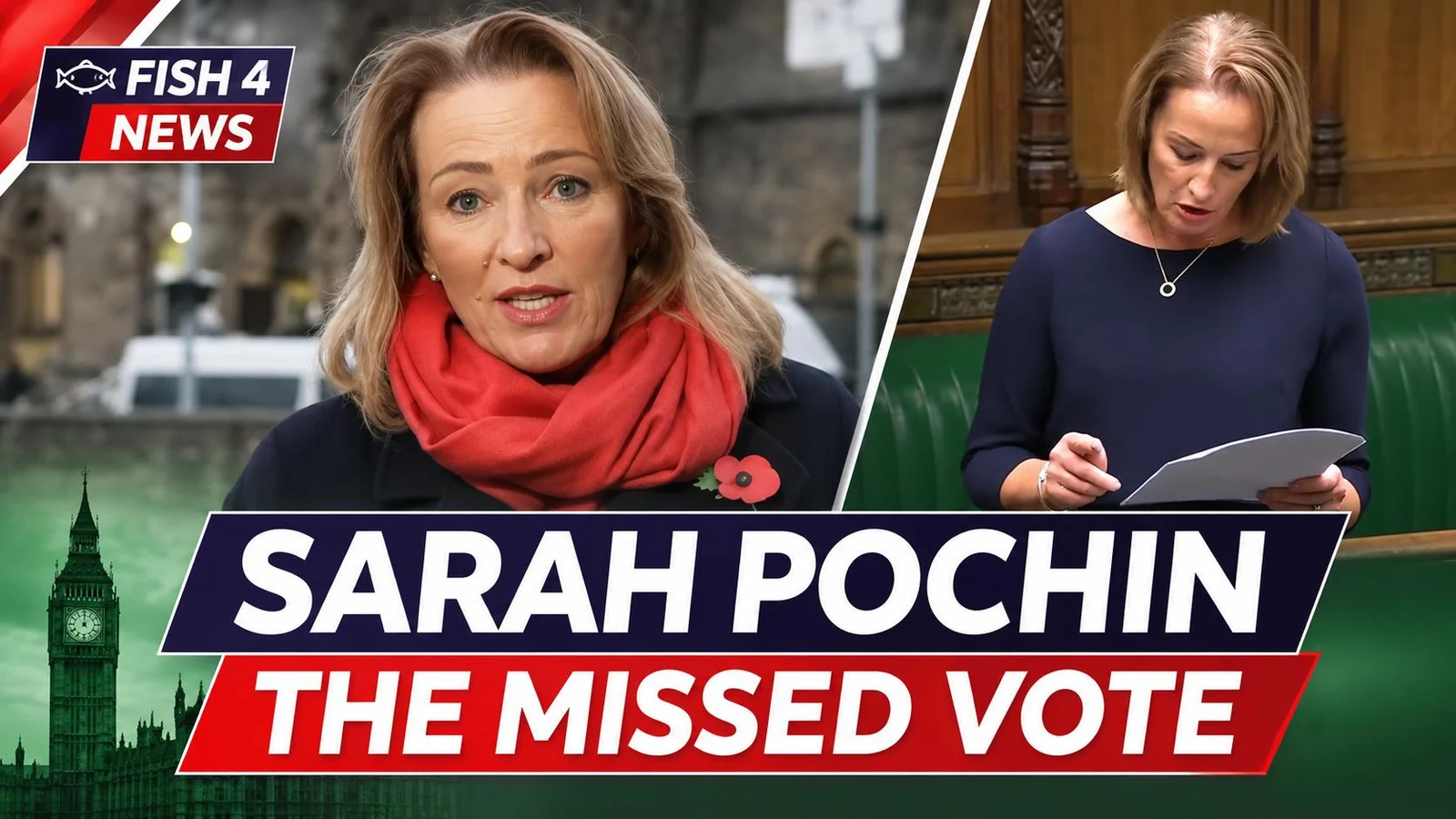
The key distinction is that Pochin did vote against the Bill at its second reading in September 2025 and took part in votes during its committee stage. However, the official division record confirms that she did not record a vote at its third reading on 29 October 2025, when four other Reform UK MPs voted against it.
What happened to Sarah Pochin on GB News?
Pochin was speaking outside HMP Wandsworth as another phase of England and Wales’s revised prisoner-release arrangements came into effect. She argued that ministers could avoid releasing prisoners earlier by deporting eligible foreign national offenders and increasing prison capacity.
Presenter Alex Armstrong asked why she had not voted at the Sentencing Bill’s third reading. After a pause, Pochin moved to her objections to the legislation, arguing that the Bill did not go far enough. Her response did not give a specific reason for the missing vote. The exchange appears in the commentary video shared with Fish 4 News, which contains clips from the broadcast.
How did Sarah Pochin vote on the Sentencing Bill?
- 16 September 2025: Pochin spoke against the Bill and voted No at second reading. She said her experience as a magistrate informed her concerns about sentencing and prison capacity. Read her Commons speech.
- 21 October 2025: She participated in several divisions during the Bill’s committee stage, backing some proposed changes and opposing a clause. These votes appear in her official voting record.
- 29 October 2025: The Bill passed its final Commons reading by 321 votes to 103. Reform MPs Lee Anderson, Nigel Farage, Danny Kruger and Richard Tice voted No. Pochin was listed among MPs with no vote recorded. See division 336.
- 22 January 2026: The legislation received Royal Assent and became the Sentencing Act 2026. See the parliamentary timeline.
Pochin’s absence from that final division is therefore a legitimate question for a politician strongly opposed to the policy. It is not evidence that she supported the Bill, and claims that she never voted against it are inaccurate.
Why was Sarah Pochin absent from the final vote?
The official voting record does not state why Pochin did not vote. MPs can miss divisions because of illness, constituency work, parliamentary duties or other circumstances.
There is relevant contemporaneous reporting: a Guardian parliamentary sketch published on 29 October 2025 reported that she was unwell and had not been seen for days. That raises a plausible explanation, but it is not a confirmed account from Pochin of why she missed this specific division. Describing her as simply unwilling to vote would go beyond the evidence.
What about the deportation alternative she proposed?
Pochin suggested removing foreign national offenders from British prisons rather than releasing other prisoners early. Yet the Sentencing Act 2026, section 35, already provides for the removal of the minimum custodial period before certain foreign national prisoners can be removed for deportation.
The power is not a universal or instant deportation mechanism. It applies to eligible prisoners and does not eliminate legal, operational or diplomatic obstacles. In a September 2026 parliamentary answer, justice minister Jake Richards said ministers expected to implement the power early in 2027, while excluding some of the most serious offenders from immediate removal.
Her proposal therefore overlaps with a provision in the legislation Reform UK opposed. That does not mean the policy has already been implemented or that deportations alone could resolve prison overcrowding.
Why are around 650 prisoners being released?
The Ministry of Justice estimated that approximately 650 people would be released on the first day of the third implementation phase, which began on 10 November 2026. This is a projection, not a verified final count of people who actually left custody that day. It is one of ten planned phases running into 2027.
Under the progression model, many prisoners serving standard determinate sentences can reach their earliest release point after one-third of their sentence. Other offenders have different release points, and the Government excluded several serious categories, including rape, specified child sexual offences, offences involving organised child sexual exploitation and unlawful killing. People released under licence remain subject to conditions and may be recalled to prison. Read the Ministry of Justice’s estimates and the Commons Library briefing.
Is Sarah Pochin right about prisoners being released without tags?
Pochin has raised the question of electronic monitoring repeatedly. During Justice questions in the Commons on 10 November, she asked how many people could be released without a tag because of homelessness or mental health issues.
Minister Alex Norris referred to a presumption in favour of tagging and said fuller data would be published. Separately, a written parliamentary answer on 22 October said that poor mental health alone was not grounds for exemption, although tagging can be medically inappropriate in particular cases. The precise number released without tags was not established by those answers.
What the GB News exchange actually shows
The interview exposed an unanswered question about the difference between Pochin’s forceful public criticism and her lack of a recorded vote at the Bill’s final Commons stage. Her earlier opposition, documented involvement in committee votes and contemporaneous reports of illness are also part of the factual record.
Whether the reasons for her absence were satisfactory cannot be judged without an explanation from Pochin herself. The prison policy can be assessed separately against its stated aims, exclusions, enforcement and practical consequences.
Watch the exchange
The following video is independent political commentary, not a full unedited GB News broadcast. It includes extracts of the interview and footage from parliamentary proceedings.
Sources and further reading
- UK Parliament: Sentencing Bill third-reading division, 29 October 2025
- UK Parliament: Sarah Pochin’s voting record
- Hansard: Sentencing Bill second reading
- Sentencing Act 2026: section 35
- Ministry of Justice: phased-release estimates
- Hansard: justice questions, 10 November 2026
- The Guardian: contemporaneous reporting of Pochin being unwell
For further updates, follow our Sarah Pochin coverage.