A new £2 billion-plus electricity connection between Suffolk and Kent has been approved, promising to ease pressure on Britain’s power grid. But whether households will see lower bills, and what the project ultimately costs, remain important questions.
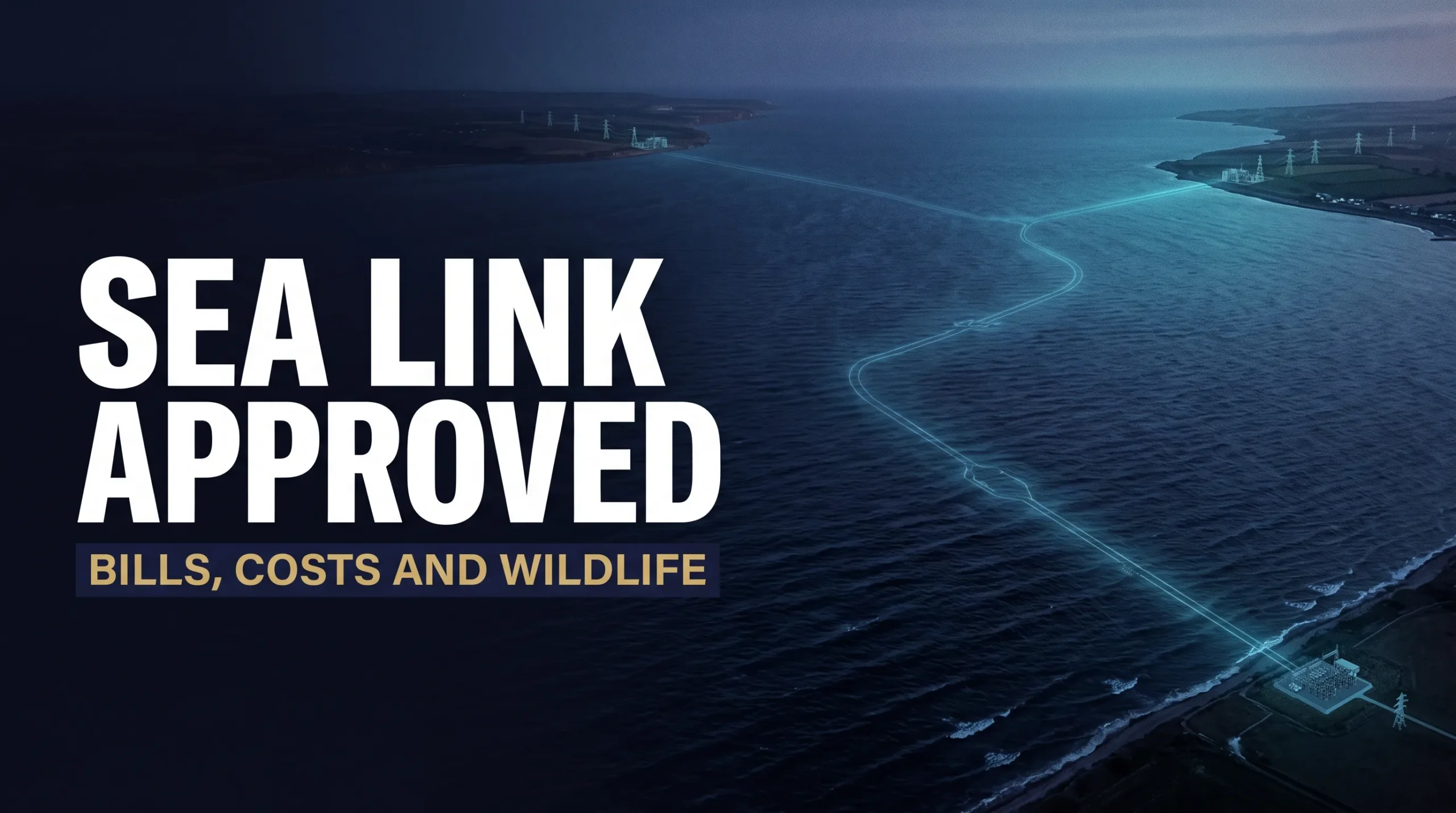
The government granted development consent for Sea Link on Friday 30 October 2026. National Grid plans a 2-gigawatt (GW) connection, running mainly beneath the North Sea, to move electricity from East Anglia towards the South East. Construction is expected to begin in early 2027 and the connection is currently due for completion in 2031.
Why should households care?
Electricity does not always flow freely from where it is generated to where people need it. If parts of the network are congested, the system operator may pay some generators to reduce output and arrange other power elsewhere. Those network-management costs ultimately matter to consumers.
Sea Link is intended to increase capacity between East Anglia and the South East, where more offshore wind and other generation is expected to connect. The government says relieving congestion should reduce the need for costly interventions. But it has not provided a guaranteed amount that an individual household’s bill would fall because of this particular cable.
The distinction matters: Sea Link is not a new power station. National Grid’s statement that it could carry enough electricity for the equivalent of two million homes is a comparison of transmission capacity, not a promise to supply two million homes continuously or exclusively.
What will it cost, and who pays?
In its September 2026 project assessment, energy regulator Ofgem recorded National Grid Electricity Transmission’s request for £3.197 billion in 2023/24 prices. Ofgem proposed an allowance of £2.8915 billion, removing £305.5 million from that request.
These are regulatory proposals, not a final construction bill or an approved final allowance. When checked on 31 October, Ofgem still listed its consultation as closed and awaiting a decision. Some costs may also be considered separately through future funding mechanisms.
Electricity network investment is paid for through regulated charges that form part of the overall cost of supplying electricity. Ofgem identifies network costs as one component of household energy bills. Whether the longer-term savings from less congestion outweigh the scheme’s costs will depend on what is built, when it becomes operational and how the system is used.
Ofgem cited National Energy System Operator modelling suggesting £1.1 billion to £1.4 billion in consumer benefits if Sea Link could be brought forward to 2030. That is a modelled benefit from an earlier delivery scenario, not an estimate of money to be returned directly to households, and the current completion target is 2031.
What exactly has been approved?
- A 2GW high-voltage electricity connection between Suffolk and Kent.
- Approximately 122km of subsea cable, with underground connections on land and a total high-voltage route of around 138km.
- Converter stations in Suffolk, near Saxmundham, and Kent, near Minster, plus related works to the existing electricity network.
- A nationally significant infrastructure project granted development consent after examination by the Planning Inspectorate.
National Grid says Siemens Energy has been appointed to deliver the converter stations. It says the subsea cable will be manufactured by Sumitomo Electric at a new factory at the Port of Nigg in Scotland. These are potential UK supply-chain benefits, although the factory’s own £350 million investment should not be confused with Sea Link’s project budget.
Why are local communities and conservation groups opposed?
Suffolk County Council says it remains opposed and argues that construction traffic, disruption, environmental harm and the cumulative effect of several large energy developments in the county have not been adequately addressed. It says it will hold National Grid to its commitments as the project moves forward.
At the Kent end, the cable would make landfall at Pegwell Bay, part of the Sandwich and Pegwell Bay National Nature Reserve. Kent Wildlife Trust warns of potential disturbance to protected birds and damage to sensitive coastal habitat, including saltmarsh. The charity says saltmarsh affected by the earlier Nemo Link project has still not fully recovered, a concern it wants taken seriously in Sea Link’s environmental safeguards.
These are stated objections and concerns from the council and charity, not findings that Sea Link has already damaged those habitats. The Planning Inspectorate says local views and evidence were considered during its examination.
The government says community benefit funds of more than £1 million each will be delivered in Kent and Suffolk. National Grid’s earlier information describes planned funds of approximately £1.06 million for each county. The funds do not remove the need to manage construction and environmental effects.
An unresolved technical question
Ofgem has identified a separate issue with electrical harmonics, distortions in the electricity waveform that need to be controlled to protect reliable operation of the network. Its September assessment says further study and possible additional filters or reinforcement elsewhere on the grid may be needed so Sea Link can operate at its full intended 2GW capacity.
This does not mean the project is unworkable. It does mean the precise solution, its location and any additional funding implications had not been fully settled in the assessment.
What happens next?
Development consent allows the scheme to advance, but does not mean construction can begin everywhere without further checks. National Grid says it will work with local authorities on detailed construction arrangements, including traffic management and environmental measures, before work begins. The company currently expects construction to start in early 2027 and completion in 2031.
For the wider public, the questions to watch are whether the project is delivered on time, whether the final cost stays within regulatory allowances and whether the promised reduction in network congestion translates into value for electricity consumers. For communities in Suffolk and Kent, the test will also be how effectively the project’s environmental and disruption commitments are enforced.
Sources
- Department for Energy Security and Net Zero, approval announcement (30 October 2026)
- Planning Inspectorate, development consent announcement (30 October 2026)
- Ofgem, Sea Link project assessment (1 September 2026)
- National Grid, development consent response (30 October 2026)
- Suffolk County Council, response to approval (30 October 2026)
- Kent Wildlife Trust, response to approval (30 October 2026)
- Ofgem, how energy bills are calculated