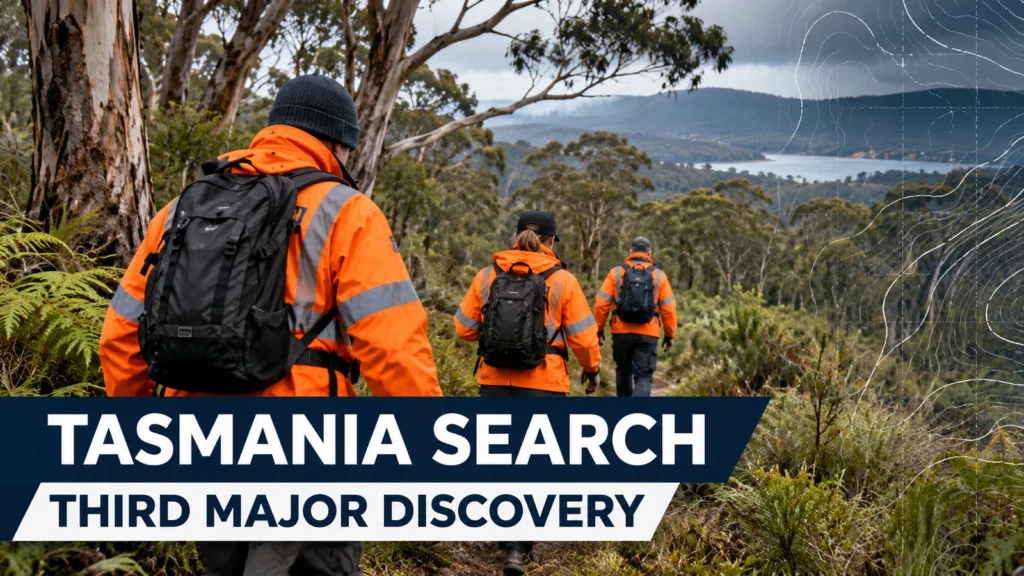
A volunteer search team in Tasmania has discovered suspected human remains while looking for missing man Michael Vrankovic, marking a third major breakthrough involving the searchers behind Find Our Lost Loved Ones. Police stress that the latest remains have not yet been formally identified.
The discovery was made on Friday 6 November on a bush block near George Town, in northern Tasmania, just hours into a three-day search involving about 60 volunteers. The searchers had divided into five teams to cover an area where police and emergency services had previously carried out extensive work.
It is an extraordinary development for a relatively new volunteer organisation. But it also raises an important question: how can private searchers contribute to missing-person investigations without undermining the urgent work of police and emergency services?
What happened in George Town?
Mr Vrankovic, 58, was last confirmed seen in the George Town area on 13 January 2026. A neighbour reported concerns eight days later, after which Tasmania Police and the State Emergency Service searched around George Town, Low Head, Beechford and Mount George. Searches between 23 January and 5 March included ground teams, motorbikes and helicopter work.
On 6 November a volunteer discovered what police believe are adult human remains. The volunteer immediately notified Tasmania Police, who sent officers and specialist forensic personnel to the scene. Inspector Melanie Groves confirmed that identification could take several weeks and said a report would be prepared for the coroner.
As of 9 November, police have not confirmed that the remains belong to Mr Vrankovic. Their discovery should therefore not be treated as a formal identification, nor has a cause of death been established.
According to ABC News, the site had been burned off since Mr Vrankovic disappeared, leaving some ground more open than it may have been during earlier searches. His family has thanked police, emergency services, residents and the volunteers for their efforts.
Who are Find Our Lost Loved Ones?
Find Our Lost Loved Ones (FOLLO) grew out of the prolonged search for Belgian traveller Celine Cremer, who vanished while walking near Philosopher Falls in June 2023. After an initial official search, her family engaged private investigator Ken Gamble of IFW Global. Volunteers helped find her mobile phone in December 2025, and an individual searcher who had taken part in that effort discovered human remains in January 2026.
Those discoveries brought together people determined to put their skills and time towards other families’ searches. They subsequently formed FOLLO as an organised volunteer group.
In May 2026, FOLLO volunteers located suspected human remains while searching for Peter Willoughby, a 76-year-old Scottsdale man missing since October 2025. Police thanked searchers and began forensic work. The George Town discovery is therefore the third major breakthrough associated with this volunteer network in 2026, although the organisation itself was established after the Cremer search.
The painstaking methods behind the searches
FOLLO’s approach relies on preparation as much as fieldwork. The group says it uses open Tasmanian mapping data in QGIS to divide promising terrain into measured grids, with teams walking carefully spaced lines while recording their movements through the QField mapping application.
That record helps organisers understand which ground has been covered and which gaps still need attention. FOLLO also undertakes reconnaissance missions, assesses access and terrain, and selects volunteers according to the demands of each operation.
President Jon Edmunds told ABC News that planning for the Vrankovic search began in April. The group brought around 60 searchers to George Town, its largest deployment yet, while secretary Alex Smith said it had approximately 270 registered volunteers across Australia. Members include bushwalkers, nurses, paramedics and people with other practical experience.
Its volunteers are not conducting an initial emergency rescue. They are able to spend months preparing renewed, methodical searches after the immediate official operation has been scaled back. The difference in timing, intelligence and conditions matters when judging the results.
Does this mean police searches failed?
Not necessarily. The initial operation must prioritise the possibility of finding someone alive, often in difficult weather and with incomplete information. Volunteer teams arriving months or years later have different objectives, preparation time and sometimes substantially changed ground conditions.
FOLLO secretary Alex Smith has said the group would have taken much the same approach as police if it had been involved at the outset of Mr Vrankovic’s disappearance. He described a cooperative relationship with Tasmania Police, including extensive contact during preparations.
Inspector Groves has said police and volunteers share the purpose of helping families. Tasmania Police has defended its ability to conduct searches and says it will continue acting on available leads.
What the Celine Cremer coroner actually found
The issue was examined in detail by coroner Madeleine Wilson, whose findings on Celine Cremer’s death were issued in August 2026. She ruled that Ms Cremer died accidentally after becoming lost in remote terrain, and found that the initial Tasmania Police response was appropriate, taking account of the information, environmental conditions and search methods available at the time.
The coroner praised the private investigators and volunteers, but also identified risks associated with unofficial searches. Poorly managed efforts can place searchers in danger, disturb scenes, contaminate evidence or spread inaccurate information that causes distress to families.
She recommended that Tasmania Police review how private search groups are used in missing-person investigations and consider formal arrangements covering eligibility, registration, information sharing and evidence handling.
In comments reported by ABC News on 7 November, Tasmania Police said that protocols were still being finalised, but its review was already informing cooperation and the sharing of information with groups including FOLLO.
What happens next?
The immediate priority is the forensic examination and formal identification of the remains found near George Town. Until those results are available, questions about identity, how the person died and the precise circumstances of the discovery must remain open.
The wider story is not a competition between police and volunteers. It is about how careful, coordinated civilian searches may extend the work of official investigations and help families who have lived with uncertainty, while protecting evidence and the safety of everyone involved.
Watch the ABC News report
Sources
- Tasmania Police: remains located near George Town, 6 November 2026
- ABC News: how FOLLO made its third discovery, 7 November 2026
- ABC News: background to the Michael Vrankovic search, 8 June 2026
- Tasmania Police: Peter Willoughby search, 30 May 2026
- Tasmanian Coroners Court: Celine Cremer findings, 25 August 2026 (PDF)
- FOLLO: official organisation and search methods