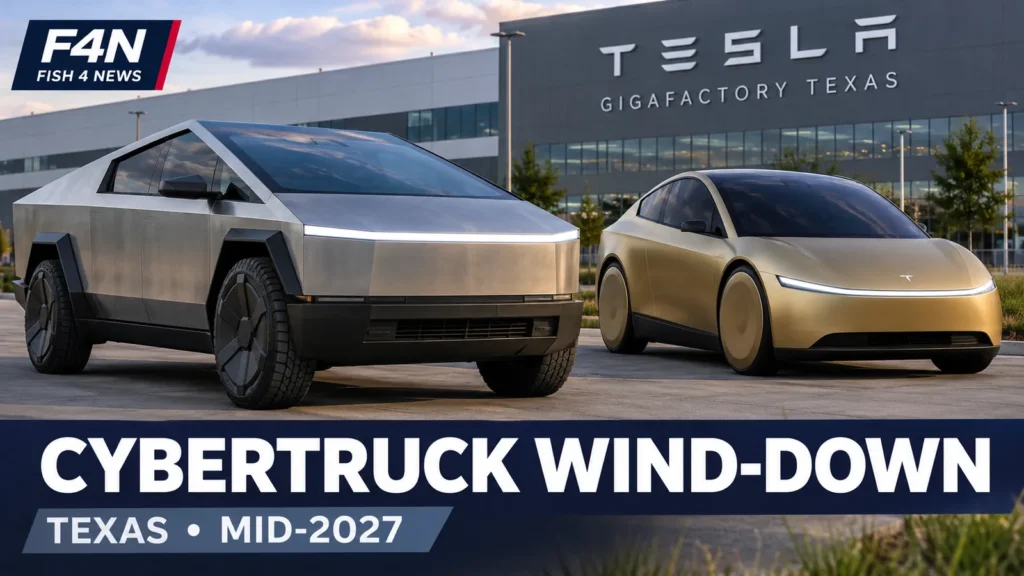
Tesla will wind down production of its Cybertruck at its Texas factory around mid-2027, chief executive Elon Musk has confirmed, as the electric carmaker makes room for more Cybercab autonomous taxis.
The announcement is a major retreat for one of Tesla’s most distinctive vehicles, following sales far below the volumes Musk once envisaged. It does not, however, amount to an explicit announcement that Cybertruck production will cease worldwide.
What Elon Musk announced
In a post on X published on 6 November, Musk said production would be wound down at Gigafactory Texas around the middle of 2027 to make room for increased Cybercab production. He gave no precise final assembly date, production target or location for any possible replacement line.
The Texas facility is the only known Tesla factory currently equipped to assemble the Cybertruck. Without confirmation of an alternative site, the announcement raises serious questions about the pickup’s future, but a definitive worldwide cancellation would go beyond Musk’s stated decision.
Cybertruck sales fell sharply
US sales estimates compiled by Cox Automotive and Kelley Blue Book put Cybertruck sales at 38,965 in 2024 and 20,237 in 2025, a fall of 48.1%. Its 2025 electric vehicle sales report provides the model-level comparison.
The same research organisation estimated 11,586 US Cybertruck sales in January to September 2026, down 28% from 16,097 in the equivalent period of 2025. Its third-quarter 2026 report recorded 4,323 Cybertruck sales in July to September, 19.7% below the same quarter a year earlier.
Those are industry estimates, not Cybertruck-specific totals published by Tesla. Tesla’s own third-quarter production and deliveries release groups the pickup with other models, making direct comparisons with the US estimates inappropriate.
The results were a long way below Musk’s previous ambition of selling around 250,000 Cybertrucks a year. They also came amid broader difficulties for the US electric vehicle market, so the Cybertruck’s decline should not be attributed to one factor alone.
A highly publicised launch, followed by difficulties
The angular stainless-steel pickup was unveiled in 2019 and first reached customers in late 2023, later than originally envisaged. Its distinctive appearance won an enthusiastic following but also divided opinion, while pricing, manufacturing challenges and repeated safety recalls complicated its commercial prospects.
The US National Highway Traffic Safety Administration has published multiple Cybertruck recalls. One April 2024 safety notice concerned an accelerator-pedal cover that could come loose and become trapped by interior trim, potentially causing unintended acceleration. Tesla said affected vehicles would be repaired.
The model’s potential international market was also constrained. The Dutch government confirmed in a 2025 parliamentary response that the Cybertruck did not have EU vehicle type approval. That does not mean every possible individually imported vehicle is automatically prohibited on every European road, but it is a significant obstacle to conventional mass-market sales in the EU.
Why Tesla is prioritising Cybercab
Tesla is allocating more of its Texas manufacturing capacity to Cybercab, a purpose-built two-seat autonomous taxi. Its third-quarter 2026 investor update said Cybercab rides began in Austin on 3 September and listed installed annual manufacturing capacity of more than 125,000 vehicles for each of Cybercab and Cybertruck at Texas.
Installed factory capacity is not the same as vehicles actually produced or sold. Tesla itself makes that distinction in the investor materials.
The change reflects Tesla’s emphasis on autonomy, artificial intelligence and robotics. However, scaling a fully driverless taxi service beyond initial operations is a different commercial and regulatory challenge from selling conventional cars, and Cybercab’s future mass-market success is not established.
Will existing Cybertrucks still be supported?
Cybertruck lead engineer Wes Morrill described the truck in his public response as a technology-development platform whose work would live on through Cybercab. He has also said Tesla intends to maintain spare parts and service support for existing trucks.
Musk has indicated that Cybertrucks already on the road will remain in use for years. What has not been confirmed is whether the company will manufacture the model somewhere else after mid-2027, how many further units will be built or how outstanding orders will be handled.
What is confirmed, and what remains unknown
- Confirmed: Tesla plans to wind down Cybertruck production at Gigafactory Texas around mid-2027.
- Confirmed: Musk says the manufacturing space will be used to increase Cybercab output.
- Supported by industry estimates: US Cybertruck sales declined markedly in 2025 and the first nine months of 2026.
- Not yet confirmed: A permanent worldwide end to Cybertruck production, a replacement factory or a final vehicle build date.
The decision is nonetheless a striking change of direction for a model once presented as central to Tesla’s expansion into the pickup market. The key question is whether Cybercab can achieve the scale Cybertruck never reached.
Sources
- Elon Musk’s announcement on X, 6 November 2026
- Cox Automotive / Kelley Blue Book, 2025 US EV sales
- Cox Automotive / Kelley Blue Book, Q3 2026 US EV sales
- Tesla, Q3 2026 investor update
- Tesla, Q3 2026 production and deliveries
- NHTSA Cybertruck accelerator pedal recall
- Dutch parliamentary response on EU type approval