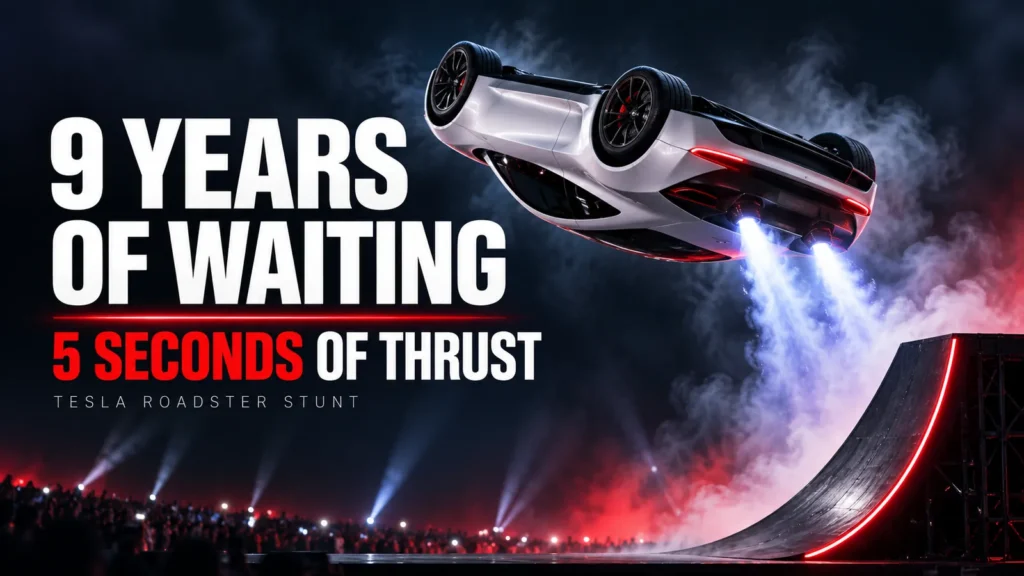
Elon Musk’s spectacular Roadster reveal featured rocket thrusters, upside-down driving and extraordinary acceleration. But much of the engineering has existed for decades, Tesla has repeatedly missed its production deadlines and Chinese competitors are already delivering electric supercars capable of astonishing performance.
Elon Musk unveiled a redesigned Tesla Roadster at SpaceX’s McGregor facility in Texas on 15 October 2026, demonstrating a car that drove upside down, jumped over other vehicles and achieved a claimed 0–60mph acceleration time of just 0.81 seconds. Yet almost nine years after Tesla began accepting reservations in November 2017, not a single customer has received a second-generation Roadster. Production is now promised for 2028, while Chinese rival BYD has already recorded speeds exceeding Tesla’s latest published performance figures.
Step Right Up: The Greatest Tesla Show on Earth
There was smoke. Dramatic music. A rocket-launch countdown.
And then came the main attraction.
A white Tesla Roadster accelerated towards a towering curved ramp, climbed its surface, travelled upside down and launched itself into the air.
SpaceX-developed cold-gas thrusters fired, allowing the vehicle to rotate before landing on its wheels. In another demonstration, the prototype jumped over a line of Tesla vehicles.
It was an extraordinary spectacle.
But watching the presentation, the carefully choreographed stunts and the enthusiastic audience, one could be forgiven for thinking legendary American showman P.T. Barnum had returned to run an electric-car company.
Barnum understood the commercial value of spectacle. Give audiences something remarkable to talk about and the publicity can become an attraction in its own right.
Elon Musk has undoubtedly mastered that particular art. But behind the dramatic presentation lies a considerably less glamorous story.
Tesla first unveiled its second-generation Roadster in November 2017. Customers were told production would begin in 2020. It didn’t. The deadline moved again. And again.
Now, after almost nine years of development and repeated announcements, Tesla is promising production in 2028.
Are we watching the birth of a revolutionary sports car, or has the Roadster become an elaborate publicity spectacle designed to keep Tesla looking technologically exceptional?
The ‘Sucker Car’: Technology From 1970, Not 2026
One of the most impressive elements of Tesla’s demonstration was the Roadster’s ability to cling to an inverted surface.
Powerful fans extract air from beneath the vehicle, creating an area of reduced pressure. Deployable skirts help prevent outside air from rushing underneath. The higher atmospheric pressure above the vehicle then pushes it towards the surface, providing extraordinary downforce.
It is clever engineering. It is also an idea that existed more than half a century before Tesla’s October demonstration.
1970: Jim Hall’s Chaparral 2J
American racing pioneer Jim Hall introduced the Chaparral 2J to the Can-Am racing series in 1970.
Nicknamed the Sucker Car, it used two large fans, powered by a separate engine, to extract air from beneath its chassis. Flexible skirts helped maintain the pressure difference.
The system allowed the vehicle to generate tremendous grip even at relatively low speeds, giving it a considerable advantage through corners.
The car suffered mechanical reliability problems and was eventually outlawed by the championship’s governing body. But the engineering principle worked.
Motor Sport Magazine’s history of the Chaparral 2J documents the design and its remarkable performance.
1978: Gordon Murray’s Brabham BT46B
Eight years later, British Formula One designer Gordon Murray applied the same fundamental principle to the Brabham BT46B.
The car used a large rear-mounted fan to create substantial downforce. Driven by Niki Lauda, it won the 1978 Swedish Grand Prix in its only championship appearance.
Rival teams objected to its aerodynamic system, and Brabham subsequently withdrew the design. Although frequently described as banned, the precise regulatory situation was more complicated. Murray maintained that the car complied with the regulations at the time.
The important point is that fan-generated suction had already proved itself in top-level motorsport.
Read Gordon Murray’s account of the fan-car technology.
2025: McMurtry Drives Upside Down Before Tesla
Perhaps the most relevant comparison comes from British manufacturer McMurtry Automotive.
In April 2025, its electric Spéirling hypercar demonstrated that it could remain attached to an inverted surface using fan-generated downforce.
On a specially constructed rotating platform, the car was turned upside down. It then drove forwards while completely inverted, supported by its own suction system.
No magnetic attachment was required. The vehicle’s fans generated sufficient downforce to counteract gravity.
McMurtry’s official demonstration and technical explanation were published on 11 April 2025.
Tesla’s later demonstration was more elaborate, involving a curved ramp, controlled separation and a thruster-assisted landing. That represents a different engineering challenge.
But the basic principle of creating enough suction to drive upside down had already been demonstrated.
Musk did not invent ground-effect suction, fan-generated downforce or the concept of an inverted-running car. His engineers have developed an extraordinary application of established technologies. That still deserves recognition. It simply isn’t the same thing as inventing the underlying physics.
Rocket Thrusters: Five Seconds of Glory?
Tesla’s next attraction involved technology developed in collaboration with SpaceX.
The new Roadster can be equipped with cold-gas thrusters, which release highly pressurised nitrogen through nozzles to produce force. These thrusters can supplement acceleration and, on the extreme Rocket configuration, help control movement in the air.
Cold-gas propulsion is well-established aerospace technology, commonly used for controlling spacecraft orientation. Once again, the innovation lies in the application rather than the invention of the original principle.
And there are some significant practical limitations.
According to engineering details provided to Top Gear, the Roadster’s Thrust configuration uses a 200-litre pressure system. It can produce extraordinary acceleration, but the tank is exhausted in approximately six seconds of operation.
The larger Rocket configuration adds another 400 litres of pressure storage and additional thrusters, replacing the passenger seat.
Tesla engineering chief Lars Moravy told WIRED that refilling the full 600-litre system currently requires approximately six to seven hours. Tesla hopes to reduce that to around 30 minutes. But that is a development goal, not a demonstrated production capability.
Read WIRED’s technical breakdown.
Strictly speaking, the available engineering figures suggest approximately five to six seconds of exceptional thrust for the smaller system, rather than a universally fixed five-second limit across every Roadster version.
The electric drivetrain can continue operating once the compressed gas is exhausted. But the spectacular rocket-assisted capabilities depend on pressure storage that cannot be replenished instantly.
If somebody buys a supercar partly because it can perform these astonishing feats, how useful is that technology if it takes hours to recharge the system after a brief burst of activity?
And where, exactly, would owners replenish high-pressure nitrogen while travelling?
Tesla has demonstrated remarkable engineering. It has not yet demonstrated a practical nationwide network of facilities capable of supporting that engineering.
Nine Years, Repeated Promises and No Delivered Roadster
The history of Tesla’s second-generation Roadster is a catalogue of shifting dates. When Musk unveiled it in November 2017, production was expected in 2020. That deadline passed without a vehicle reaching customers. Further targets followed.
| When announced | New production target | Position |
|---|---|---|
| November 2017 | 2020 | Missed |
| July 2020 | Within 12–18 months | Missed |
| January 2021 | 2022 | Missed |
| September 2021 | 2023 | Missed |
| May 2023 | 2024, hopefully | Missed |
| February 2024 | 2025 deliveries | Missed |
| October 2024 | 2025–26 | Superseded |
| November 2025 | 2027–28 | Revised |
| October 2026 | 2028 | Future target |
The actual unveiling of the redesigned vehicle also suffered repeated delays. A demonstration expected in 2025 was moved to April 2026, then subsequently postponed until October.
There is a difference between a manufacturer honestly acknowledging that development is taking longer than expected and a company repeatedly generating excitement around new deadlines.
The Roadster’s history contains an extraordinary number of revised expectations. And the latest promise puts production in 2028.
That would be eleven years after the car was first unveiled, and eight years after its original production target.
Tesla 2017 vs Tesla 2026 vs BYD: What Do the Figures Say?
Tesla’s latest Roadster has not simply been delayed. The specifications have also changed substantially. Some promised capabilities have improved, particularly acceleration with rocket assistance. Others have moved in the opposite direction.
Meanwhile, Chinese competitor BYD has been developing and delivering its Yangwang U9 electric supercar.
The following comparison separates Tesla’s original claims, its latest development figures and the performance BYD has already demonstrated.
| Specification | Tesla Roadster 2017 | Tesla Roadster 2026 | BYD U9 / U9 Xtreme |
|---|---|---|---|
| Top speed | Over 250mph promised | 210–230mph quoted; 300mph development ambition | 243.5mph U9 test; 308.4mph U9 Xtreme record |
| Acceleration | 0–60mph in 1.9s | 1.6s Performance; 0.81s demonstrated with thrusters; 0.59s Rocket target | Standard U9: 0–62mph in 2.36s |
| Range | 620 miles claimed | Approximately 310–320 miles projected | Standard U9: 289 miles, CLTC test cycle |
| Seating | 2+2, four seats | Two seats; Rocket version one seat | Two seats |
| Production | 2020 | 2028 target | Standard U9 deliveries began August 2024 |
| Price | Starting at $200,000 | No confirmed final price | Standard U9 launched at ¥1.68 million |
| Customer deliveries | None | None yet | Standard U9 already delivered |
BYD Has Already Reached 308mph
On 14 September 2025, BYD’s Yangwang U9 Xtreme recorded 496.22km/h, equivalent to approximately 308.4mph, at Germany’s Papenburg testing facility. BYD described the result as a world production-car speed record.
The model is a specialised hypercar planned for an extremely limited run of 30 vehicles. It should not be confused with the standard U9, which is already in customer hands.
However, the comparison remains striking. Tesla’s current Roadster development figures centre on speeds above 230mph, with engineers reportedly targeting as much as 300mph in future development.
The U9 Xtreme has already recorded a higher figure. Indeed, even the standard U9 achieved 243.5mph during a 2024 test, above Tesla’s currently quoted 230mph performance benchmark.
The test conditions and vehicle configurations differ, so these figures do not establish which car would be faster under identical conditions. But the difference between an achieved speed and a future engineering target is fundamental.
BYD has demonstrated the result. Tesla is still promising what its next-generation Roadster might eventually achieve.
The U9 Can Jump Too
In January 2025, BYD demonstrated its standard Yangwang U9 jumping over obstacles using its DiSus-X active suspension system. The technology rapidly adjusts the suspension to lift the vehicle clear of the ground.
It is not the same mechanism as Tesla’s compressed-gas thrusters, nor does it provide the same airborne control demonstrated by Tesla’s Rocket prototype.
But it is another example of a Chinese manufacturer developing unusual, highly sophisticated automotive technology. Crucially, the standard U9 is already a delivered production vehicle.
Can We Believe Musk’s 2028 Production Promise?
If the Roadster were Musk’s only repeatedly delayed project, this might simply be a story about unexpectedly difficult engineering. But the record extends considerably further.
Over the past decade, Musk has repeatedly announced ambitious timelines for autonomous vehicles, electric trucks, robotaxis and humanoid robots. Some of those projects have eventually reached customers. Others remain in development.
The difficulty is the repeated gap between an announced timetable and the outcome.
Full Self-Driving: A Coast-to-Coast Journey by 2017
In October 2016, Musk said Tesla aimed to demonstrate a fully autonomous journey from Los Angeles to New York by the end of 2017. The demonstration would require no human intervention, including during charging. That specific demonstration did not happen on schedule.
Nearly a decade later, Tesla has developed significantly more capable automated driving software. But the company’s consumer Full Self-Driving system still requires active supervision.
Tesla’s own description makes clear that its supervised system does not turn a consumer vehicle into a fully autonomous car.
One Million Robotaxis by 2020
At Tesla’s Autonomy Investor Day in April 2019, Musk predicted that more than one million Tesla vehicles would be operating as robotaxis in 2020. The prediction was extraordinary. So was the eventual shortfall.
By the end of 2020, Tesla had not delivered the promised autonomous taxi network. Limited paid robotaxi operations finally began in Austin, Texas, in June 2025.
Those services have subsequently expanded, but their early deployment involved a comparatively small fleet and safety monitoring. The existence of a limited robotaxi service in 2026 is not equivalent to one million autonomous taxis operating in 2020.
Reuters reported on Musk’s original prediction and the later delays.
Optimus: Where Are the Humanoid Robots?
Tesla’s Optimus humanoid robot has become a central component of Musk’s vision for the company.
In 2024, Musk suggested commercial sales could begin as early as the end of 2025. He subsequently talked about manufacturing thousands of robots for Tesla factories and potentially achieving much larger production volumes.
But those early ambitions did not materialise at the anticipated scale. According to Associated Press reporting, fewer than 500 general-purpose intelligent robots were shipped during 2025.
Tesla continues to develop Optimus and has discussed expanding production during 2026 and beyond. That work is real, but a functioning prototype or internal testing programme is not the same as mass-producing commercially useful humanoid robots.
Once again, extraordinary future expectations have proved much easier to announce than fulfil.
Cybertruck: Two Years Late and More Expensive
Tesla unveiled the Cybertruck in November 2019. Production was originally expected around late 2021, with an advertised starting price of $39,900.
Customer deliveries eventually began in November 2023. The entry price available at launch was substantially higher than the originally advertised figure.
The Cybertruck certainly exists. Tesla delivered it, and describing it as a product that never materialised would be wrong.
But it reached customers roughly two years later than originally expected and with important changes to its price and specifications.
Tesla Semi: From 2019 to 2022
The Tesla Semi was unveiled in November 2017, alongside the original second-generation Roadster prototype. Musk initially indicated that production would begin in 2019.
The first commercial vehicles were delivered to PepsiCo in December 2022. That was approximately three years late.
Again, Tesla eventually delivered a real vehicle, but the original production timetable was not achieved.
Musk’s Promises: The Wider Record
| Project | Original public expectation | What followed |
|---|---|---|
| Fully autonomous coast-to-coast drive | By the end of 2017 | Original demonstration deadline missed |
| Tesla Semi | Production in 2019 | First deliveries December 2022 |
| One million robotaxis | 2020 | Target missed; limited service began in 2025 |
| Tesla Roadster | Production in 2020 | Still awaiting customer deliveries; 2028 target |
| Cybertruck | Production around 2021 | Deliveries began November 2023 |
| Optimus commercial availability | As early as late 2025 | Early commercial ambitions missed; development continues |
These projects involve different levels of complexity and different commercial circumstances. Some statements were ambitious predictions rather than contractual guarantees. But the recurring discrepancy between public expectations and delivered outcomes is difficult to ignore.
That record is directly relevant when assessing Musk’s claim that the Roadster will finally enter production in 2028.
Is China Overtaking Tesla?
The global electric-vehicle industry has changed dramatically since Tesla unveiled the original prototype in 2017.
Back then, Tesla was widely regarded as the manufacturer redefining what electric cars could achieve. Today, it faces serious competition from Chinese manufacturers producing electric vehicles across an increasingly broad range of prices and performance categories.
BYD Has Overtaken Tesla in Annual Pure-Electric Sales
In 2025, BYD sold approximately 2.26 million battery-electric vehicles worldwide. Tesla delivered approximately 1.64 million.
| Global battery-electric sales, 2025 | Vehicles |
|---|---|
| BYD | 2.26 million |
| Tesla | 1.64 million |
| BYD’s lead | Approximately 620,000 |
That does not mean Tesla is finished. It remains one of the world’s most significant electric-vehicle manufacturers. Its software, charging infrastructure, energy-storage business and engineering capabilities are substantial.
Its third-quarter 2026 vehicle deliveries actually reached 486,532, exceeding market expectations.
But Tesla no longer operates in an industry where rivals are years behind. In several areas, competitors have moved ahead. BYD’s achievement with the U9 Xtreme makes that particularly difficult to dismiss.
Tesla’s Share Price: Is the Pressure Building?
There is also a financial dimension to the timing of Tesla’s spectacular demonstration. Tesla’s share price has experienced significant weakness during 2026.
The stock closed at $449.72 on 31 December 2025. On Friday 16 October 2026, the day after the Roadster reveal, it closed at $354.72. That represents a decline of approximately 21.1% during the year to that point.
| Tesla share-price comparison | Closing price |
|---|---|
| 31 December 2025 | $449.72 |
| 16 October 2026 | $354.72 |
| Change | -21.1% |
On 16 October itself, Tesla shares fell approximately 2.1%, although the wider technology market was also under pressure. The Roadster demonstration did not produce a sustained rally during the following full trading session.
That does not establish that investors rejected the car or that the presentation caused the decline.
Tesla’s valuation is influenced by a far wider range of factors, including vehicle demand, profit margins, interest rates, competition and expectations around artificial intelligence.
But the commercial context matters. Chinese manufacturers are gaining ground. Tesla’s share price has declined substantially since the beginning of the year. And investors are increasingly being asked to value Tesla not simply as a car company, but as a future leader in autonomous transport and robotics.
A spectacular flying-car demonstration reinforces that futuristic image. It is therefore reasonable to ask whether the Roadster also serves an important publicity and investor-relations purpose.
However, there is no established evidence that Musk staged the event specifically because he feared BYD or intended to manipulate Tesla’s share price. Those explanations remain interpretations, not proven motivations.
Indeed, Musk himself described the Roadster as a prestige project rather than a vehicle expected to make a major contribution to Tesla’s revenue. That makes the distinction between engineering demonstration and commercial product all the more important.
The Reservation Question: Paying Today for an Uncertain Tomorrow
Tesla is once again accepting substantial Roadster reservations. The Performance version requires a total reservation payment of $50,000. The Thrust version requires $250,000. The extreme Rocket variant, which includes the full flight system, is invitation-only.
These are reservation payments, not final purchase prices.
Under Tesla’s published reservation terms, the money does not have to be held in escrow or a separate trust account. The payments earn no interest. And Tesla does not guarantee a delivery date.
The reservations are refundable under the contractual terms, an important protection that should not be overlooked.
Nevertheless, the arrangements raise questions about the amount of money customers are expected to commit and the length of time they may wait.
Technology reviewer Marques Brownlee experienced difficulties cancelling his Roadster reservation after waiting approximately eight years. He ultimately recovered his full $50,000.
Electrek documented the difficulties and subsequently confirmed his complete refund.
The issue is not that Tesla has been proven to steal customers’ deposits. It has not.
The issue is whether the repeated changes to its production forecasts should make consumers more cautious about committing substantial interest-free sums to a vehicle whose final specifications, price and delivery timetable remain uncertain.
P.T. Barnum Would Have Loved This
There is an important distinction between engineering innovation and marketing spectacle.
Tesla has built an impressive experimental vehicle. Its engineers have combined established aerodynamic principles with sophisticated pressure systems, electric powertrain technology and advanced electronic controls.
Achieving the October demonstration required considerable expertise. It would be unfair to dismiss the engineering as fake. But it would be equally wrong to confuse the demonstration with a finished, commercially available sports car.
The suction principle existed in 1970. Brabham used similar technology in Formula One in 1978. McMurtry demonstrated upside-down driving in April 2025. Cold-gas propulsion has a long history in aerospace engineering.
Tesla has brought these ideas together in an unusually ambitious package, but the individual principles are not Musk’s inventions.
What is distinctly recognisable is the presentation. The dramatic countdown. The darkness. The smoke. The cheering audience. The gravity-defying performance.
It was engineered to attract attention. In that respect, it was P.T. Barnum-style showmanship for the social-media age.
And perhaps the most remarkable trick was persuading audiences to concentrate on a few seconds of extraordinary movement rather than almost nine years of waiting.
Nine Years of Waiting. Five Seconds of Thrust.
The Tesla Roadster could eventually become an extraordinary production vehicle. Its latest prototype shows that the engineering team is capable of remarkable achievements.
But what has actually been established?
A prototype can drive upside down on a specially constructed ramp. A specialised thruster system can generate short bursts of extraordinary acceleration and airborne movement. Tesla says production will begin in 2028.
What has not been established is whether the company can manufacture the complete vehicle economically, secure the necessary regulatory approvals, provide practical support for its unusual systems or deliver it to customers on the latest promised timetable.
Meanwhile, competing manufacturers are delivering electric supercars and recording performance figures that once seemed beyond reach.
The wider history of Musk’s product announcements provides legitimate reasons to question the latest deadline.
The Roadster was supposed to arrive in 2020. Then the date moved. And moved again. Now it is 2028.
Elon Musk has demonstrated that he can produce a spectacular show. What he has not yet demonstrated is that he can deliver the second-generation Roadster to the customers who have been waiting since 2017.
And after almost nine years, that is the achievement that matters.
Sources and further reading
- Reuters: Tesla’s new Roadster and 2028 production target
- WIRED: The Roadster engineering
- McMurtry: Upside-down driving demonstration
- BYD: U9 Xtreme speed demonstration
- Tesla: Roadster reservation terms
Watch: How Tesla’s Flying Roadster Works
Tesla vehicle engineering chief Lars Moravy explains the suction system, compressed-gas propulsion and engineering challenges.
Watch the technical walkthrough directly on YouTube
Watch: Nine Years of Tesla Roadster Delays
Wall Street Millennial examines Tesla’s Roadster announcements, reservation arrangements and the financial questions surrounding the project.