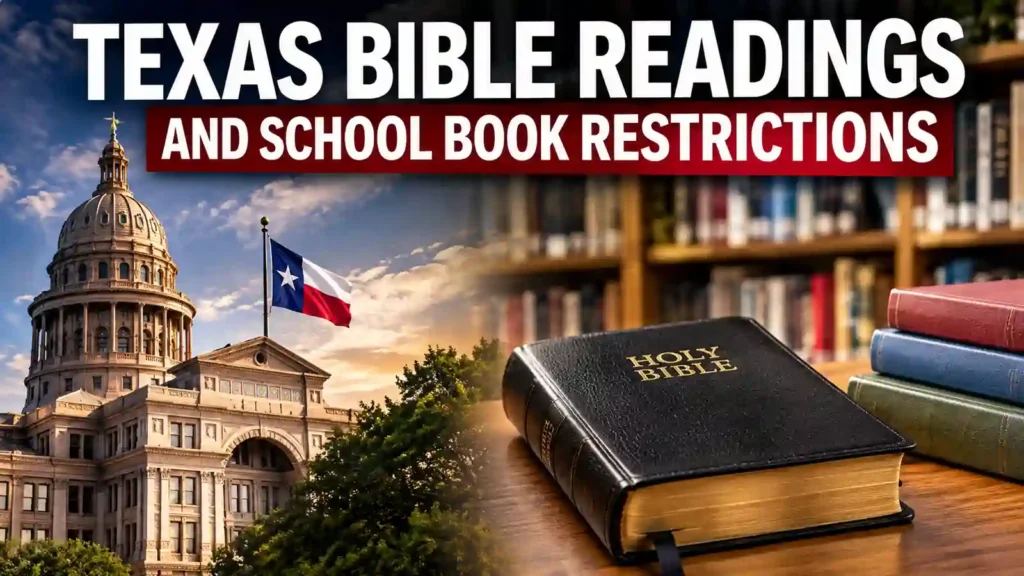
Texas has approved compulsory reading of selected Bible passages in public schools, even as a separate state law restricts the books that school libraries can offer pupils.
The apparent contradiction has drawn fresh attention on social media, where critics argue that the Bible contains violence and sexual material of the kind politicians have sought to keep away from children. Both policies are real, but they apply to different categories of educational material. They also leave an important distinction between studying parts of a religious text and requiring pupils to read the entire Bible.
What Texas has approved
On 26 June 2026, the Republican-controlled Texas State Board of Education approved statewide lists of required literature. They include selected biblical stories and passages alongside novels, poetry and other established works. The board says the lists are intended to strengthen literacy and connect literature with history. Its official announcement describes the decision as part of a wider curriculum overhaul.
The prescribed selections include David and Goliath for younger pupils, passages from Exodus, Psalm 23 and material from the New Testament for older children. The list also features works by authors including Charles Dickens and E. B. White. It does not require every child to read the Bible from beginning to end.
Implementation is staggered. The new lists begin with kindergarten to fifth grade in the 2030–31 school year, followed by later grades in subsequent years. The Texas Education Agency publishes the adopted reading lists and timetable.
What the school-library restrictions say
Texas Senate Bill 13 took effect on 1 September 2025. It tightens oversight of public school libraries, provides procedures for challenging titles and requires collection policies to exclude library material meeting statutory definitions of indecent or profane content. Parents also have rights to inspect catalogues and restrict their own children’s access to particular library materials.
There is a significant legal difference: Section 33.020 of the Texas Education Code expressly defines library materials separately from instructional materials. Section 33.0205 also protects the acquisition of materials needed to teach the state curriculum. That means an approved text used in lessons is not automatically subject to the same school-library provisions.
This does not settle whether the standards are consistent, but it explains why the state can mandate a classroom text while separately regulating what is available for pupils to borrow.
Does the Bible contain material that would raise concerns in other books?
Yes. Beyond familiar accounts such as David and Goliath, the Bible contains depictions of warfare, killing, incest and sexual assault. Judges 19 and 2 Samuel 13 are examples of particularly disturbing narratives. These are not the passages cited above as mandatory classroom selections.
It would therefore be misleading to say Texas has instructed children of every age to study all of the Bible’s most graphic material. Equally, the existence of challenging passages raises a legitimate question about how educators, legislators and school boards judge literary merit, historical significance, context and age suitability across religious and non-religious books.
Whether a particular text violates Texas library law requires assessment under that law. A reference to violence or sex alone does not establish that a book is prohibited.
Are library books being removed?
Yes, although the scale and reasons vary by school district. In September, The Texas Tribune reported that some librarians had slowed purchases and described increased pressure over their selections. Lubbock Independent School District said it had placed no book orders from August 2025 to February 2026 because of implementing Senate Bill 13.
In an October 2026 report, the campaigning group Texas Freedom to Read Project said it had documented 7,861 book removals or restrictions during the 2025–26 academic year, using records from 538 districts. That figure is the group’s own tally and includes restrictions linked to several policies and practices. It should not be presented as an independently audited total caused solely by Senate Bill 13.
What supporters and critics argue
Supporters of the reading list say pupils should understand biblical literature because of its influence on Western writing, American history and public life. The education board says the wider list reflects a classical approach to teaching enduring works.
Critics question why one religious tradition is specifically mandated, whether the approach respects the separation of church and state and whether teachers retain enough discretion over their reading choices. The debate is not simply about whether religious texts can be studied academically. It is also about the state’s power to decide which books must be read and which books may be available.
What the viral claim gets right and wrong
Confirmed: Texas has approved mandatory study of selected Bible passages, and it has separately introduced tighter rules for school-library books.
Important context: The requirement does not cover the entire Bible, its implementation is phased from 2030 and the library legislation expressly distinguishes instructional texts from library materials.
Open to debate: Whether lawmakers are applying fair and consistent principles to books with challenging content is an editorial and public-policy question, not a contradiction that the wording of the law alone can prove.
Watch: Texas education board approves Bible readings
CBS News Texas report, 26 June 2026, on the Texas State Board of Education’s decision.
Sources
- Texas State Board of Education: curriculum announcement, 26 June 2026
- Texas Education Agency: adopted literary works lists and implementation rules
- Texas Legislature: Senate Bill 13 summary and Education Code, Chapter 33
- The Texas Tribune: library purchasing and restrictions, 4 September 2026
- Texas Freedom to Read Project: book restrictions report, 9 October 2026
- ABC News: video of required-reading decision, 27 June 2026