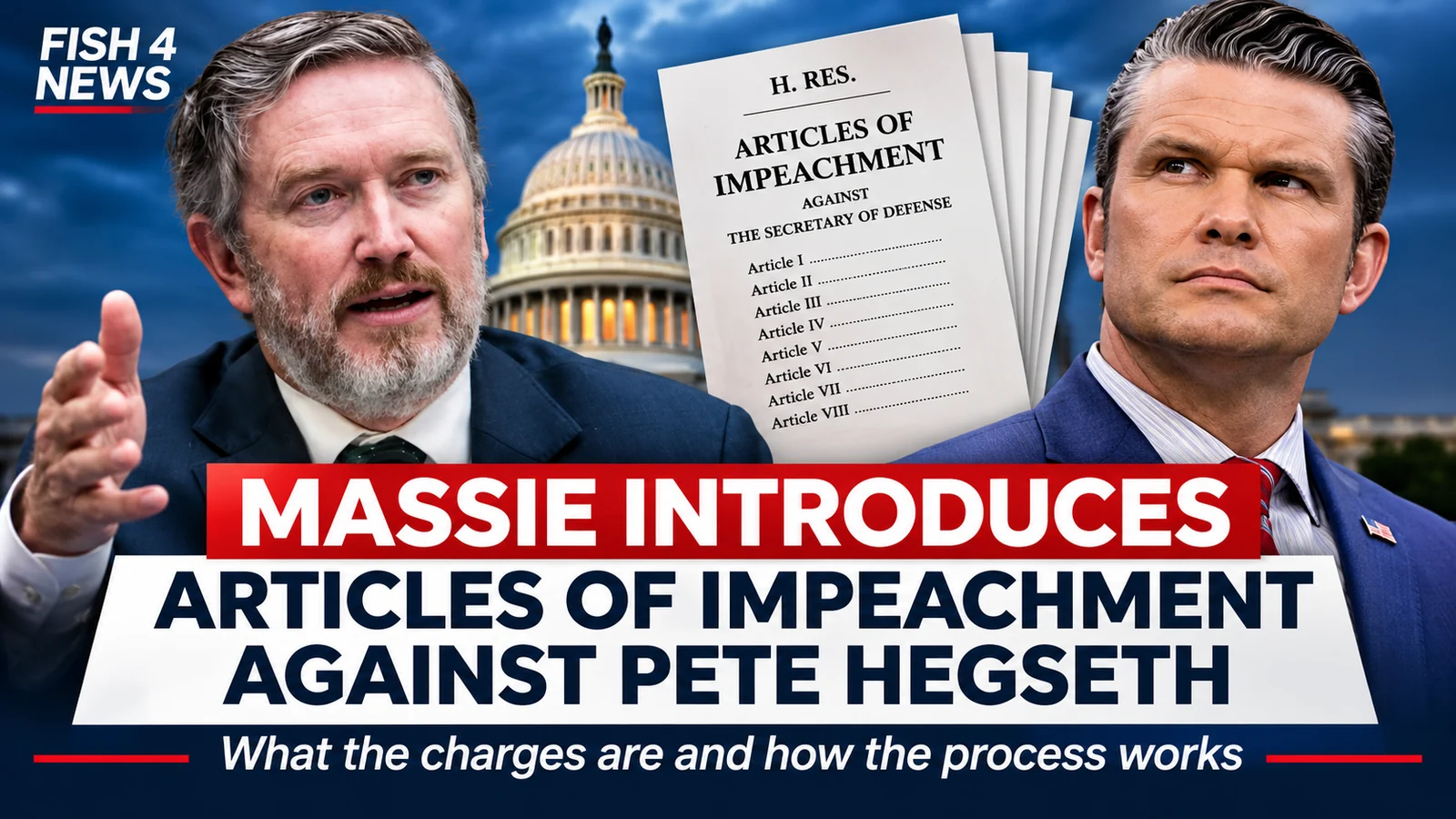
Republican congressman Thomas Massie formally introduced eight articles of impeachment against US Defence Secretary Pete Hegseth on Monday 9 November 2026, moving from a planned House challenge to a filed resolution.
Hegseth has not been impeached. The House must now decide how to handle Massie’s resolution. The eight articles contain allegations of unconstitutional military operations and abuse of authority, not proven findings of wrongdoing. Here is what he has filed, what Congress must do next and how impeachment works.
What has Thomas Massie formally introduced?
Massie’s office confirmed on 9 November that he had brought forward a resolution containing eight separate impeachment charges. The filing is an official step in the House process. It does not mean the House has voted to impeach Hegseth, and it does not establish that any of the alleged conduct was unlawful.
Massie previously raised the impeachment effort in September, but the House adjourned before a vote could take place. Earlier coverage described his intention to renew the attempt. This article reports the subsequent development: he formally reintroduced the eight articles on Monday. His office confirmed the filing in its 9 November statement.
What does the House of Representatives do next?
Massie is using a House procedure that requires the chamber to address his privileged resolution within two legislative days. Action could come by Wednesday 11 November. The House might vote on the impeachment articles, but it could instead table the resolution or refer it to a committee.
Only if a simple majority of the House approves impeachment articles would Hegseth actually be impeached. Referring or shelving the proposal is not impeachment.
Would impeachment remove Hegseth from office?
No. A separate Senate conviction would be needed for removal through impeachment. The House brings charges, while the Senate has the constitutional power to try them. A two-thirds majority of senators present is required to convict and remove the official. The process is explained in the US Senate’s official guide.
Impeachment is a constitutional process and is distinct from a criminal prosecution. The resolution neither proves a crime nor removes Hegseth from office.
What are the eight articles of impeachment?
The resolution alleges constitutional or legal misconduct in the handling of US military operations and in actions involving a senator. The following summaries describe what Massie alleges, not what a court or Congress has found to be true.
Article I: Iran war authorisation
Massie alleges Hegseth waged war in Iran without a declaration of war, specific congressional authorisation or the attack or imminent threat required under the 1973 War Powers Resolution.
Article II: Iran war after Congress’s direction
Massie claims Hegseth continued hostilities after Congress directed the removal of US forces under H. Con. Res. 86.
Article III: Iran war time limits
Massie alleges Hegseth continued hostilities after the law’s 60-day deadline and any applicable 30-day withdrawal period without the required authorisation.
Article IV: Civilian casualties
The charge alleges Hegseth ignored laws intended to minimise harm to civilians in US military operations.
Article V: Maritime killings
The charge accuses Hegseth of authorising unlawful lethal strikes on vessels suspected of drug trafficking, including attacks affecting survivors and failures to rescue people at sea. Massie’s office says at least 243 people died in the campaign; that figure is part of the allegations.
Article VI: Senator Mark Kelly’s speech
Massie accuses Hegseth of retaliation and intimidation against Democratic Senator Mark Kelly for protected speech about unlawful military orders.
Article VII: Venezuela operation
The resolution alleges Hegseth directed Operation Absolute Resolve to seize Nicolás Maduro and Cilia Flores without lawful authority.
Article VIII: Yemen operation
The final charge alleges Operation Rough Rider in Yemen was conducted without congressional approval or an imminent threat to the US, and that war-powers reporting requirements were breached.
These are accusations, not proven offences. Readers can examine the full 34-page resolution and Massie’s summary to see his precise case.
Watch: MS NOW on the impeachment move
The MS NOW report below covers Massie’s impeachment move. Introducing articles does not itself mean Hegseth has been impeached: that would require a further vote in the House.
How have Hegseth and Republican leaders responded?
Hegseth has described the effort as politically motivated and defended the military campaign in Iran. President Donald Trump has supported him, while Republican House Speaker Mike Johnson opposes holding an impeachment vote during ongoing overseas operations. Associated Press reported their responses on 9 November.
What happens next?
The next important developments are Hegseth’s expected Pentagon press conference on Tuesday 10 November and any House decision on Massie’s resolution by Wednesday. Fish 4 News will distinguish a procedural House vote from a vote actually to impeach.
Our earlier report covered Massie’s attempt to secure House action. This follow-up records the new step: the formal introduction of the articles.