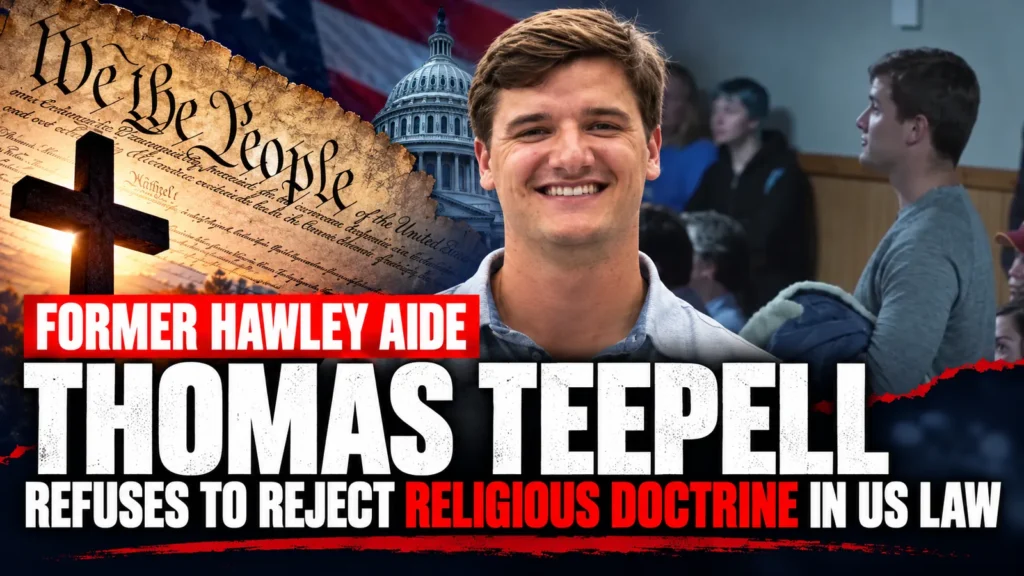
An apparent audience member who challenged Michigan Senate candidate Abdul El-Sayed over the Muslim Brotherhood has been identified as former Republican congressional staffer Thomas Teepell. His response to questions about religion and the US Constitution has placed his political background and Christian nationalist connections under scrutiny.
A viral confrontation at a Michigan Senate campaign event has raised questions about religion, political influence and the US Constitution after a man identified as former Republican Senator Josh Hawley staffer Thomas Teepell refused to disavow attempts to introduce religious doctrine into American law. The exchange took place on Saturday, 17 October 2026, in Caro, Michigan, where Democratic Senate candidate Abdul El-Sayed was answering questions from the public.
Featured image: AI-assisted editorial composite based on reference photographs, not a documentary photograph.
What happened at the Michigan town hall?
The confrontation began when a young man, identifying himself as “Tommy”, stood to question El-Sayed about the Muslim Brotherhood.
El-Sayed, a Muslim who has repeatedly rejected allegations of personal connections to the organisation, immediately disavowed it.
But rather than simply moving on, the Democratic candidate asked why the question had been directed at him.
El-Sayed challenged the implication that his religious identity should make him answerable for an organisation with which he says he has no connection.
He drew a historical comparison with John F. Kennedy, whose Catholic faith became an issue during the 1960 presidential election amid questions about whether he would take instructions from the Pope.
The discussion then took an unexpected turn.
El-Sayed asked Tommy, who identified himself as Christian, whether he would disavow attempts to introduce religious doctrine into American law.
His answer was short.
“I do not.”
El-Sayed responded by challenging the man’s understanding of the Constitution before the questioner left the gathering.
The exchange, subsequently reported by The Washington Post, rapidly spread across social media.
Who is Thomas Teepell?
The man initially appeared to viewers as an ordinary attendee asking a question of a political candidate.
However, investigative journalist Marisa Kabas identified him as Thomas Teepell, a former staff member of Republican Senator Josh Hawley of Missouri.
Writing in The Handbasket on 18 October, Kabas reported that Teepell had served as Hawley’s operations director before moving into Republican campaign work.
Publicly available congressional staffing records compiled by HillGraph list Thomas Francis Teepell as Hawley’s director of operations between October 2024 and January 2026.
Kabas also reported that he subsequently worked as political director for Republican Philip Sarnecki’s unsuccessful campaign for governor of Kansas.
This background matters because the exchange was not simply a confrontation between a politician and someone with no known political experience.
The individual identified by Kabas had worked inside the Republican political establishment and was familiar with political campaigning.
That does not make his question illegitimate. However, it provides important context for understanding who was asking it.
What are Teepell’s connections to Christian nationalism?
Teepell’s political background extends beyond his employment with Hawley.
His father, Republican strategist Timothy “Timmy” Teepell, worked closely with former Louisiana Governor Bobby Jindal and subsequently became involved in Hawley’s political rise.
The family also has documented connections to Christian activist Sean Feucht, whose efforts to combine evangelical Christianity with political influence have been widely associated with Christian nationalism.
In July 2024, Religion News Service published an investigation examining Feucht’s political network in Washington.
The report, written by journalist Jack Jenkins, described Timothy Teepell as an influential ally of Feucht.
It also documented Thomas Teepell’s involvement in Feucht’s religious activities.
Thomas appeared alongside his father at a Feucht event in Florida in 2021 and was subsequently interviewed by Feucht for a podcast recorded in April 2024.
During that interview, Thomas discussed his religious conversion and involvement with Feucht’s ministry.
Feucht has promoted prayer and worship events involving Republican politicians, including Hawley, and has sought to develop a political network around his religious activities.
These documented relationships establish Teepell’s connections to individuals associated with Christian nationalist politics.
They do not, by themselves, establish that Teepell belongs to a particular Christian nationalist organisation or subscribes to every political position advanced by those individuals.
Why does his answer raise constitutional questions?
The central issue is not Teepell’s Christianity.
Americans are constitutionally entitled to practise their religion, publicly express religious beliefs and participate in politics.
The question raised by the exchange concerns the relationship between religious doctrine and the laws governing people of different faiths, or no faith at all.
The First Amendment to the US Constitution protects both freedom of religious exercise and protection against government establishment of religion.
Meanwhile, Article VI prohibits religious tests as qualifications for federal public office.
Together, these constitutional protections safeguard religious pluralism in American public life.
They also help explain why suggestions that a Muslim candidate might be inherently unfit for office, or must prove an allegiance that Christian candidates are not similarly required to demonstrate, are politically and constitutionally sensitive.
There is an important legal distinction.
Religious beliefs may influence a person’s political opinions and the legislation they support. That is not automatically unconstitutional.
Constitutional concerns arise when government action establishes religion, coerces religious observance or otherwise violates constitutional protections.
Teepell’s refusal to disavow the introduction of religious doctrine into law therefore raises a legitimate question about what he believes the government’s relationship with religion should be.
But the brief exchange does not establish which specific laws he supports or prove that he rejects the Constitution as a whole.
His position warrants further explanation.
Was the confrontation politically organised?
Another development provides wider context, although it must be treated separately from Teepell’s appearance.
Earlier in October, The Michigan Daily reported that messages in a University of Michigan College Republicans group chat appeared to offer students $200 each to attend and disrupt an El-Sayed event in Flint.
According to the student newspaper, the messages proposed coordinating hostile questions and booing the Democratic candidate to generate negative publicity.
The individual making the offer claimed to be working with America Next, a conservative organisation associated with former Louisiana Governor Bobby Jindal.
Jindal is also a former employer and political associate of Thomas Teepell’s father.
That overlap is noteworthy, but it does not establish that Thomas Teepell participated in the earlier activity or was recruited for the Caro event.
The Michigan Daily found no evidence that Republican Senate candidate Mike Rogers’ campaign was directly involved in the reported offer.
Likewise, there is currently no verified evidence that Thomas Teepell was paid to attend the 17 October confrontation or was acting on instructions from America Next, Hawley or any campaign organisation.
Kabas reported contacting Teepell, Hawley’s office, El-Sayed’s campaign and America Next while investigating the incident. She had not received responses when her story was published.
Whether the Caro exchange was independently initiated or formed part of a broader political effort remains unresolved.
F4N Fact File: What we know and what remains unproven
Established facts
- The confrontation occurred in Caro, Michigan, on 17 October 2026.
- El-Sayed disavowed the Muslim Brotherhood when challenged.
- The questioner refused to disavow attempts to introduce religious doctrine into American law.
- Investigative journalist Marisa Kabas identified the questioner as Thomas Teepell.
- Congressional staffing records confirm Thomas Teepell previously worked for Senator Josh Hawley.
- Religion News Service documented Teepell’s family and personal connections to Sean Feucht in 2024.
- The Michigan Daily separately reported an apparent financial offer to disrupt an earlier El-Sayed event.
Not established
- Whether Teepell was paid to attend the Caro town hall.
- Whether he attended on behalf of a political organisation.
- Whether Hawley or his staff knew about the confrontation beforehand.
- Whether the Caro incident was connected to the reported Flint disruption effort.
- Whether Teepell advocates particular laws establishing or favouring a religion.
Timeline: How the story developed
2021: Thomas Teepell appears with his father at a Sean Feucht religious event in Florida.
April 2024: Feucht interviews Thomas about his personal religious journey.
July 2024: Religion News Service reports on the Teepell family’s connections to Feucht’s political and religious network.
October 2024 – January 2026: Congressional staffing records place Thomas Teepell in Hawley’s Senate office as director of operations.
Early October 2026: The Michigan Daily reports messages apparently offering $200 to students willing to disrupt an El-Sayed campaign event.
17 October 2026: El-Sayed challenges the man calling himself Tommy about religious doctrine and constitutional protections at a Caro town hall.
18 October 2026: Marisa Kabas identifies the questioner as Thomas Teepell in The Handbasket.
What happens next?
The confrontation has left several questions unanswered.
Would Teepell support legislation giving Christianity a privileged legal position? How does he distinguish personal religious conviction from government enforcement of religious doctrine? And what, if any, organisational involvement led to his appearance in Caro?
Those are questions Teepell could clarify publicly.
His previous political employment does not remove his right to question a candidate, just as El-Sayed’s religious identity does not diminish his right to seek federal office.
The significance of the exchange lies in the contrast between the original question about a Muslim candidate’s allegiances and the questioner’s own unwillingness to disavow efforts to introduce religious doctrine into American law.
Ultimately, the Constitution protects the religious freedom of both men — and of Americans who practise entirely different religions or none at all.
That is the principle at the centre of this confrontation.
Sources
- The Handbasket — Marisa Kabas’s investigation
- The Washington Post — coverage of the confrontation
- HillGraph — congressional staffing records
- Religion News Service — Sean Feucht’s connections in Congress
- The Michigan Daily — October 2026 report
- Congress — First Amendment explanation
- Congress — Article VI religious test clause