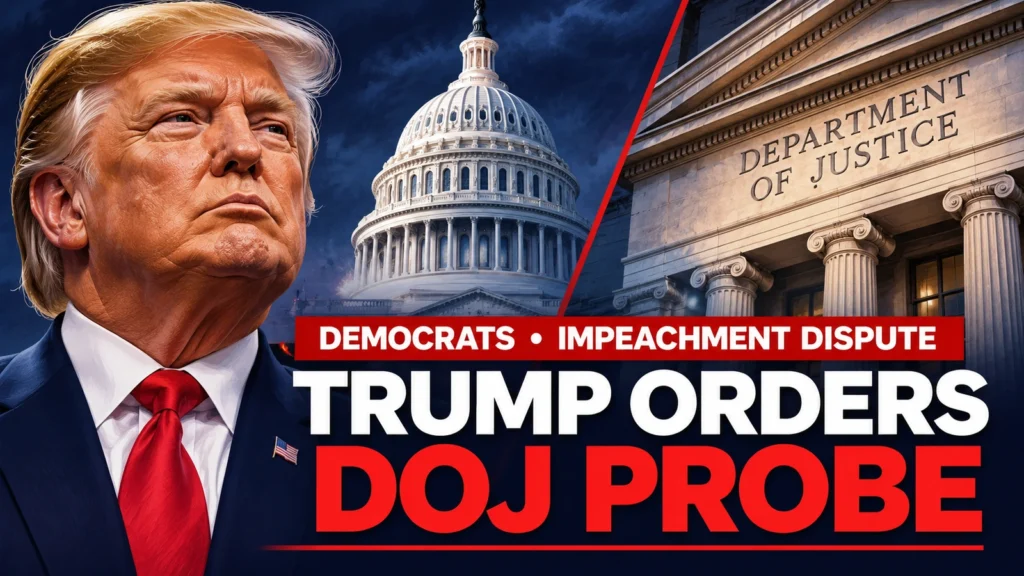
Donald Trump has ordered the US Department of Justice to examine Democrats he accuses of threatening administration officials, companies and political supporters with impeachment and investigations. The demand follows the Democrats’ victory in the midterm elections, but there is no public confirmation that a new criminal investigation has begun.
The president’s comments on Saturday, 7 November 2026, and Attorney General Todd Blanche’s response the following day have brought a sharp constitutional disagreement into the open: when is a warning about future congressional scrutiny legitimate oversight, and when could it constitute an unlawful threat?
What Trump actually ordered
Writing on Truth Social, Trump accused Democrats of sending threatening letters and promising punishment against members of his administration and others associated with him. He characterised those actions as “extortion at the highest level” and said those responsible should be held accountable.
“By copy of this statement, I am ordering the Department of Justice to look into this criminal act, immediately!”
Trump also called for imprisonment of those he described as “EXTORTIONISTS”. However, his public statement did not set out a specific criminal offence supported by evidence. His demand was for a Justice Department investigation, not for the Democrats themselves to be impeached. Impeachment is a separate constitutional process applying to federal officials.
The order came four days after Democrats won control of both the House of Representatives and the Senate in the 3 November midterm elections. Their new majorities are due to take effect when the next Congress convenes in January 2027. Democratic lawmakers have already sought records about activities including donations to the White House ballroom project.
What the attorney general has said
Appearing on CNN’s State of the Union and Fox News Sunday on 8 November, Attorney General Todd Blanche defended the administration’s position. He argued that some Democrats had gone beyond legitimate scrutiny by making public threats against officials, companies and potential recruits.
Blanche acknowledged that Congress has an oversight role, but did not identify a particular criminal statute that the Democrats had violated. Asked whether investigations could follow, he left the possibility open. Asked about imprisonment, he said it would depend on what offence had been committed and what those concerned had done.
The White House subsequently issued an official summary endorsing Blanche’s remarks and accusing Democrats of using oversight as a form of political retribution. That is the administration’s allegation, not an established legal finding.
Why Elissa Slotkin was singled out
Trump named Democratic Senator Elissa Slotkin of Michigan. His criticism followed remarks she made at the University of Chicago in October, in which she said young people considering roles in the Trump administration should think about the possibility of later scrutiny of conduct connected to government policies.
Slotkin has said that people who break the law or use public money for personal enrichment should be held accountable, while people who have done nothing unlawful have no reason to fear an investigation. Her office responded to the president on 7 November, rejecting his portrayal of her comments and criticising his threat of legal action.
There is a significant history here. Earlier in 2026, federal prosecutors sought to indict Slotkin and five other Democratic lawmakers following a video in which they told military and intelligence personnel to refuse unlawful orders. A grand jury declined to indict them. That earlier episode is not evidence that the new investigation Trump has demanded is under way.
Democrats prepare to investigate the administration
Representative Robert Garcia, the Democrat set to lead the House Oversight Committee in the next Congress, has promised investigations involving the administration, its immigration policies and the conduct of senior officials. Following Trump’s appointment of Stephen Miller as White House chief of staff, Garcia said Miller should “lawyer up”.
Blanche criticised that language. Garcia, for his part, accused the attorney general of attempting to intimidate congressional investigators and said the committee would not be deterred.
Democratic House leader Hakeem Jeffries has said that wrongdoing, where established, should be addressed through Congress’s constitutional powers. He has also expressed support for a proposal to impeach Defence Secretary Pete Hegseth. Not all Democrats agree on the priority impeachment should receive: some incoming lawmakers want the party to concentrate on living costs and legislation rather than prolonged confrontation.
Is threatening impeachment a crime?
Calling for impeachment or announcing an investigation is not automatically a criminal act. The US Constitution gives the House of Representatives the sole power to impeach federal officials, while the Senate conducts impeachment trials. Congress also has broad investigative powers as part of its legislative responsibilities.
Those powers have limits. Congressional inquiries must serve a legitimate legislative or other constitutionally authorised purpose; they are not an unrestricted licence to harass private individuals or demand information for unrelated personal reasons. Equally, describing an investigation as politically motivated does not, on its own, establish extortion.
A genuine allegation of criminal threats or coercion would require identifiable conduct and evidence meeting the elements of a federal offence. The Justice Department’s published prosecution principles require prosecutors to assess the law and admissible evidence before bringing a case. Neither Trump nor Blanche has publicly identified such a case arising from these latest statements.
What is confirmed, and what is not
- Confirmed: Trump publicly instructed the DOJ to examine what he called criminal threats by Democrats on 7 November.
- Confirmed: Attorney General Blanche defended the president’s concerns on 8 November and did not rule out possible investigations.
- Confirmed: Democrats have outlined plans for congressional scrutiny following their midterm victories, and senior figures have publicly rejected the administration’s allegations.
- Not confirmed: That a new criminal investigation has formally opened, that named Democrats have been charged, or that the conduct cited meets the definition of extortion.
The next important development will be whether the Justice Department identifies a legal basis for a case, or whether the argument remains a political confrontation over the powers of the incoming Congress. Fish 4 News will update this report if there is a documented change in the investigation’s status.
Sources and further reading
- Reuters, 7 November: Trump orders DOJ to look into Democrats
- White House, 8 November: official account of Blanche interviews
- Senator Elissa Slotkin, 7 November: official response
- House Oversight Democrats, 6 November: Robert Garcia statement
- Associated Press, 8 November: congressional plans and reactions
- US Senate: constitutional process for impeachment
- US Department of Justice: principles of federal prosecution