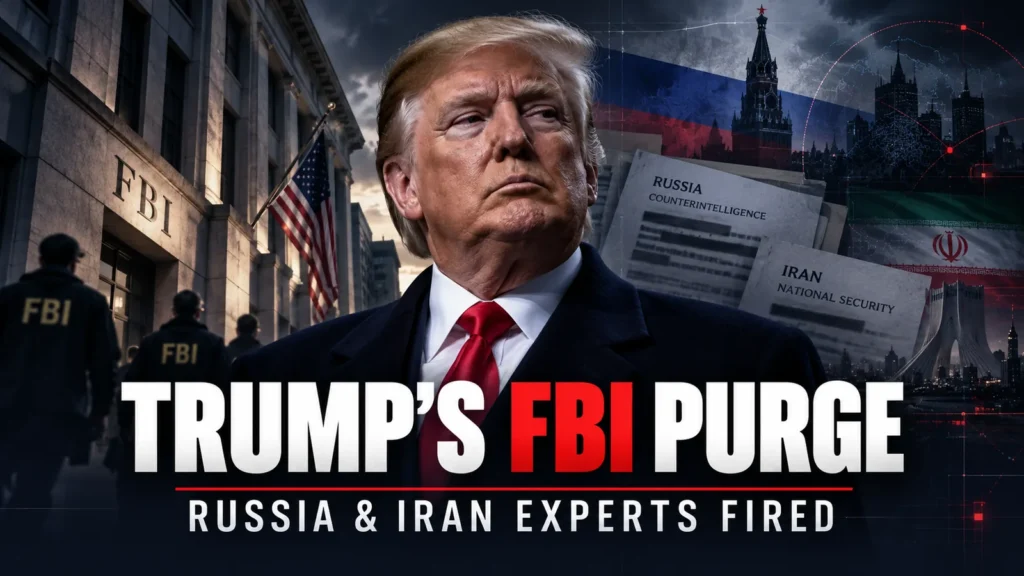
Nine former FBI employees have launched legal action against Donald Trump’s administration, alleging they were dismissed for investigating the president despite holding specialist expertise in foreign intelligence threats. The lawsuit, filed on 15 October 2026, raises concerns about the removal of personnel responsible for investigating Iranian intelligence operations, while a documentary published on 20 October traces a longer pattern of conflict between Trump and FBI officials involved in investigating Russian interference in American politics.
Nine FBI employees challenge their dismissal
Nine former FBI agents, intelligence analysts and operational specialists filed a lawsuit in federal court in Washington on 15 October, seeking reinstatement, back pay and a declaration that their dismissals were unlawful.
The employees were dismissed in February 2026 under FBI Director Kash Patel.
According to the complaint, they were targeted because of their involvement in the investigation into Trump’s retention of classified government documents at his Mar-a-Lago estate in Florida.
The plaintiffs argue that their work was assigned through normal FBI procedures and that they were carrying out legitimate investigative responsibilities.
They allege that their dismissals were politically motivated and took place without appropriate investigation or procedural safeguards.
Patel has defended his handling of FBI personnel, previously asserting that employees involved in the bureau’s political weaponisation should face consequences. The plaintiffs reject the allegation that they engaged in misconduct or allowed political views to influence their investigations.
The case has not established that the dismissals were unlawful. Those allegations remain for the courts to determine.
Experienced Iran investigators among those dismissed
The national security implications of the dismissals form a particularly significant part of the lawsuit.
Several plaintiffs had extensive experience investigating foreign intelligence threats, including those associated with Iran.
One former FBI employee, Jeremy Linton, was reportedly responsible for managing several dozen Iranian counterintelligence investigations when he was dismissed.
According to the lawsuit, Linton lost his position just three days before the United States and Israel launched military strikes against Iran.
The complaint alleges that he was given no meaningful opportunity to transfer his active investigations or pass important intelligence to colleagues.
The employees argue that the sudden removal of experienced counterintelligence personnel endangered national security.
Their combined professional experience exceeded a century and included work involving hostage recovery, terrorism, espionage and investigations connected to the attempted assassination of Trump in Pennsylvania in 2024.
That detail raises an uncomfortable question.
What happens when investigators responsible for protecting a president from foreign threats are dismissed because they previously investigated that same president?
The available evidence does not establish that a particular Iranian operation succeeded because of these dismissals. However, the loss of experienced staff and the alleged failure to transfer ongoing investigations provide concrete grounds for examining the consequences.
How the controversy began with Russia in 2016
The current legal dispute has historical parallels with events following Russia’s interference in the 2016 US presidential election.
American intelligence agencies concluded that Russia conducted an extensive campaign intended to influence the election.
The operation included hacking, the release of stolen information and coordinated online influence activities.
The FBI launched a counterintelligence investigation, known as Crossfire Hurricane, in July 2016 to examine potential links between individuals associated with the Trump campaign and Russian activity.
Among the central figures was FBI counterintelligence agent Peter Strzok, who had previously worked on investigations involving Russian espionage.
Strzok participated in the FBI’s investigation of a Russian intelligence network uncovered in 2010, involving undercover operatives living within American communities.
The case demonstrated the importance of specialist counterintelligence knowledge, developed through years of investigating Russian intelligence methods.
That experience would become central to concerns about what the FBI lost when Trump began publicly attacking officials involved in investigating his campaign.
What investigators actually established about Trump and Russia
There is an important distinction between Russia’s confirmed election interference and allegations that Trump personally coordinated with the Russian government.
Special counsel Robert Mueller’s investigation documented extensive Russian interference and numerous contacts between people associated with the Trump campaign and individuals connected to Russia.
However, the investigation did not establish that members of Trump’s campaign conspired or coordinated with the Russian government in its election-interference operations.
That conclusion does not mean Russian interference was imaginary.
The bipartisan Senate Intelligence Committee subsequently identified serious counterintelligence concerns, particularly involving former Trump campaign chairman Paul Manafort.
Its 2020 report examined Manafort’s relationship with Konstantin Kilimnik, who had connections to Russian intelligence, including the sharing of sensitive campaign information.
The committee concluded that Manafort’s access to the campaign and willingness to share information with Russian intelligence-linked individuals represented a grave counterintelligence threat.
These findings establish the seriousness of the original investigation. They do not establish a joint Trump-Putin plan to dismantle the FBI.
James Comey and the firing that transformed the investigation
On 9 May 2017, Trump dismissed FBI Director James Comey.
The White House initially emphasised Comey’s handling of the investigation into Hillary Clinton’s emails as justification.
Two days later, Trump gave a different account during an interview with NBC News journalist Lester Holt.
He said he had intended to dismiss Comey regardless of recommendations from Justice Department officials.
Trump also acknowledged thinking about the Russia investigation when making his decision, describing the controversy as a politically motivated story.
At the time, Comey had confirmed publicly that the FBI was investigating Russian interference and potential connections involving the Trump campaign.
His dismissal prompted serious questions about whether the president was attempting to influence or obstruct an investigation involving his associates.
On 17 May 2017, Deputy Attorney General Rod Rosenstein appointed Robert Mueller as special counsel.
Trump’s statements about Comey’s dismissal remain important because they demonstrate that the Russia investigation was part of his own explanation for removing the FBI director.
Peter Strzok and Lisa Page: Personal messages become a political weapon
Another major dispute involved Peter Strzok and former FBI lawyer Lisa Page.
Private text messages exchanged between the two, who were involved in an extramarital relationship, contained highly critical comments about Trump.
The messages raised legitimate concerns about political impartiality among officials working on sensitive investigations.
Strzok was removed from Mueller’s investigative team and subsequently dismissed from the FBI in August 2018.
Trump repeatedly criticised both officials in public statements and political appearances, using their relationship and personal messages to question the legitimacy of the Russia investigation.
The dispute continued long after they left the bureau.
In July 2024, the US Department of Justice agreed to pay Strzok $1.2 million and Page $800,000 to settle claims involving the disclosure of their private communications.
The settlements concerned privacy claims and did not amount to a court finding that every disciplinary decision involving the pair was unlawful.
Strzok’s dismissal and the handling of his employment rights remained separate issues.
Nevertheless, the settlement demonstrated that the controversy had significant legal consequences for the federal government.
The FBI’s Russia investigation was not beyond criticism
Any assessment of these events must also acknowledge serious errors identified within the FBI’s original investigation.
A December 2019 report by the Department of Justice inspector general concluded that the opening of Crossfire Hurricane was supported by an authorised investigative purpose and sufficient factual basis.
The review did not find that political bias drove the decision to open the investigation.
However, it identified significant errors and omissions in applications seeking surveillance authority against former Trump campaign adviser Carter Page.
Those failings were serious and warranted scrutiny.
They also demonstrate why allegations of misconduct within intelligence agencies must be investigated independently rather than dismissed automatically as political attacks.
But identifying failures in particular investigations is different from establishing that the entire inquiry into Russian election interference was illegitimate.
Did Trump’s actions benefit Russian intelligence?
A documentary released on 20 October 2026, titled Taking Out The FBI, argues that Russia’s interference in American politics had consequences extending beyond the presidential election itself.
Drawing on material from the Ball of Threads podcast and earlier reporting, it examines how investigators involved in Russian counterintelligence became targets of political controversy, public attacks and disciplinary proceedings.
Its central argument is that undermining experienced FBI investigators could weaken America’s ability to identify and respond to foreign intelligence operations.
There is a credible national security concern underlying that argument.
Experienced counterintelligence investigators develop specialist knowledge of foreign intelligence services, their networks, operational methods and patterns of activity.
Removing those individuals can create gaps that are difficult to fill quickly.
A further concern is whether repeated public attacks on investigators discourage other officials from pursuing politically sensitive cases.
However, the documentary goes further by suggesting that these outcomes formed part of Russia’s broader strategic success.
There is no publicly established evidence that Trump and Putin agreed on a coordinated plan to dismantle the FBI or remove its Russian intelligence specialists.
The documented actions and their possible benefits to Russia can be examined without treating that unproven allegation as fact.
A pattern extending into Trump’s second presidency
The dismissals challenged in October 2026 are not an isolated controversy.
Since Trump’s return to the White House in January 2025, multiple FBI personnel have challenged employment decisions involving staff who participated in investigations connected to the president.
Those disputes have included investigations into the January 2021 attack on the US Capitol and Trump’s handling of classified documents.
The administration maintains that it is addressing misconduct and political bias within federal law enforcement.
Former employees and their lawyers argue that the actions constitute retaliation against officials for performing their duties.
The question is not whether FBI employees should be accountable for wrongdoing. They should.
It is whether personnel decisions are based on individually established misconduct and fair procedures, or on participation in investigations that displeased the president.
That distinction matters for the independence of federal law enforcement.
Could political pressure damage future investigations?
Counterintelligence work depends on continuity, confidentiality, institutional knowledge and the willingness of investigators to follow evidence wherever it leads.
An investigator examining Russian espionage today may be assigned to Iranian intelligence threats tomorrow.
The same official may also investigate threats directed against senior political figures, including the president.
These responsibilities do not exist in separate institutional compartments.
Consequently, dismissing personnel because of their involvement in one politically controversial investigation may affect unrelated national security operations.
The October lawsuit alleges precisely that kind of wider harm.
Whether the plaintiffs ultimately succeed in court is uncertain.
The broader issue is already clear: decisions affecting experienced national security investigators can have consequences beyond the political disputes that prompted them.
The question the Trump administration must answer
Nearly a decade after the FBI began investigating Russia’s interference in the 2016 election, the controversy over the treatment of its investigators continues.
The original Russia investigation was legitimate in its opening, according to the Justice Department inspector general, although elements of the subsequent investigative process were seriously flawed.
Trump’s first administration saw the removal of senior officials including Comey and Strzok, followed by years of legal disputes and political accusations.
His second administration now faces further allegations that investigators have been dismissed because they worked on politically sensitive cases.
The October 2026 lawsuit adds a particularly significant dimension: employees involved in the Trump classified-documents investigation were also handling foreign counterintelligence threats, including investigations connected to Iran.
The courts will determine whether the dismissals were lawful.
But the national security question deserves attention regardless of the outcome.
If an intelligence agency loses experienced personnel because their investigations become politically inconvenient, who benefits from the expertise that disappears, and who bears the risk?
That is the issue at the heart of the documentary, the lawsuits and the continuing argument over the independence of the FBI.
Sources
- Associated Press, 15 October 2026
- CBS News, 15 October 2026
- Axios, 15 October 2026
- Mueller Report, Volume I
- Senate Intelligence Committee, Volume V
- FactCheck.org: Why Did Trump Fire Comey?
- The Washington Post, 26 July 2024
- US Department of Justice Inspector General, December 2019
Watch: Taking Out The FBI
The following documentary, published on 20 October 2026, examines the history of Trump’s conflicts with FBI investigators and argues that the treatment of counterintelligence specialists has weakened US national security. It presents a critical interpretation of the Trump administration’s actions. Its suggestion of a coordinated Trump-Putin effort against the FBI has not been established by publicly available evidence.